

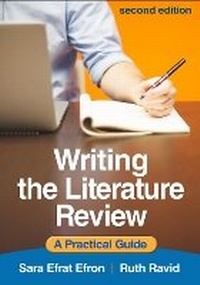
Writing the Literature Review, Second Edition
A Practical Guide
2nd Edition
Will be published approx. on 30. October 2026
Book
Paperback/Softback
308 pages
978-1-4625-6415-6 (ISBN)
Description
Taking the stress out of a challenging process, the first book to focus on crafting different types of literature reviews (systematic, traditionalaEUR"narrative, and hermeneuticaEUR"phenomenological) is now in a revised and updated second edition. Sara Efrat Efron and Ruth Ravid explain the integral role of the literature review in a thesis, dissertation, term paper, or grant proposal, and guide writers to develop reviews that reflect their research questions, methodological choices (qualitative, quantitative, or mixed methods), and approaches to knowledge. The text provides a roadmap for each step of searching for, evaluating, analyzing, and synthesizing prior studies. It features examples of student work; excerpts from peer-reviewed articles; software suggestions for locating, organizing, and arranging sources; templates, checklists, vignettes, and group activities; and writing and organizational tips.
New to This Edition
Chapter-opening vignettes that draw readers in to each chapter's content.
New section on using AI in literature searches and expanded guidance for using electronic sources, such as EBSCO and Google Scholar.
New or expanded discussions of constant comparative analysis, qualitative comparative analysis, finding and using grey literature, differences between literature reviews for class papers and research papers versus dissertations, the literature review across different dissertation formats, and more.
New and updated literature examples throughout the book.
Updated guidance for reference lists and in-text citations.
Pedagogical Features
Chapter-opening vignettes that serve as advance organizers for each chapter.
Checklists and To Do activities that break down key steps to take.
Boxed examples, graphics that organize and visually illustrate key concepts, summary tables comparing techniques, and software suggestions.
Group activities to further explore and apply the methods discussed in each chapter.
Detailed directions for using four different organizing strategies: synthesis matrix, summary table, mapping, and topic outline.
End-of-chapter summaries and What's Next sections.
Assessment matrices for evaluating and refining the completed review.
The first edition won the American Journal of Nursing Book of the Year Award, Nursing Research Category (First Place).
New to This Edition
Chapter-opening vignettes that draw readers in to each chapter's content.
New section on using AI in literature searches and expanded guidance for using electronic sources, such as EBSCO and Google Scholar.
New or expanded discussions of constant comparative analysis, qualitative comparative analysis, finding and using grey literature, differences between literature reviews for class papers and research papers versus dissertations, the literature review across different dissertation formats, and more.
New and updated literature examples throughout the book.
Updated guidance for reference lists and in-text citations.
Pedagogical Features
Chapter-opening vignettes that serve as advance organizers for each chapter.
Checklists and To Do activities that break down key steps to take.
Boxed examples, graphics that organize and visually illustrate key concepts, summary tables comparing techniques, and software suggestions.
Group activities to further explore and apply the methods discussed in each chapter.
Detailed directions for using four different organizing strategies: synthesis matrix, summary table, mapping, and topic outline.
End-of-chapter summaries and What's Next sections.
Assessment matrices for evaluating and refining the completed review.
The first edition won the American Journal of Nursing Book of the Year Award, Nursing Research Category (First Place).
Reviews / Votes
aEURoeThis text has excellent examples and provides a good overview of the writing process. Students have given me positive feedback about the engaging style. The book provides specific writing strategies and examples that help take the aEUR?stingaEUR (TM) out of starting to work on a dissertation--which students often experience as overwhelming and anxiety provoking. Students learn that it is not about perfection from the first paragraph; rather, there is a method to beginning to evaluate and write. The recommendations for working through the writing process are spot-on.aEUR--Susan Torres-Harding, PhD, Department of Psychology, Roosevelt UniversityaEURoeAs required reading in our doctoral-level course Scholarly Habits of Mind, this text has proven to be very effective and well received by the students. The book stands out for its nuanced explanations of complex concepts and the appealing visuals that accompany each topic. The second edition is a welcome gift to both students and faculty.aEUR--Antonina Lukenchuk, EdD, National College of Education, National Louis University
aEURoeThis text walks students through the process of writing a literature review. Throughout, boxed examples and tables allow students to make direct comparisons between techniques and serve as quick references. From the very first step to the last, the text instructs, offers examples, and provides opportunities for practice. A literature review written using the approach outlined in this text is likely to be a successful one. Additionally, this book serves as an appropriate guide for those who might need to construct a literature review as part of a grant application (or similar) in a professional setting.aEUR--Jennifer Scroggins, PhD, Department of Social Sciences and Cultural Studies, Montana State University Billings
aEURoeAs a social work educator, I like the succinct writing, as well as the charts, boxed examples, and group activities that can be used in the classroom for analysis or application.aEUR--Kristin Bailey-Wallace, LMSW, School of Social Work, Stephen F. Austin State University
-
More details
Edition
2nd edition
Language
English
Place of publication
New York
United States
Publishing group
Guilford Publications
Dimensions
Height: 254 mm
Width: 178 mm
Thickness: 18 mm
ISBN-13
978-1-4625-6415-6 (9781462564156)
Copyright in bibliographic data and cover images is held by Nielsen Book Services Limited or by the publishers or by their respective licensors: all rights reserved.
Schweitzer Classification
Other editions
Additional editions

Book
approx. 11/2026
2nd Edition
Guilford Press
€78.50
Not yet published
Previous edition
Book
12/2018
1st Edition
Guilford Press
€47.50
Shipment within 15-20 days
Persons
Sara Efrat Efron, EdD, is Professor Emerita of Education at National Louis University. Her areas of interest include teacher research, mentoring, and moral and democratic education in times of crisis. Dr. Efron is coauthor with Ruth Ravid of Action Research in Education, Second Edition, and Writing the Literature Review, Second Edition. She has published numerous book chapters and journal articles and presents widely at national and international conferences. She has also written several foreign-language instruction books for middle and high school students.
Ruth Ravid, PhD, is Professor Emerita of Education at National Louis University. Her areas of interest include educational research, action research, assessment, and schoolaEUR"university collaboration. Dr. Ravid has authored or edited eight books, including Writing the Literature Review, Second Edition, and Action Research in Education, Second Edition, both coauthored with Sara Efrat Efron. She has also written numerous journal articles and book chapters.
Ruth Ravid, PhD, is Professor Emerita of Education at National Louis University. Her areas of interest include educational research, action research, assessment, and schoolaEUR"university collaboration. Dr. Ravid has authored or edited eight books, including Writing the Literature Review, Second Edition, and Action Research in Education, Second Edition, both coauthored with Sara Efrat Efron. She has also written numerous journal articles and book chapters.
Content
1. What Is a Literature Review?
2. Different Orientations to a Literature Review
3. Choosing a Review Topic and Formulating a Research Question
4. Locating and Organizing Research Sources
5. Selecting, Analyzing, and Keeping Notes on Sources
6. Evaluating Research Articles
7. Structuring and Organizing the Literature Review
8. Developing Arguments and Supporting Claims
9. Synthesizing and Interpreting Literature
10. The Writer Voice and the Writing Process
11. Acknowledging Sources: Citations, Quotations, and Plagiarism
12. Putting It All Together
Resources
References
Index
About the Authors
2. Different Orientations to a Literature Review
3. Choosing a Review Topic and Formulating a Research Question
4. Locating and Organizing Research Sources
5. Selecting, Analyzing, and Keeping Notes on Sources
6. Evaluating Research Articles
7. Structuring and Organizing the Literature Review
8. Developing Arguments and Supporting Claims
9. Synthesizing and Interpreting Literature
10. The Writer Voice and the Writing Process
11. Acknowledging Sources: Citations, Quotations, and Plagiarism
12. Putting It All Together
Resources
References
Index
About the Authors