

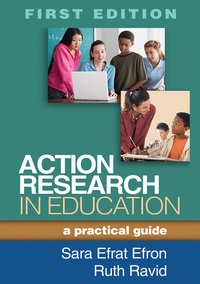
Action Research in Education, First Edition
A Practical Guide
1st Edition
Published on 10. May 2013
Book
Hardback
268 pages
978-1-4625-0971-3 (ISBN)
Description
This accessible, pragmatic text shows educators step by step how to conduct classroom- and school-based studies to improve instructional practices. The book presents methods and strategies for implementing each stage of the action research cycle, providing balanced coverage of qualitative, quantitative, and mixed-methods approaches. Readers learn how to: select and define a research topic; develop a literature review; choose a design; formulate data collection strategies; design and/or evaluate assessment tools; and interpret, analyze, and report study results. Helpful examples and vignettes depict a variety of real-world teaching and learning situations, school subjects, and age groups (PreK-12).
User-Friendly Features
*Exercises and activities in every chapter.
*Checklists, guidelines, and templates that enable busy educators to self-assess the progress and quality of their studies.
*Example boxes illustrating the components of an action research report.
*Summary tables highlighting key aspects of different research strategies.
*Chapter summaries and suggestions for further reading.
User-Friendly Features
*Exercises and activities in every chapter.
*Checklists, guidelines, and templates that enable busy educators to self-assess the progress and quality of their studies.
*Example boxes illustrating the components of an action research report.
*Summary tables highlighting key aspects of different research strategies.
*Chapter summaries and suggestions for further reading.
Reviews / Votes
"Just as the subtitle claims, this book is a practical guide to a powerful form of research. Filled with examples and helpful templates and checklists, the book is especially suited to the novice researcher. Teacher educators can use this book to help both preservice and inservice teachers make research an integral part of their practice, whether by conducting their own studies, learning how to review research conducted by others, or learning ways to use assessment to inform instruction."--Frances O'Connell Rust, EdD, Graduate School of Education, University of Pennsylvania"I recommend this text without hesitation! The book meets the needs of beginning researchers by providing solid explanations of the 'why' and 'how' of action research in a practitioner-friendly way. The authors offer an evenhanded account of qualitative, quantitative, and mixed-methods approaches. They do a very fine job of illustrating how the research question--rather than the researcher's preference for a particular method or technique--should drive how a study is designed and the data collected."--Cheryl A. Kreutter, PhD, School of Education, State University of New York at Geneseo
"A wonderful synopsis of action research that provides supporting evidence, illustrative examples, and practical applications. The chapters on collecting and analyzing data are among the many highlights of the text. Students really need a significant amount of guidance on data collection, as many of them have never conducted their own research. The explicit detail of the authors' discussion is essential for student success. I will definitely consider using this text for my course."--Lauren Birney, EdD, School of Education, Pace University
"As educators increase their familiarity with data to measure student progress, techniques for assessing their own effectiveness are key in improving practices in schools. Efron and Ravid provide educators with clear and rigorous steps for conducting action research. With this book, school administrators and teachers will be able to develop self-studies that can inform classroom improvement, schoolwide strategic planning, and professional development initiatives."--Elizabeth T. Murakami, PhD, Department of Educator and Leadership Preparation, Texas A&M University-San Antonio
"The text is organized into eight chapters, which should make it easy to adapt to a variety of class scheduling designs....If you are teaching a research class to novice researchers, especially those in education, I would highly recommend this book for its practical approach, and the emphasis on writing and the use of assessment data. Teachers are often overwhelmed with available data in their classrooms and schools understanding as well as the data. This text provides much needed practical instructions for both issues."--Inquiry in Education
"The text is organized into eight chapters, which should make it easy to adapt to a variety of class scheduling designs....If you are teaching a research class to novice researchers, especially those in education, I would highly recommend this book for its practical approach, and the emphasis on writing and the use of assessment data. Teachers are often overwhelmed with available data in their classrooms and schools understanding as well as the data. This text provides much needed practical instructions for both issues."--Inquiry in Education "I recommend this text without hesitation! The book meets the needs of beginning researchers by providing solid explanations of the 'why' and 'how' of action research in a practitioner-friendly way. The authors offer an evenhanded account of qualitative, quantitative, and mixed methods approaches. They do a very fine job of illustrating how the research question - rather than the researcher's preference for a particular method or techniqu - should drive how a study is designed and the data collected." - Cheryl A. Kreutter, PhD, State University of New York at Geneseo, USA
"A wonderful synopsis of action research that provides supporting evidence, illustrative examples, and practical applications. The chapters on collecting and analyzing data are among the many highlights of the text. Students really need a significant amount of guidance on data collection, as many of them have never conducted their own research. The explicit detail of the authors' discussion is essential for student success. I will definitely consider using this text for my course." - Lauren Birney, EdD, Pace University, USA
"Just as the subtitle claims, this book is a practical guide to a powerful form of research. Filled with examples and helpful templates and checklists, the book is especially suited to the novice researcher. Teacher educators can use this book to help both preservice and inservice teachers make research an integral part of their practice, whether by conducting their own studies, learning how to review research conducted by others, or learning ways to use assessment to inform instruction." - Frances O'Connell Rust, EdD, University of Pennsylvania, USA
More details
Language
English
Place of publication
New York
United States
Publishing group
Guilford Publications
Target group
College/higher education
Dimensions
Height: 235 mm
Width: 187 mm
Weight
656 gr
ISBN-13
978-1-4625-0971-3 (9781462509713)
Copyright in bibliographic data and cover images is held by Nielsen Book Services Limited or by the publishers or by their respective licensors: all rights reserved.
Schweitzer Classification
Other editions
New editions
Book
02/2020
2nd Edition
Guilford Press
€91.00
Article not available at the moment
Additional editions
Book
05/2013
1st Edition
Guilford Press
€67.11
Article exhausted; check for reprint
Persons
Sara Efrat Efron, EdD, is Professor of Education at National Louis University, where she teaches courses in qualitative research, curriculum studies, and foundations of education to preservice, inservice, and doctoral students. Dr. Efron's areas of interest include teacher research, the role of the teacher's personal voice, and moral democratic education.
Ruth Ravid, PhD, is Professor Emerita of Education at National Louis University. Her areas of interest include educational research, action research, assessment, and school-university collaboration. Dr. Ravid is the author of several books, including Practical Statistics for Educators.
Ruth Ravid, PhD, is Professor Emerita of Education at National Louis University. Her areas of interest include educational research, action research, assessment, and school-university collaboration. Dr. Ravid is the author of several books, including Practical Statistics for Educators.
Content
1. Introduction to Action Research
What Is Educational Research?
Practitioners as Researchers
Historical Perspectives
The Unique Characteristics of Action Research
Chapter Summary
Chapter Exercises and Activities
Additional Readings
2. Choosing and Learning about Your Research Topic
Choosing Your Research Topic
Framing the Research Problem Statement
Developing the Literature Review
Formulating Specific Research Question(s)
Chapter Summary
Chapter Exercises and Activities
Additional Readings
3. Approaches to Action Research
Educational Research Approaches
Qualitative Educational Research
Quantitative Educational Research
Mixed-Methods Research
Choosing an Approach for Your Research Project
Chapter Summary
Chapter Exercises and Activities
Additional Readings
4. Developing a Plan of Action
Considering Your Role as a Researcher
Establishing the Research Scope
Identifying the Research Site and Participants
Choosing Data Collection Procedures
Ensuring the Study's Validity and Trustworthiness
Developing Ethical Guidelines
Creating a "To-Do" List
Finalizing the Research Plan
Chapter Summary
Chapter Exercises and Activities
Additional Readings
5. Data Collection Tools
Observation
Interview
Surveys
Artifacts and Documents
Final Comments about Data Collection Tools
Chapter Summary
Chapter Exercises and Activities
Additional Readings
6. Using Assessment Data in Action Research
Understanding Standardized Commercial Achievement Tests
Teacher-Made Tests
Writing Instructional Objectives
Constructing Teacher-Made Traditional Assessment Tools
Using Teacher-Made Authentic Assessment Tools
Final Comments about Classroom Assessment
Chapter Summary
Chapter Exercises and Activities
Additional Readings
7. Data Analysis and Interpretation
Qualitative Data Analysis
Quantitative Data Analysis
Mixed-Methods Data Analysis
Reporting the Study's Results, Conclusions, and Implications
Chapter Summary
Chapter Exercises and Activities
Additional Readings
8. Writing, Sharing, and Implementing the Research Findings
Writing a Formal Action Research Report
Developing Alternative Formats for Reporting on Action Research
Sharing the Research Findings
Implementing the Research Findings
Completing the Action Research Project
Becoming a Part of the Research Community
Chapter Summary
Chapter Exercises and Activities
Additional Readings
References
Author Index
Subject Index
About the Authors
What Is Educational Research?
Practitioners as Researchers
Historical Perspectives
The Unique Characteristics of Action Research
Chapter Summary
Chapter Exercises and Activities
Additional Readings
2. Choosing and Learning about Your Research Topic
Choosing Your Research Topic
Framing the Research Problem Statement
Developing the Literature Review
Formulating Specific Research Question(s)
Chapter Summary
Chapter Exercises and Activities
Additional Readings
3. Approaches to Action Research
Educational Research Approaches
Qualitative Educational Research
Quantitative Educational Research
Mixed-Methods Research
Choosing an Approach for Your Research Project
Chapter Summary
Chapter Exercises and Activities
Additional Readings
4. Developing a Plan of Action
Considering Your Role as a Researcher
Establishing the Research Scope
Identifying the Research Site and Participants
Choosing Data Collection Procedures
Ensuring the Study's Validity and Trustworthiness
Developing Ethical Guidelines
Creating a "To-Do" List
Finalizing the Research Plan
Chapter Summary
Chapter Exercises and Activities
Additional Readings
5. Data Collection Tools
Observation
Interview
Surveys
Artifacts and Documents
Final Comments about Data Collection Tools
Chapter Summary
Chapter Exercises and Activities
Additional Readings
6. Using Assessment Data in Action Research
Understanding Standardized Commercial Achievement Tests
Teacher-Made Tests
Writing Instructional Objectives
Constructing Teacher-Made Traditional Assessment Tools
Using Teacher-Made Authentic Assessment Tools
Final Comments about Classroom Assessment
Chapter Summary
Chapter Exercises and Activities
Additional Readings
7. Data Analysis and Interpretation
Qualitative Data Analysis
Quantitative Data Analysis
Mixed-Methods Data Analysis
Reporting the Study's Results, Conclusions, and Implications
Chapter Summary
Chapter Exercises and Activities
Additional Readings
8. Writing, Sharing, and Implementing the Research Findings
Writing a Formal Action Research Report
Developing Alternative Formats for Reporting on Action Research
Sharing the Research Findings
Implementing the Research Findings
Completing the Action Research Project
Becoming a Part of the Research Community
Chapter Summary
Chapter Exercises and Activities
Additional Readings
References
Author Index
Subject Index
About the Authors