

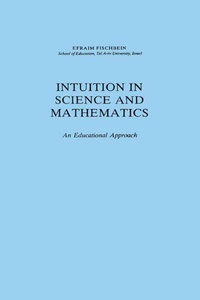
Intuition in Science and Mathematics
An Educational Approach
Published on 28. October 2010
Book
Paperback/Softback
XIII, 226 pages
978-90-481-8437-8 (ISBN)
Description
In writing the present book I have had in mind the following objectives: - To propose a theoretical, comprehensive view of the domain of intuition. - To identify and organize the experimental findings related to intuition scattered in a wide variety of research contexts. - To reveal the educational implications of the idea, developed for science and mathematics education. Most of the existing monographs in the field of intuition are mainly concerned with theoretical debates - definitions, philosophical attitudes, historical considerations. (See, especially the works of Wild (1938), of Bunge (1 962) and of Noddings and Shore (1 984).) A notable exception is the book by Westcott (1968), which combines theoretical analyses with the author's own experimental studies. But, so far, no attempt has been made to identify systematically those findings, spread throughout the research literature, which could contribute to the deciphering of the mechanisms of intuition. Very often the relevant studies do not refer explicitly to intuition. Even when this term is used it occurs, usually, as a self-evident, common sense term.
More details
Series
Edition
Softcover reprint of the original 1st ed. 1987
Language
English
Place of publication
Dordrecht
Netherlands
Target group
Professional and scholarly
Research
Illustrations
1 s/w Abbildung
XIII, 226 p. 1 illus.
Dimensions
Height: 235 mm
Width: 155 mm
Thickness: 14 mm
Weight
376 gr
ISBN-13
978-90-481-8437-8 (9789048184378)
DOI
10.1007/0-306-47237-6
Schweitzer Classification
Other editions
Additional editions
Book
10/1987
Kluwer Academic Publishers
€160.49
Shipment within 15-20 days
Content
The Theory.- Intuition and the Need for Certitude.- Intuition and Mathematical Reasoning.- Investigations in Overconfidence.- General Characteristics of Intuitive Cognitions.- The Classification of Intuitions.- Inferential Intuitions and Logical Reasoning.- Factors which Shape Intuitions.- Intuition and Experience.- The Practicalyty of Intuitive Meanings, Analysis of an Example: The Negative Numbers.- Factors of Immediacy.- Factors of Globality.- Intuition and Intuitive Models.- Models and Analogies.- Paradigmatic Models.- Diagrammatic Models.- Phenomenological Primitives.- Conflicts and Compromises.- Factors of Perseverance and Closure: The Primacy Effect.- Summary and Didactical Implications.