

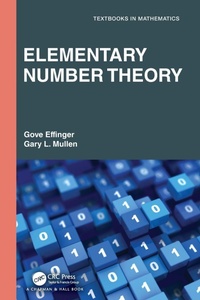
Elementary Number Theory
1st Edition
Published on 9. September 2021
Book
Paperback/Softback
242 pages
978-1-032-01723-5 (ISBN)
Description
Elementary Number Theory, Gove Effinger, Gary L. Mullen
This text is intended to be used as an undergraduate introduction to the theory of numbers. The authors have been immersed in this area of mathematics for many years and hope that this text will inspire students (and instructors) to study, understand, and come to love this truly beautiful subject.
Each chapter, after an introduction, develops a new topic clearly broken out in sections which include theoretical material together with numerous examples, each worked out in considerable detail. At the end of each chapter, after a summary of the topic, there are a number of solved problems, also worked out in detail, followed by a set of supplementary problems. These latter problems give students a chance to test their own understanding of the material; solutions to some but not all of them complete the chapter.
The first eight chapters discuss some standard material in elementary number theory. The remaining chapters discuss topics which might be considered a bit more advanced. The text closes with a chapter on Open Problems in Number Theory. Students (and of course instructors) are strongly encouraged to study this chapter carefully and fully realize that not all mathematical issues and problems have been resolved! There is still much to be learned and many questions to be answered in mathematics in general and in number theory in particular.
This text is intended to be used as an undergraduate introduction to the theory of numbers. The authors have been immersed in this area of mathematics for many years and hope that this text will inspire students (and instructors) to study, understand, and come to love this truly beautiful subject.
Each chapter, after an introduction, develops a new topic clearly broken out in sections which include theoretical material together with numerous examples, each worked out in considerable detail. At the end of each chapter, after a summary of the topic, there are a number of solved problems, also worked out in detail, followed by a set of supplementary problems. These latter problems give students a chance to test their own understanding of the material; solutions to some but not all of them complete the chapter.
The first eight chapters discuss some standard material in elementary number theory. The remaining chapters discuss topics which might be considered a bit more advanced. The text closes with a chapter on Open Problems in Number Theory. Students (and of course instructors) are strongly encouraged to study this chapter carefully and fully realize that not all mathematical issues and problems have been resolved! There is still much to be learned and many questions to be answered in mathematics in general and in number theory in particular.
More details
Series
Language
English
Place of publication
Oxford
United Kingdom
Publishing group
Taylor & Francis Ltd
Target group
College/higher education
Undergraduate Advanced
Illustrations
1 s/w Abbildung, 1 Farbfoto bzw. farbiges Rasterbild, 1 s/w Zeichnung, 12 s/w Tabellen
12 Tables, black and white; 1 Line drawings, black and white; 1 Halftones, color; 1 Illustrations, black and white
Dimensions
Height: 234 mm
Width: 156 mm
Thickness: 14 mm
Weight
392 gr
ISBN-13
978-1-032-01723-5 (9781032017235)
Copyright in bibliographic data and cover images is held by Nielsen Book Services Limited or by the publishers or by their respective licensors: all rights reserved.
Schweitzer Classification
Other editions
Additional editions
Gove Effinger | Gary L. Mullen
Elementary Number Theory
Book
09/2021
1st Edition
Chapman & Hall/CRC
€205.70
Shipment within 10-20 days
Gove Effinger | Gary L. Mullen
Elementary Number Theory
E-Book
09/2021
1st Edition
Chapman & Hall/CRC
€73.99
Available for download
Gove Effinger | Gary L. Mullen
Elementary Number Theory
E-Book
09/2021
1st Edition
Chapman & Hall/CRC
€73.99
Available for download
Persons
Gove Effinger received his Ph.D. in Mathematics from the University of Massachusetts (Amherst) in 1981 and subsequently taught at Bates College for 5 years and then Skidmore College for 29 years. He is the author of three books: An Elementary Transition to Abstract Mathematics (with Gary L. Mullen, CRC Press), Additive Number Theory of Polynomials over a Finite Field (with David R. Hayes), and Common-Sense BASIC: Structured Programming with Microsoft Quick BASIC (with Alice M. Dean), as well as numerous research papers. His research focus has primarily been concerned with the similarities of polynomials over a finite fields and ordinary integers.
?
Gary L. Mullen is Professor of Mathematics at the Pennsylvania State University, University Park, PA. He has taught both undergraduate and graduate courses there for over 40 years. In addition, he has written more than 150 research papers and co-authored seven books, including both graduate as well as undergraduate textbooks. He also served as department head for seven years and has served as an editor on numerous editorial boards, including having served as Editor-in-Chief of the journal Finite Fields and Their Applications since its founding in 1995.
?
Gary L. Mullen is Professor of Mathematics at the Pennsylvania State University, University Park, PA. He has taught both undergraduate and graduate courses there for over 40 years. In addition, he has written more than 150 research papers and co-authored seven books, including both graduate as well as undergraduate textbooks. He also served as department head for seven years and has served as an editor on numerous editorial boards, including having served as Editor-in-Chief of the journal Finite Fields and Their Applications since its founding in 1995.
Content
1. Divisibility in the Integers Z 2. Prime Numbers and Factorization 3. Congruences and the Sets Zn 4. Solving Congruences 5. The Theorems of Fermat and Euler 6. Applications in Modern Cryptography 7. Quadratic Residues and Quadratic Reciprocity 8. Some Fundamental Number Theory Functions 9. Diophantine Equations 10. Finite Fields 11. Some Open Problems in Number Theory A. Mathematical Induction B. Sets of Numbers Beyond the Integers