

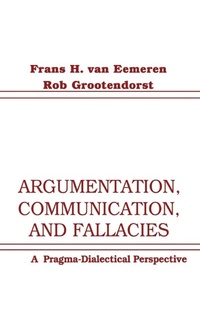
Argumentation, Communication, and Fallacies
A Pragma-dialectical Perspective
1st Edition
Published on 29. July 2016
Book
Hardback
252 pages
978-1-138-14455-2 (ISBN)
Description
This volume gives a theoretical account of the problem of analyzing and evaluating argumentative discourse. After placing argumentation in a communicative perspective, and then discussing the fallacies that occur when certain rules of communication are violated, the authors offer an alternative to both the linguistically-inspired descriptive and logically-inspired normative approaches to argumentation.
The authors characterize argumentation as a complex speech act in a critical discussion aimed at resolving a difference of opinion. The various stages of a critical discussion are outlined, and the communicative and interactional aspects of the speech acts performed in resolving a simple or complex dispute are discussed. After dealing with crucial aspects of analysis and linking the evaluation of argumentative discourse to the analysis, the authors identify the fallacies that can occur at various stages of discussion. Their general aim is to elucidate their own pragma- dialectical perspective on the analysis and evaluation of argumentative discourse, bringing together pragmatic insight concerning speech acts and dialectical insight concerning critical discussion.
The authors characterize argumentation as a complex speech act in a critical discussion aimed at resolving a difference of opinion. The various stages of a critical discussion are outlined, and the communicative and interactional aspects of the speech acts performed in resolving a simple or complex dispute are discussed. After dealing with crucial aspects of analysis and linking the evaluation of argumentative discourse to the analysis, the authors identify the fallacies that can occur at various stages of discussion. Their general aim is to elucidate their own pragma- dialectical perspective on the analysis and evaluation of argumentative discourse, bringing together pragmatic insight concerning speech acts and dialectical insight concerning critical discussion.
Reviews / Votes
"...a coherent, well-considered, and novel framework, which has been deservedly well received on several continents....Argumentation, Communication, and Fallacies is an important statement of an important theory....graduate students and scholars will find this to be an essential description of pragma-dialectics."-Communication Theory
More details
Language
English
Place of publication
London
United Kingdom
Publishing group
Taylor & Francis Ltd
Target group
Professional and scholarly
Dimensions
Height: 235 mm
Width: 157 mm
Thickness: 18 mm
Weight
521 gr
ISBN-13
978-1-138-14455-2 (9781138144552)
Copyright in bibliographic data and cover images is held by Nielsen Book Services Limited or by the publishers or by their respective licensors: all rights reserved.
Schweitzer Classification
Other editions
Additional editions
Frans H. van Eemeren | Rob Grootendorst
Argumentation, Communication, and Fallacies
A Pragma-dialectical Perspective
E-Book
07/2016
Routledge
€73.99
Available for download
Frans H. van Eemeren | Rob Grootendorst
Argumentation, Communication, and Fallacies
A Pragma-dialectical Perspective
E-Book
07/2016
Routledge
€73.99
Available for download
Frans H. van Eemeren | Rob Grootendorst
Argumentation, Communication, and Fallacies
A Pragma-dialectical Perspective
Book
04/1992
1st Edition
Routledge
€95.70
Shipment within 10-20 days
Persons
Frans H. van Eemeren, Rob Grootendorst
Content
Contents: Part I:Argumentation and Communication. The Pragma-Dialectical Approach. Standpoints and Differences of Opinion. Argumentation as a Complex Speech Act. Speech Acts in a Critical Discussion. Implicit and Indirect Speech Acts. Unexpressed Premises in Argumentative Discourse. Complex Argumentation Structures. Part II:Communication and Fallacies. Analyzing and Evaluating Argumentative Discourse. Fallacies in the Confrontation. Fallacies in the Distribution of Discussion Roles. Fallacies in Representing a Standpoint. Fallacies in Choosing the Means of Defense. Fallacies in Dealing with Unexpressed Premises. Fallacies in Utilizing Starting Points. Fallacies in Utilizing Argumentation Schemes. Fallacies in Utilizing Logical Argument Forms. Fallacies in Concluding the Discussion. Fallacies in Usage. Conclusion.