

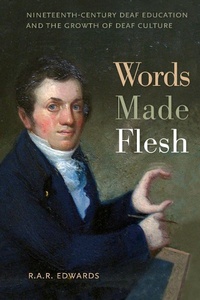
Words Made Flesh
Nineteenth-Century Deaf Education and the Growth of Deaf Culture
Published on 1. January 2014
Book
Paperback/Softback
263 pages
978-1-4798-8373-8 (ISBN)
Description
During the early nineteenth century, schools for the deaf appeared in the United States for the first time. These schools were committed to the use of the sign language to educate deaf students. Manual education made the growth of the deaf community possible, for it gathered deaf people together in sizable numbers for the first time in American history. It also fueled the emergence of Deaf culture, as the schools became agents of cultural transformations.
Just as the Deaf community began to be recognized as a minority culture, in the 1850s, a powerful movement arose to undo it, namely oral education. Advocates of oral education, deeply influenced by the writings of public school pioneer Horace Mann, argued that deaf students should stop signing and should start speaking in the hope that the Deaf community would be abandoned, and its language and culture would vanish. In this revisionist history, Words Made Flesh explores the educational battles of the nineteenth century from both hearing and deaf points of view. It places the growth of the Deaf community at the heart of the story of deaf education and explains how the unexpected emergence of Deafness provoked the pedagogical battles that dominated the field of deaf education in the nineteenth century, and still reverberate today.
Just as the Deaf community began to be recognized as a minority culture, in the 1850s, a powerful movement arose to undo it, namely oral education. Advocates of oral education, deeply influenced by the writings of public school pioneer Horace Mann, argued that deaf students should stop signing and should start speaking in the hope that the Deaf community would be abandoned, and its language and culture would vanish. In this revisionist history, Words Made Flesh explores the educational battles of the nineteenth century from both hearing and deaf points of view. It places the growth of the Deaf community at the heart of the story of deaf education and explains how the unexpected emergence of Deafness provoked the pedagogical battles that dominated the field of deaf education in the nineteenth century, and still reverberate today.
Reviews / Votes
"[A] useful addition to the still-developing history of the nation's evolving deaf community." (The Journal of American History) "R.A.R. Edwards' Words Made Flesh: Nineteenth-Century Deaf Education and the Growth of Deaf Culture is a brilliant study of the emergence of a deaf community in nineteenth-century America . . . . Beyond a more nuanced account of the emergence of the American Deaf community, this monograph is ultimately a revisionist history of the ongoing conflict over pedagogical methods in deaf education. Building on the established historiography produced by a small cadre of deaf historians, Edwards represents a new generation of scholarship in the field, offering a revisionist thesis of the ideas originally presented by Van Cleve and Crouch over twenty years ago. Words Made Flesh is a fine addition to New York University press's history of disability series." (Common-Place) "[This book is] provocative, detailed, and a welcome examination of the emergence of a signing deaf culture." (American Historical Review) "In this gracefully written book, Edwards offers both a fascinating narrative and a provocative, revisionist thesis.Scholars and general readers interested in the Deaf community and American cultural history will find it a rewarding read." - Douglas Baynton,University of Iowa "Words Made Fleshis a stimulating, beautifully written, and thoroughly engaging book." - James W. Trent (American Studies)More details
Series
Language
English
Place of publication
New York
United States
Target group
Professional and scholarly
Product notice
Paperback (trade)
Dimensions
Height: 222 mm
Width: 152 mm
Thickness: 17 mm
Weight
380 gr
ISBN-13
978-1-4798-8373-8 (9781479883738)
Copyright in bibliographic data and cover images is held by Nielsen Book Services Limited or by the publishers or by their respective licensors: all rights reserved.
Schweitzer Classification
Other editions
Additional editions
E-Book
05/2014
New York University Press
€142.99
Available for download
E-Book
03/2012
New York University Press
€0.00
Available for download
Person
Normal
0
MicrosoftInternetExplorer4
/* Style Definitions */
table.MsoNormalTable
{mso-style-name:"Table Normal";
mso-tstyle-rowband-size:0;
mso-tstyle-colband-size:0;
mso-style-noshow:yes;
mso-style-parent:"";
mso-padding-alt:0pt 5.4pt 0pt 5.4pt;
mso-para-margin:0pt;
mso-para-margin-bottom:.0001pt;
mso-pagination:widow-orphan;
font-size:10.0pt;
font-family:"Times New Roman";}
R. A. R. Edwards is Associate
Professor of History at the Rochester Institute of Technology, in Rochester,
New York.
0
MicrosoftInternetExplorer4
/* Style Definitions */
table.MsoNormalTable
{mso-style-name:"Table Normal";
mso-tstyle-rowband-size:0;
mso-tstyle-colband-size:0;
mso-style-noshow:yes;
mso-style-parent:"";
mso-padding-alt:0pt 5.4pt 0pt 5.4pt;
mso-para-margin:0pt;
mso-para-margin-bottom:.0001pt;
mso-pagination:widow-orphan;
font-size:10.0pt;
font-family:"Times New Roman";}
R. A. R. Edwards is Associate
Professor of History at the Rochester Institute of Technology, in Rochester,
New York.
Content
Acknowledgments Introduction 1 Thomas Hopkins Gallaudet and Laurent Clerc: A Yale Man and a Deaf Man Open a School and Create a World 2 Manual Education: An American Beginning 3 Learning to Be Deaf: Lessons from the Residential School 4 The Deaf Way: Living a Deaf Life 5 Horace Mann and Samuel Gridley Howe: The First American Oralists 6 Languages of Signs: Methodical versus Natural 7 The Fight over the Clarke School: Manualists and Oralists Confront Deafness Conclusion Notes Index About the Author