

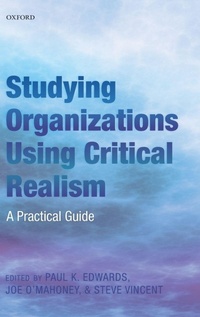
Studying Organizations Using Critical Realism
A Practical Guide
Published on 20. March 2014
Book
Hardback
404 pages
978-0-19-966552-5 (ISBN)
Description
The development of Critical Realism (CR), as a philosophy of science, is generally attributed to a series of books by Roy Bhaskar. It has proven to be influential, not least because it has an affinity with many people's views about the way the world fits together, both within and outside of academia. Whilst there are numerous contributions outlining CR theory in sociological and organizational research, as well as general texts about realist ontology, work delineating the consequences of these views for research practice is an emerging area of interest.
This book aims to fill a significant gap in the literature by providing a practical guide to the application of CR in empirical research projects. More specifically, it explores the methodological consequences of committing to a CR ontology--the assumptions that researchers from this tradition make about the nature of reality. These assumptions are important because ontological commitments, which relate what we believe exists, often affect our epistemological concerns, which relate to our beliefs about how whatever exists can be studied and known. Thus, for a researcher, ontology and epistemology are important because they have consequences for the possibilities and limits of the research methods, techniques, and analyses that they employ.
The book explains what CR is and outlines the logic of research design. In a series of chapters on major social science research methods, purpose-written by experts in the relevant technique, the book contains extended illustration of how to conduct inquiry using CR.
This book aims to fill a significant gap in the literature by providing a practical guide to the application of CR in empirical research projects. More specifically, it explores the methodological consequences of committing to a CR ontology--the assumptions that researchers from this tradition make about the nature of reality. These assumptions are important because ontological commitments, which relate what we believe exists, often affect our epistemological concerns, which relate to our beliefs about how whatever exists can be studied and known. Thus, for a researcher, ontology and epistemology are important because they have consequences for the possibilities and limits of the research methods, techniques, and analyses that they employ.
The book explains what CR is and outlines the logic of research design. In a series of chapters on major social science research methods, purpose-written by experts in the relevant technique, the book contains extended illustration of how to conduct inquiry using CR.
Reviews / Votes
Those who have sought to pursue a critical realist research strategy in recent years only to be frustrated by the paucity of applied studies will find this book of great service, given the range of detailed examples encompassing both related methodologies and empirical work in the field of OMS. * Christopher McLachlan, University of Leeds, Work, Employment and Society * this work provides a timely and useful guide for the design and use of research techniques when informed through critical realism. * Lee Martin, Critical Realism *More details
Language
English
Place of publication
Oxford
United Kingdom
Target group
College/higher education
Professional and scholarly
Dimensions
Height: 240 mm
Width: 161 mm
Thickness: 26 mm
Weight
769 gr
ISBN-13
978-0-19-966552-5 (9780199665525)
Copyright in bibliographic data and cover images is held by Nielsen Book Services Limited or by the publishers or by their respective licensors: all rights reserved.
Schweitzer Classification
Other editions
Additional editions
Paul K. Edwards | Joe O'Mahoney | Steve Vincent
Studying Organizations Using Critical Realism
A Practical Guide
Book
03/2014
Oxford University Press
€68.09
Shipment within 15-20 days
Paul K. Edwards | Joe O'Mahoney | Steve Vincent
Studying Organizations Using Critical Realism
A Practical Guide
E-Book
03/2014
1st Edition
OUP eBook
€51.49
Available for download
Persons
Paul Edwards has been Professor of Employment Relations at the University of Birmingham since 2011; he was previously at Warwick University, where he was Director of the Industrial Relations Research Unit. He has published widely on work and employment, including The Politics of Working Life (with Judy Wajcman; OUP, 2005). He is a Fellow of the British Academy and is editor-in-chief of Human Relations.
Joe O'Mahoney is a Senior Lecturer at Cardiff University and was previously Head of Business Analysis at Three, a senior strategy consultant and the founder of StayMobile Technology LLP. He has published widely on the consulting industry, and more recently on critical realism, in Work, Employment and Society, Organisation Studies, Organisation, the Journal of Management Studies, and the Journal of Business Ethics.
Steve Vincent is Professor of Human Resource Management at Newcastle University since 2012. He was previously Senior Lecturer in Human Resource Management at the University of Leeds. He has published widely in books and journals, including articles in Human Relations; Journal of Management Studies; Work, Employment and Society; Public Administration, and New Technology, Work and Employment. He has also been a member of the editorial board of Work, Employment and Society journal.
Joe O'Mahoney is a Senior Lecturer at Cardiff University and was previously Head of Business Analysis at Three, a senior strategy consultant and the founder of StayMobile Technology LLP. He has published widely on the consulting industry, and more recently on critical realism, in Work, Employment and Society, Organisation Studies, Organisation, the Journal of Management Studies, and the Journal of Business Ethics.
Steve Vincent is Professor of Human Resource Management at Newcastle University since 2012. He was previously Senior Lecturer in Human Resource Management at the University of Leeds. He has published widely in books and journals, including articles in Human Relations; Journal of Management Studies; Work, Employment and Society; Public Administration, and New Technology, Work and Employment. He has also been a member of the editorial board of Work, Employment and Society journal.
Content
Foreword ; 1. Critical Realism as an Empirical Project: A Beginner s Guide ; 2. Critical Realism, Research Techniques, and Research Designs ; 3. Employing a Form of Critical Realist Discourse Analysis for Identity Research: An Example from Women s Talk of Motherhood, Childcare and Employment ; 4. Researching Identity: a Critical Realist Approach ; 5. Critical Realism and Grounded Theory ; 6. Critical Realism and Interviewing Subjects ; 7. Critical Realism and Ethnography ; 8. Critical Realism and the Organizational Case Study: A Guide to Discovering Institutional Mechanisms ; 9. Comparing Cases ; 10. Critical Realism and International Comparative Research ; 11. Pulling the Levers of Agency: Implementing Critical Realist Action Research ; 12. History and Documents in Critical Realism ; 13. Critical Realism and Mixed Methods Research: Combining the Extensive and Intensive at Multiple Levels ; 14. Realist Synthesis ; 15. Probability and Models ; 16. An Appraisal of the Contribution of Critical Realism to Qualitative and Quantitative Research Methodology: Is Dialectics the Way Forward? ; 17. Concluding Comments