

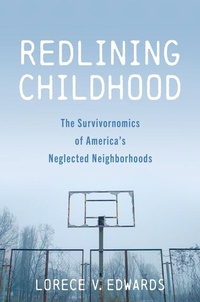
Redlining Childhood
The Survivornomics of America's Neglected Neighborhoods
Will be published approx. on 20. October 2026
Book
Hardback
272 pages
978-1-4214-5038-4 (ISBN)
Description
A searing portrait of young Black people's day-to-day lives growing up in marginalized communities-and how to help.
In underserved communities across the United States, violence, food insecurity, unstable housing, lead poisoning, and other factors such as racist redlining policies negatively impact young people's everyday experiences-and their futures. What opportunities are available to young Black people living in these neighborhoods? What are their survival expectations? Who can they look to for support? In this searing portrait of today's youth, Lorece V. Edwards offers a thought-provoking and timely account of the day-to-day experience of living in America's neglected neighborhoods.
Edwards examines the reality of growing up Black in marginalized communities and provides a nuanced, systems-level perspective of the daily lives of these youths. Many of the practices for which these young people are demonized are simply survival strategies. Structural violence plays a key role in their opportunities to be successful. Using Baltimore as a case study, Edwards examines the historical roots of how these neighborhoods developed, from the detrimental impacts of historical redlining policies during the 1930s to continued disinvestment in Black communities today.
The narrative is enriched through the poignant, firsthand accounts of youth who live in these neighborhoods. Incorporating the results of longitudinal research projects focused on sexual health, substance use, communicable diseases, and decision-making among minority youth residing in the inner city, Edwards provides recommendations for how to address systemic issues and change the trajectory of these children's futures.
In underserved communities across the United States, violence, food insecurity, unstable housing, lead poisoning, and other factors such as racist redlining policies negatively impact young people's everyday experiences-and their futures. What opportunities are available to young Black people living in these neighborhoods? What are their survival expectations? Who can they look to for support? In this searing portrait of today's youth, Lorece V. Edwards offers a thought-provoking and timely account of the day-to-day experience of living in America's neglected neighborhoods.
Edwards examines the reality of growing up Black in marginalized communities and provides a nuanced, systems-level perspective of the daily lives of these youths. Many of the practices for which these young people are demonized are simply survival strategies. Structural violence plays a key role in their opportunities to be successful. Using Baltimore as a case study, Edwards examines the historical roots of how these neighborhoods developed, from the detrimental impacts of historical redlining policies during the 1930s to continued disinvestment in Black communities today.
The narrative is enriched through the poignant, firsthand accounts of youth who live in these neighborhoods. Incorporating the results of longitudinal research projects focused on sexual health, substance use, communicable diseases, and decision-making among minority youth residing in the inner city, Edwards provides recommendations for how to address systemic issues and change the trajectory of these children's futures.
More details
Language
English
Place of publication
Baltimore, MD
United States
Illustrations
8 s/w Abbildungen, 1 s/w Abbildung
8 Illustrations, black and white; 1 Illustrations, black and white
Dimensions
Height: 229 mm
Width: 152 mm
Thickness: 21 mm
ISBN-13
978-1-4214-5038-4 (9781421450384)
DOI
10.56021/9781421450384
Copyright in bibliographic data and cover images is held by Nielsen Book Services Limited or by the publishers or by their respective licensors: all rights reserved.
Schweitzer Classification
Persons
Lorece V. Edwards (BALTIMORE, MD) is a professor of public health at Morgan State University's School of Community Health and Policy, where she is the director of the Center for Sexual Health Advancement and Prevention Education.
Content
Foreward
Preface
Introduction: Welcome to Baltimore-Where Place Matters
1. Construct One: Excessive Police Force/Brutality-Might Not Be a Tomorrow
2. Construct Two: The Impact of Exposure to Community Violence
3. Construct Three: High-Risk Landscapes of Despair Generate Threats to Black Lives
4. Construct Four: Youth Homelessness and Food Insecurity Experiences
5. Conclusion: Where Do We Go from Here?
Preface
Introduction: Welcome to Baltimore-Where Place Matters
1. Construct One: Excessive Police Force/Brutality-Might Not Be a Tomorrow
2. Construct Two: The Impact of Exposure to Community Violence
3. Construct Three: High-Risk Landscapes of Despair Generate Threats to Black Lives
4. Construct Four: Youth Homelessness and Food Insecurity Experiences
5. Conclusion: Where Do We Go from Here?