

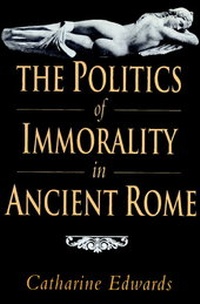
The Politics of Immorality in Ancient Rome
Published on 9. May 2002
Book
Paperback/Softback
244 pages
978-0-521-89389-3 (ISBN)
Description
This book addresses the question not how immoral the ancient Romans were but why the literature they produced is so preoccupied with immorality. The modern image of immoral Rome derives from ancient accounts which are largely critical rather than celebratory. Far from being empty commonplaces these accusations constituted a powerful discourse through which Romans negotiated conflicts and tensions in their social and political order. This study proceeds by a detailed examination of a wide range of ancient texts (all of which are translated), exploring the dynamics of their rhetoric, as well as the ends to which they were deployed. Roman moralising discourse, the author suggests, may be seen as especially concerned with the articulation of anxieties about gender, social status and political power. Individual chapters focus on adultery, effeminacy, the immorality of the Roman theatre, luxurious buildings and the dangers of pleasure.
More details
Language
English
Place of publication
Cambridge
United Kingdom
Target group
Professional and scholarly
Product notice
Paperback (trade)
Illustrations
Worked examples or Exercises
Dimensions
Height: 229 mm
Width: 151 mm
Thickness: 18 mm
Weight
397 gr
ISBN-13
978-0-521-89389-3 (9780521893893)
Copyright in bibliographic data and cover images is held by Nielsen Book Services Limited or by the publishers or by their respective licensors: all rights reserved.
Schweitzer Classification
Other editions
New editions
Catharine Edwards
The Politics of Immorality in Ancient Rome
Book
03/2025
2nd Edition
Cambridge University Press
€33.40
Shipment within 15-20 days
Person
Content
Introduction; 1. A moral revolution? The law against adultery; 2. Mollitia: reading the body; 3. Playing Romans: representations of actors and the theatre; 4. Structures of immorality: rhetoric, building and social hierarchy; 5. Prodigal pleasures.