

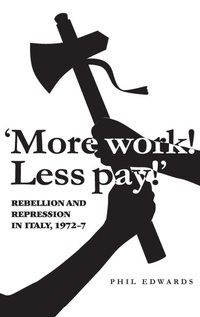
'More Work! Less Pay!'
Rebellion and Repression in Italy, 1972-7
Published on 25. November 2009
Book
Hardback
256 pages
978-0-7190-7873-6 (ISBN)
Description
In the mid-1970s, a long wave of contentious radicalism swept through Italy. 'Proletarian youth', 'metropolitan Indians', 'the area of Autonomy': a shifting galaxy of groups and movements practised new forms of activism. Factories and universities were occupied; rent and utility payments were withheld; neo-Fascists and drug pushers were attacked on sight.
The movements were at once creative and brutal, intransigent and playful. A particular target for mockery was the parliamentary Left, and above all the Italian Communist Party (PCI). An earlier wave of radical activism had culminated in the Hot Autumn of 1969; then, the PCI had managed to 'ride the tiger' of industrial militancy, emerging with its credibility enhanced. Now, however, the PCI was committed to compromise with the ruling Christian Democrats. The second cycle of contention thus ended in a hostile engagement: rather than adopt their policies, the PCI labelled the movements Fascists, criminals and hooligans. By the end of 1977 the movements were broken, while the PCI had moved sharply to the Right. The main beneficiaries were left-wing 'armed struggle' groups such as the Red Brigades.
Building on Sidney Tarrow's 'cycle of contention' model and drawing on a wide range of Italian materials, Phil Edwards has told the story of a unique and fascinating group of political movements, and of their disastrous engagement with the mainstream Left. As well as shedding light on a neglected period of twentieth century history, this book offers lessons for understanding today's contentious movements ('No Global', 'Black Bloc') and today's 'armed struggle' groups. -- .
The movements were at once creative and brutal, intransigent and playful. A particular target for mockery was the parliamentary Left, and above all the Italian Communist Party (PCI). An earlier wave of radical activism had culminated in the Hot Autumn of 1969; then, the PCI had managed to 'ride the tiger' of industrial militancy, emerging with its credibility enhanced. Now, however, the PCI was committed to compromise with the ruling Christian Democrats. The second cycle of contention thus ended in a hostile engagement: rather than adopt their policies, the PCI labelled the movements Fascists, criminals and hooligans. By the end of 1977 the movements were broken, while the PCI had moved sharply to the Right. The main beneficiaries were left-wing 'armed struggle' groups such as the Red Brigades.
Building on Sidney Tarrow's 'cycle of contention' model and drawing on a wide range of Italian materials, Phil Edwards has told the story of a unique and fascinating group of political movements, and of their disastrous engagement with the mainstream Left. As well as shedding light on a neglected period of twentieth century history, this book offers lessons for understanding today's contentious movements ('No Global', 'Black Bloc') and today's 'armed struggle' groups. -- .
More details
Language
English
Place of publication
Manchester
United Kingdom
Target group
College/higher education
Professional and scholarly
Illustrations
Illustrations, black & white|Tables
Dimensions
Height: 240 mm
Width: 161 mm
Thickness: 18 mm
Weight
543 gr
ISBN-13
978-0-7190-7873-6 (9780719078736)
Copyright in bibliographic data and cover images is held by Nielsen Book Services Limited or by the publishers or by their respective licensors: all rights reserved.
Schweitzer Classification
Other editions
Additional editions
E-Book
07/2013
Manchester University Press
€127.99
Available for download
Person
Phil Edwards is Lecturer in Criminology at the University of Manchester -- .
Content
1. Introduction
2. The Hot Autumn and after: a cycle of contention reconsidered
3. From Resistance to Historic Compromise: the politics of the PCI
4. From Feltrinelli to Moro: a second cycle of contention
5. 'Repudiate all forms of intolerance': how the movements were framed
6. A cycle and its aftermath
7.Do you remember revolution?
8. Social movements and cycles of contention: theoretical appendix
References
Index -- .
2. The Hot Autumn and after: a cycle of contention reconsidered
3. From Resistance to Historic Compromise: the politics of the PCI
4. From Feltrinelli to Moro: a second cycle of contention
5. 'Repudiate all forms of intolerance': how the movements were framed
6. A cycle and its aftermath
7.Do you remember revolution?
8. Social movements and cycles of contention: theoretical appendix
References
Index -- .