

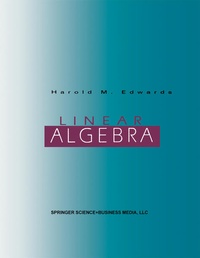
Linear Algebra
Published on 15. October 2004
Book
Paperback/Softback
XIII, 184 pages
978-0-8176-4370-6 (ISBN)
Description
Linear Algebra is a text for a one-semester course that is given in every undergraduate university and college curriculum in most of the world. The book adopts an algorithmic approach, giving the student many examples to work through and copious exercises to test their skill and extend their knowledge of the subject. The course will generally be at the junior/senior level, though sometimes will also be taught at the beginning graduate level.
More details
Edition
Softcover reprint of the original 1st ed. 1995
Language
English
Place of publication
Boston
United States
Target group
Lower undergraduate
Illustrations
XIII, 184 p.
Dimensions
Height: 246 mm
Width: 189 mm
Thickness: 12 mm
Weight
406 gr
ISBN-13
978-0-8176-4370-6 (9780817643706)
DOI
10.1007/978-0-8176-4446-8
Schweitzer Classification
Other editions
Additional editions
Harold M. Edwards
Linear Algebra
Book
01/1994
Birkhauser Boston Inc
€85.59
Article exhausted; check different version
Person
Harold M. Edwards [1936-2020] was Professor Emeritus of Mathematics at New York University. His research interests lay in number theory, algebra, and the history and philosophy of mathematics. He authored numerous books, including Riemann's Zeta Function (1974, 2001) and Fermat's Last Theorem (1977), for which he received the Leroy P. Steele Prize for mathematical exposition in 1980.
David A. Cox (Contributing Author) is Professor Emeritus of Mathematics in the Department of Mathematics and Statistics of Amherst College. He received the Leroy P. Steele Prize for mathematical exposition in 2016 for his book Ideals, Varieties, and Algorithms, with John Little and Donal O'Shea.
Content
Matrix Multiplication.- Equivalence of Matrices. Reduction to Diagonal Form.- Matrix Division.- Determinants.- Testing for Equivalence.- Matrices with Rational Number Entries.- The Method of Least Squares.- Matrices with Polynomial Entries.- Similarity of Matrices.- The Spectral Theorem.