

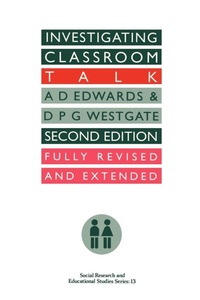
Investigating Classroom Talk
2nd Edition
Published on 22. July 1994
Book
Paperback/Softback
216 pages
978-0-7507-0325-3 (ISBN)
Description
In this fully revised and extended edition, Tony Edwards and David Westgate continue to examine methods of investigation for use in classrooms and ways in which researchers and teachers may advance their knowledge of classroom talk. They have taken the opportunity to add material on oracy and the importance of spoken language in the curriculum.; All research evidence and bibliographic material has been revised and updated. This book should continue to be an important text for a new generation of students and researchers in language and linguistics, social science and education studies.
More details
Edition
2nd edition
Language
English
Place of publication
London
United Kingdom
Publishing group
Taylor & Francis Ltd
Target group
College/higher education
Dimensions
Height: 234 mm
Width: 156 mm
Thickness: 12 mm
Weight
336 gr
ISBN-13
978-0-7507-0325-3 (9780750703253)
Copyright in bibliographic data and cover images is held by Nielsen Book Services Limited or by the publishers or by their respective licensors: all rights reserved.
Schweitzer Classification
Other editions
Additional editions
A. Edwards | D. P. G. Westgate
Investigating Classroom Talk
E-Book
08/2005
2nd Edition
Routledge
€68.49
Available for download
A. Edwards | D. P. G. Westgate
Investigating Classroom Talk
E-Book
08/2005
2nd Edition
Routledge
€68.49
Available for download
A. Edwards | D. P. G. Westgate
Investigating Classroom Talk
Book
07/1994
2nd Edition
Routledge Falmer
€273.50
Article not available for order
Persons
Edwards, A.; Westgate, D. P. G.
Content
1 A Rationale for Researching Classroom Talk: The Educational Status of Classroom Talk; The Status of Talk as Evidence; Concepts and Terminology. 2 Characteristic Patterns of Classroom Talk: Varieties of Classroom Language; Status, Knowledge, and Unequal Communicative Rights. 3 Research Purposes, Practices and Problems: Choice of Approach; Recording and Transcribing; Reality Observed. 4 Coding Classroom Interaction - Systematic Classroom Observation: Purposes and Methods; Systematic Classroom Observation: Assumptions and Limitations. 5 Interpreting Classroom Communication: Turns, Sequences and Meanings: Learning the Language; Curriculum and Communication; The Essential Teaching Exchange. 6 Analyses of Classroom Discourse: A Linguistic View; Normal Classroom Discourse; A Language Gap Between Home and School? 7 Conclusion.