

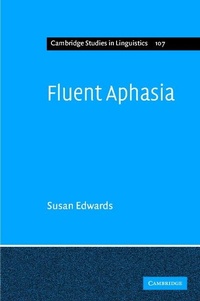
Fluent Aphasia
Published on 29. September 2005
Book
Hardback
244 pages
978-0-521-79107-6 (ISBN)
Description
Fluent aphasia is a language disorder that follows brain damage, causing difficulty in finding the correct words and structuring sentences. Speakers also experience problems in understanding language, severely impairing their ability to communicate. In this informative study Susan Edwards provides a detailed description of fluent aphasia, by drawing widely on research data, and by comparing fluent aphasia with other types of aphasia as well as with normal language. She discusses evidence that the condition affects access to underlying grammatical rules as well as to the lexicon, and explores the relationship between language and the brain, the controversy over aphasia syndromes, the assessment of aphasia via standardized tests, and the analysis of continuous speech data. Extensive examples of aphasic speech are given, and the progress of one fluent aphasic speaker is discussed in detail. Written by an internationally renowned expert, this book will be invaluable to linguists and practitioners alike.
Reviews / Votes
' ... provides a good portrayal of Wernicke's aphasia ... can be recommended to readers from many different fields who are interested in gaining insight into aphasia, its assessment, and its underlying causes.' LinguisticsMore details
Series
Language
English
Place of publication
Cambridge
United Kingdom
Target group
Professional and scholarly
Dimensions
Height: 235 mm
Width: 157 mm
Thickness: 19 mm
Weight
552 gr
ISBN-13
978-0-521-79107-6 (9780521791076)
Copyright in bibliographic data and cover images is held by Nielsen Book Services Limited or by the publishers or by their respective licensors: all rights reserved.
Schweitzer Classification
Other editions
Additional editions
Susan Edwards
Fluent Aphasia
E-Book
10/2005
1st Edition
Cambridge University Press
€29.49
Available for download
Person
Susan Edwards is Professor of Clinical Linguistics at the School of Linguistics and Applied Language Studies, University of Reading.
Content
1. Fluent aphasia: identification and classic descriptions; 2. Descriptions of fluent aphasia; 3. Assessment and fluent aphasia; 4. Connected fluent aphasic speech; 5. Non-fluent and fluent aphasic speech; 6. Comprehension and processing problems in fluent aphasia; 7. The manifestation of fluent aphasia in one speaker; 8. Some concluding thoughts.