

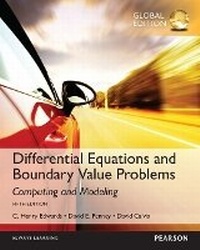
Differential Equations and Boundary Value Problems: Computing and Modeling, Global Edition
5th Edition
Published on 12. April 2016
Book
Paperback/Softback
800 pages
978-1-292-10877-3 (ISBN)
Description
For introductory courses in Differential Equations. This best-selling text by these well-known authors blends the traditional algebra problem solving skills with the conceptual development and geometric visualisation of a modern differential equations course that is essential to science and engineering students. It reflects the new qualitative approach that is altering the learning of elementary differential equations, including the wide availability of scientific computing environments like Maple, Mathematica, and MATLAB. Its focus balances the traditional manual methods with the new computer-based methods that illuminate qualitative phenomena and make accessible a wider range of more realistic applications. Seldom-used topics have been trimmed and new topics added: it starts and ends with discussions of mathematical modeling of real-world phenomena, evident in figures, examples, problems, and applications throughout the text.
More details
Edition
5th edition
Language
English
Place of publication
Harlow
United Kingdom
Target group
College/higher education
Professional and scholarly
Dimensions
Height: 248 mm
Width: 205 mm
Thickness: 48 mm
Weight
1840 gr
ISBN-13
978-1-292-10877-3 (9781292108773)
Copyright in bibliographic data and cover images is held by Nielsen Book Services Limited or by the publishers or by their respective licensors: all rights reserved.
Schweitzer Classification
Other editions
Additional editions
C. Henry Edwards | David E. Penney | David Calvis
Differential Equations and Boundary Value Problems: Computing and Modeling, Global Edition
Computing and Modeling, Global Edition
E-Book
03/2016
5th Edition
Pearson
from
€58.19
Available for download
Previous edition
C. Henry Edwards | David E. Penney
Differential Equations and Boundary Value Problems
Computing and Modeling: International Edition
Book
08/2007
4th Edition
Pearson
€156.17
Article exhausted; check for reprint
Content
1. First-Order Differential Equations
1.1 Differential Equations and Mathematical Models
1.2 Integrals as General and Particular Solutions
1.3 Slope Fields and Solution Curves
1.4 Separable Equations and Applications
1.5 Linear First-Order Equations
1.6 Substitution Methods and Exact Equations
2. Mathematical Models and Numerical Methods
2.1 Population Models
2.2 Equilibrium Solutions and Stability
2.3 Acceleration-Velocity Models
2.4 Numerical Approximation: Euler's Method
2.5 A Closer Look at the Euler Method
2.6 The Runge-Kutta Method
3. Linear Equations of Higher Order
3.1 Introduction: Second-Order Linear Equations
3.2 General Solutions of Linear Equations
3.3 Homogeneous Equations with Constant Coefcients
3.4 Mechanical Vibrations
3.5 Nonhomogeneous Equations and Undetermined Coefcients
3.6 Forced Oscillations and Resonance
3.7 Electrical Circuits
3.8 Endpoint Problems and Eigenvalues
4. Introduction to Systems of Differential Equations
4.1 First-Order Systems and Applications
4.2 The Method of Elimination
4.3 Numerical Methods for Systems
5. Linear Systems of Differential Equations
5.1 Matrices and Linear Systems
5.2 The Eigenvalue Method for Homogeneous Systems
5.3 A Gallery of Solution Curves of Linear Systems
5.4 Second-Order Systems and Mechanical Applications
5.5 Multiple Eigenvalue Solutions
5.6 Matrix Exponentials and Linear Systems
5.7 Nonhomogeneous Linear Systems
6. Nonlinear Systems and Phenomena
6.1 Stability and the Phase Plane
6.2 Linear and Almost Linear Systems
6.3 Ecological Models: Predators and Competitors
6.4 Nonlinear Mechanical Systems
6.5 Chaos in Dynamical Systems
7. Laplace Transform Methods
7.1 Laplace Transforms and Inverse Transforms
7.2 Transformation of Initial Value Problems
7.3 Translation and Partial Fractions
7.4 Derivatives, Integrals, and Products of Transforms
7.5 Periodic and Piecewise Continuous Input Functions
7.6 Impulses and Delta Functions
8. Power Series Methods
8.1 Introduction and Review of PowerSeries
8.2 Series Solutions Near Ordinary Points
8.3 Regular Singular Points
8.4 Method of Frobenius: The Exceptional Cases
8.5 Bessel's Equation
8.6 Applications of Bessel Functions
9. Fourier Series Methods and Partial Differential Equations
9.1 Periodic Functions and Trigonometric Series
9.2 General Fourier Series and Convergence
9.3 Fourier Sine and Cosine Series
9.4 Applications of Fourier Series
9.5 Heat Conduction and Separation of Variables
9.6 Vibrating Strings and the One-Dimensional Wave Equation
9.7 Steady-State Temperature and Laplace's Equation
10. Eigenvalue Methods and Boundary Value Problems
10.1 Sturm-Liouville Problems and Eigenfunction Expansions
10.2 Applications of Eigenfunction Series
10.3 Steady Periodic Solutions and Natural Frequencies
10.4 Cylindrical Coordinate Problems
10.5 Higher-Dimensional Phenomena
1.1 Differential Equations and Mathematical Models
1.2 Integrals as General and Particular Solutions
1.3 Slope Fields and Solution Curves
1.4 Separable Equations and Applications
1.5 Linear First-Order Equations
1.6 Substitution Methods and Exact Equations
2. Mathematical Models and Numerical Methods
2.1 Population Models
2.2 Equilibrium Solutions and Stability
2.3 Acceleration-Velocity Models
2.4 Numerical Approximation: Euler's Method
2.5 A Closer Look at the Euler Method
2.6 The Runge-Kutta Method
3. Linear Equations of Higher Order
3.1 Introduction: Second-Order Linear Equations
3.2 General Solutions of Linear Equations
3.3 Homogeneous Equations with Constant Coefcients
3.4 Mechanical Vibrations
3.5 Nonhomogeneous Equations and Undetermined Coefcients
3.6 Forced Oscillations and Resonance
3.7 Electrical Circuits
3.8 Endpoint Problems and Eigenvalues
4. Introduction to Systems of Differential Equations
4.1 First-Order Systems and Applications
4.2 The Method of Elimination
4.3 Numerical Methods for Systems
5. Linear Systems of Differential Equations
5.1 Matrices and Linear Systems
5.2 The Eigenvalue Method for Homogeneous Systems
5.3 A Gallery of Solution Curves of Linear Systems
5.4 Second-Order Systems and Mechanical Applications
5.5 Multiple Eigenvalue Solutions
5.6 Matrix Exponentials and Linear Systems
5.7 Nonhomogeneous Linear Systems
6. Nonlinear Systems and Phenomena
6.1 Stability and the Phase Plane
6.2 Linear and Almost Linear Systems
6.3 Ecological Models: Predators and Competitors
6.4 Nonlinear Mechanical Systems
6.5 Chaos in Dynamical Systems
7. Laplace Transform Methods
7.1 Laplace Transforms and Inverse Transforms
7.2 Transformation of Initial Value Problems
7.3 Translation and Partial Fractions
7.4 Derivatives, Integrals, and Products of Transforms
7.5 Periodic and Piecewise Continuous Input Functions
7.6 Impulses and Delta Functions
8. Power Series Methods
8.1 Introduction and Review of PowerSeries
8.2 Series Solutions Near Ordinary Points
8.3 Regular Singular Points
8.4 Method of Frobenius: The Exceptional Cases
8.5 Bessel's Equation
8.6 Applications of Bessel Functions
9. Fourier Series Methods and Partial Differential Equations
9.1 Periodic Functions and Trigonometric Series
9.2 General Fourier Series and Convergence
9.3 Fourier Sine and Cosine Series
9.4 Applications of Fourier Series
9.5 Heat Conduction and Separation of Variables
9.6 Vibrating Strings and the One-Dimensional Wave Equation
9.7 Steady-State Temperature and Laplace's Equation
10. Eigenvalue Methods and Boundary Value Problems
10.1 Sturm-Liouville Problems and Eigenfunction Expansions
10.2 Applications of Eigenfunction Series
10.3 Steady Periodic Solutions and Natural Frequencies
10.4 Cylindrical Coordinate Problems
10.5 Higher-Dimensional Phenomena