

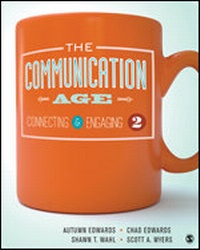
The Communication Age
Connecting and Engaging
2nd Edition
Published on 29. February 2016
Book
Paperback/Softback
520 pages
978-1-4833-7370-6 (ISBN)
Description
This best-selling book shows students how to apply key principles of effective communication - whether incorporating media, technology, or traditional face-to-face speech communication.
NEW TO THIS EDITION:
Communication Unplugged feature encourages students to put their devices down and offers practical tips for communicating without the assistance of technology when needed.
Career Frontier feature presents examples and suggestions for using communication skills to enhance career development.
Original SAGE video brings concepts to life, featuring communication skills in action, career insights from professionals, and engaging sample student speeches.
New contemporary examples and updated references throughout keep readers up-to-date with the latest scholarship and its application to everyday life.
Stronger emphasis on the "dark side" of technology shows students how negative issues can be managed and brought under control.
KEY FEATURES:
Assess Your Communication encourages students to engage in a self-inventory to prepare them for a variety of communication contexts.
Communication How To creatively directs students to apply course content to real life situations.
Make a Difference promotes student civic engagement and activism connected to chapter content.
Ethical Connection emphasizes the importance of ethical communication.
NEW TO THIS EDITION:
Communication Unplugged feature encourages students to put their devices down and offers practical tips for communicating without the assistance of technology when needed.
Career Frontier feature presents examples and suggestions for using communication skills to enhance career development.
Original SAGE video brings concepts to life, featuring communication skills in action, career insights from professionals, and engaging sample student speeches.
New contemporary examples and updated references throughout keep readers up-to-date with the latest scholarship and its application to everyday life.
Stronger emphasis on the "dark side" of technology shows students how negative issues can be managed and brought under control.
KEY FEATURES:
Assess Your Communication encourages students to engage in a self-inventory to prepare them for a variety of communication contexts.
Communication How To creatively directs students to apply course content to real life situations.
Make a Difference promotes student civic engagement and activism connected to chapter content.
Ethical Connection emphasizes the importance of ethical communication.
Reviews / Votes
"The Communication Age: Connecting and Engaging is the most accessible, user friendly introduction to speech communication currently on the market. It is truly a title that not only captures the challenge of teaching this subject but which also rises to that challenge and makes that goal attainable for 21st Century undergrads." -- Dr. Tim Chandler "This generation of students learns differently, approach life differently, and has a different set of goals than generations in the past. The whole tone and theme of this book is just that! It embraces life in the communication age and the civic-mindedness of our current students. From the relevant real life scenarios presented by the authors to the Career Frontier feature, which offers practical strategies for communication competence in the workplace, this book has been so useful for me in the classroom. It's definitely more accessible/relevant than other textbooks on the market." -- Jaime Bochantin "The Communication Age is a thought-provoking reflection of how we have arrived at a time in which traditional means of communicating are intricately intertwined with new technologies. Through the authors' modern, conversational writing style and extensive connection to current issues, the information in the text demonstrates a keen sense of understanding how to reach Millennial (Digital Native) students while also appealing to their Generation X (Digital Immigrant) professors. It is a solid base and a must read for any course that is designed to blend 21st century communication concepts with public speaking mastery." -- Deborah SheffieldMore details
Edition
2nd Revised edition
Language
English
Place of publication
Thousand Oaks
United States
Target group
College/higher education
Edition type
Revised edition
Dimensions
Height: 254 mm
Width: 203 mm
Weight
816 gr
ISBN-13
978-1-4833-7370-6 (9781483373706)
Copyright in bibliographic data and cover images is held by Nielsen Book Services Limited or by the publishers or by their respective licensors: all rights reserved.
Schweitzer Classification
Other editions
New editions
Book
approx. 04/2019
3rd Edition
SAGE Publications Inc
€124.79
Not yet published
Previous edition
Book
10/2012
1st Edition
SAGE Publications Inc
€95.52
Article exhausted; check for reprint
Persons
Autumn P. Edwards (PhD, Ohio University) is an associate professor in the School of Communication at Western Michigan University. Her scholarly interests include interpersonal communication, communication and technology, and communication theory. Her research focuses on the influence of individuals' personally held theories of communication on aspects of community life, relational health, and personal well-being. Recent published work appears in journals such as the Journal of Family Communication, Communication Studies, Health Communication, Communication Research Reports, Communication Education, and The Journal of Computer Mediated Communication and in several edited books. She is the recipient of an Outstanding Teaching Award and the Kim Giffin Research Award from the University of Kansas and was designated a Claude Kantner Research Fellow at Ohio University.
Chad Edwards (PhD, University of Kansas) is an associate professor of communication in the School of Communication at Western Michigan University. Previously, he was a Hartel Fellow at Marietta College. Chad's research interests include communication in the teacher-student relationship, human-robot interaction, and transformative communication practices. Recent publications include articles in Communication Education, Communication Research Reports, Basic Communication Course Annual, Journal on Excellence in College Teaching, and other communication and education studies journals. He serves on numerous editorial boards including that of Communication Education. He has held offices at both national and regional communication conferences and is currently the first vice president of the Central States Communication Association. In 2009, Chad received the Distinguished Teaching Award from Western Michigan University (the highest teaching award given by WMU). He also has been awarded teaching awards from the College of Arts and Sciences at Western Michigan University, the University of Kansas, and Texas Tech University. Additionally, Chad has received several top paper awards for his research. Dr. Shawn Wahl is the Founding Dean of the Judith Enyeart Reynolds College of Arts, Social Sciences, and Humanities (RCASH) and Professor of Communication at Missouri State University (MSU). Shawn's most notable accomplishment in higher education leadership is facilitating the largest scholarship and structural private eight-figure gift in university history. He has served in the Dean role since 2017 and as Department Head of Communication at MSU from 2012 to 2017. Prior to MSU, he served as the Department Head of Communication, Mass Media & Theatre at Angelo State University and as the Founding Director of Graduate Studies at Texas A&M University, Corpus Christi. Dr. Wahl was the 2016 President of the Central States Communication Association (CSCA). He has authored numerous books, including The Communication Age: Connecting and Engaging; Business and Professional Communication: KEYS for Workplace Excellence; Persuasion in Your Life; Intercultural Communication in Your Life; Public Speaking: Essentials for Excellence; Nonverbal Communication for a Lifetime; Public Relations Principles: Bridging Theory and Practice and Organizational Communication: Strategies for Success. He has published articles in Communication Education, Communication Research Reports, Communication Studies, Communication Teacher, Journal of Family Communication, and the Basic Communication Course Annual. Dr. Wahl and colleagues received the Distinguished Article Award: Instructional Development Division (IDD) National Communication Association (NCA), 2021. Shawn completed two executive leadership programs at the Harvard University Graduate School of Education, the Management Development Program (MDP, 2016), and the Institute for Educational Management (IEM, 2022). In addition, Shawn is an experienced organizational communication consultant and executive leadership coach in various industries (e.g., commodity trading, mining, oil and gas, and health care).
Scott A. Myers (PhD, Kent State University) is a professor and Peggy Rardin McConnell Chair in the Department of Communication Studies at West Virginia University (WVU) where he teaches courses in instructional communication, organizational communication, and communication pedagogy. His research interests center primarily on the student-instructor relationship in the college classroom and the adult sibling relationship, with his research appearing in outlets such as Communication Education, Journal of Family Communication, Communication Research Reports, and Communication Quarterly, among others. At WVU, he was recognized by the Eberly College of Arts and Sciences as a Woodburn Professor (2005-2007) and as an Outstanding Teacher in 2010. He is a former editor of Communication Teacher, a former executive director of the Central States Communication Association (CSCA), and a past president of CSCA.
Chad Edwards (PhD, University of Kansas) is an associate professor of communication in the School of Communication at Western Michigan University. Previously, he was a Hartel Fellow at Marietta College. Chad's research interests include communication in the teacher-student relationship, human-robot interaction, and transformative communication practices. Recent publications include articles in Communication Education, Communication Research Reports, Basic Communication Course Annual, Journal on Excellence in College Teaching, and other communication and education studies journals. He serves on numerous editorial boards including that of Communication Education. He has held offices at both national and regional communication conferences and is currently the first vice president of the Central States Communication Association. In 2009, Chad received the Distinguished Teaching Award from Western Michigan University (the highest teaching award given by WMU). He also has been awarded teaching awards from the College of Arts and Sciences at Western Michigan University, the University of Kansas, and Texas Tech University. Additionally, Chad has received several top paper awards for his research. Dr. Shawn Wahl is the Founding Dean of the Judith Enyeart Reynolds College of Arts, Social Sciences, and Humanities (RCASH) and Professor of Communication at Missouri State University (MSU). Shawn's most notable accomplishment in higher education leadership is facilitating the largest scholarship and structural private eight-figure gift in university history. He has served in the Dean role since 2017 and as Department Head of Communication at MSU from 2012 to 2017. Prior to MSU, he served as the Department Head of Communication, Mass Media & Theatre at Angelo State University and as the Founding Director of Graduate Studies at Texas A&M University, Corpus Christi. Dr. Wahl was the 2016 President of the Central States Communication Association (CSCA). He has authored numerous books, including The Communication Age: Connecting and Engaging; Business and Professional Communication: KEYS for Workplace Excellence; Persuasion in Your Life; Intercultural Communication in Your Life; Public Speaking: Essentials for Excellence; Nonverbal Communication for a Lifetime; Public Relations Principles: Bridging Theory and Practice and Organizational Communication: Strategies for Success. He has published articles in Communication Education, Communication Research Reports, Communication Studies, Communication Teacher, Journal of Family Communication, and the Basic Communication Course Annual. Dr. Wahl and colleagues received the Distinguished Article Award: Instructional Development Division (IDD) National Communication Association (NCA), 2021. Shawn completed two executive leadership programs at the Harvard University Graduate School of Education, the Management Development Program (MDP, 2016), and the Institute for Educational Management (IEM, 2022). In addition, Shawn is an experienced organizational communication consultant and executive leadership coach in various industries (e.g., commodity trading, mining, oil and gas, and health care).
Scott A. Myers (PhD, Kent State University) is a professor and Peggy Rardin McConnell Chair in the Department of Communication Studies at West Virginia University (WVU) where he teaches courses in instructional communication, organizational communication, and communication pedagogy. His research interests center primarily on the student-instructor relationship in the college classroom and the adult sibling relationship, with his research appearing in outlets such as Communication Education, Journal of Family Communication, Communication Research Reports, and Communication Quarterly, among others. At WVU, he was recognized by the Eberly College of Arts and Sciences as a Woodburn Professor (2005-2007) and as an Outstanding Teacher in 2010. He is a former editor of Communication Teacher, a former executive director of the Central States Communication Association (CSCA), and a past president of CSCA.
Content
Chapter 1: Communication in the 21st Century
The Communication Age
Benefits of Studying Communication
What Is Communication?
Contexts of Communication
Communication Metaphors
Communication Competence
Communication Ethics
Connecting and Engaging in Communication
Chapter 2: Perception, Self, and Communication
Perception and Communication
Self and Communication
Perception, Self, Communication, and Convergence
Chapter 3: Verbal Communication
Verbal Versus Nonverbal Communication
The Building Blocks of Language
Functions of Verbal Messages
Production and Interpretation of Verbal Messages
Verbal Communication and Convergence
Chapter 4: Nonverbal Communication
Why Does Nonverbal Communication Matter?
Functions of Nonverbal Communication
Codes of Nonverbal Communication
Improving Your Nonverbal Communication Skills
Nonverbal Communication and Convergence
Chapter 5: Listening
Hearing Versus Listening
Listening Problems
Benefits of Being a Good Listener
Types of Listening
Becoming a Better Listener
Listening and Convergence
Chapter 6: Communication, Culture, and Diversity
Culture and Diversity Defined
Cultural Awareness
Cultural Competence
Examples of Diversity Across Communication Contexts
Barriers to Communication, Culture, and Diversity
Communication, Culture, Diversity, and Convergence
Chapter 7: Interpersonal Communication
Forming Relationships
Models of Relationship Formation
Communication of Interpersonal Relationships
Interpersonal Communication and Convergence
Chapter 8: Small Group and Team Communication
What is Small Group Communication?
Small Group Development
Small Group Member Roles and Leadership
Small Group Conflict
Small Group and Team Communication and Convergence
Chapter 9: Workplace and Organizational Communication
What Is Workplace Communication?
Workplace Culture
Workplace Socialization
Workplace Dissent
Workplace Relationships
Workplace and Organizational Communication and Convergence
Chapter 10: Communication and New Media
Communication Traditions and Technology
New Media: Connecting and Engaging
Characteristics of New Media Theory
Presenting My Online Identity
New Media as Your Community
New Media and Convergence
Chapter 11: Selecting Your Topic and Knowing Your Audience
What Is the Purpose of Your Presentation?
Types of Presentations
How Do I Choose a Topic?
Audience Analysis
The Basics of Your Presentation
Selecting a Topic and Knowing Your Audience and Convergence
Chapter 12: Researching Your Presentation
Plagiarism
Building Credibility With Research
Finding Information
Types of Evidence
Citing Your Sources
Research and Convergence
Chapter 13: Organizing Your Presentation
Telling a Story
Organizational Patterns
Introducing the Topic
Body
Conclusion
Transitions
Outlines
Time Considerations
Organizing Your Presentation and Convergence
Chapter 14: Delivering Your Presentations
How to Reduce Your Anxiety and Fear Over Presentations
Methods of Delivery
Effective Delivery Skills
Multimedia Presentational Aids
Delivery in Presentations and Convergence
Chapter 15: Informative Presentations
The Difference Between Informative and Persuasive Presentations
Relating Your Topic to the Audience
Types of Informative Presentations
Strategies for Informative Presentations
Samples of Informative Presentations
Informative Presentations and Convergence
Chapter 16: Persuasive Presentations
Types of Persuasive Claims
Crafting Persuasive Arguments
Strategies to Persuade
Organizing Your Persuasive Presentation
Samples of Persuasive Presentations
Persuasive Presentations and Convergence
Appendix: Interviewing in the Communication Age
Basics of Interviewing
Types of Questions
Structure of the Interview
The Interview Environment
Types of Interviews
Interviewing and Convergence
The Communication Age
Benefits of Studying Communication
What Is Communication?
Contexts of Communication
Communication Metaphors
Communication Competence
Communication Ethics
Connecting and Engaging in Communication
Chapter 2: Perception, Self, and Communication
Perception and Communication
Self and Communication
Perception, Self, Communication, and Convergence
Chapter 3: Verbal Communication
Verbal Versus Nonverbal Communication
The Building Blocks of Language
Functions of Verbal Messages
Production and Interpretation of Verbal Messages
Verbal Communication and Convergence
Chapter 4: Nonverbal Communication
Why Does Nonverbal Communication Matter?
Functions of Nonverbal Communication
Codes of Nonverbal Communication
Improving Your Nonverbal Communication Skills
Nonverbal Communication and Convergence
Chapter 5: Listening
Hearing Versus Listening
Listening Problems
Benefits of Being a Good Listener
Types of Listening
Becoming a Better Listener
Listening and Convergence
Chapter 6: Communication, Culture, and Diversity
Culture and Diversity Defined
Cultural Awareness
Cultural Competence
Examples of Diversity Across Communication Contexts
Barriers to Communication, Culture, and Diversity
Communication, Culture, Diversity, and Convergence
Chapter 7: Interpersonal Communication
Forming Relationships
Models of Relationship Formation
Communication of Interpersonal Relationships
Interpersonal Communication and Convergence
Chapter 8: Small Group and Team Communication
What is Small Group Communication?
Small Group Development
Small Group Member Roles and Leadership
Small Group Conflict
Small Group and Team Communication and Convergence
Chapter 9: Workplace and Organizational Communication
What Is Workplace Communication?
Workplace Culture
Workplace Socialization
Workplace Dissent
Workplace Relationships
Workplace and Organizational Communication and Convergence
Chapter 10: Communication and New Media
Communication Traditions and Technology
New Media: Connecting and Engaging
Characteristics of New Media Theory
Presenting My Online Identity
New Media as Your Community
New Media and Convergence
Chapter 11: Selecting Your Topic and Knowing Your Audience
What Is the Purpose of Your Presentation?
Types of Presentations
How Do I Choose a Topic?
Audience Analysis
The Basics of Your Presentation
Selecting a Topic and Knowing Your Audience and Convergence
Chapter 12: Researching Your Presentation
Plagiarism
Building Credibility With Research
Finding Information
Types of Evidence
Citing Your Sources
Research and Convergence
Chapter 13: Organizing Your Presentation
Telling a Story
Organizational Patterns
Introducing the Topic
Body
Conclusion
Transitions
Outlines
Time Considerations
Organizing Your Presentation and Convergence
Chapter 14: Delivering Your Presentations
How to Reduce Your Anxiety and Fear Over Presentations
Methods of Delivery
Effective Delivery Skills
Multimedia Presentational Aids
Delivery in Presentations and Convergence
Chapter 15: Informative Presentations
The Difference Between Informative and Persuasive Presentations
Relating Your Topic to the Audience
Types of Informative Presentations
Strategies for Informative Presentations
Samples of Informative Presentations
Informative Presentations and Convergence
Chapter 16: Persuasive Presentations
Types of Persuasive Claims
Crafting Persuasive Arguments
Strategies to Persuade
Organizing Your Persuasive Presentation
Samples of Persuasive Presentations
Persuasive Presentations and Convergence
Appendix: Interviewing in the Communication Age
Basics of Interviewing
Types of Questions
Structure of the Interview
The Interview Environment
Types of Interviews
Interviewing and Convergence