

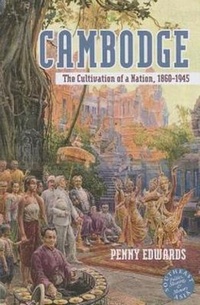
Cambodge
The Cultivation of a Nation, 1860-1945
Will be published approx. on 30. September 2008
Book
Paperback/Softback
392 pages
978-0-8248-3346-6 (ISBN)
Description
This strikingly original study of Cambodian nationalism brings to life eight turbulent decades of cultural change and sheds new light on the colonial ancestry of Pol Pot's murderous dystopia. Penny Edwards recreates the intellectual milieux and cultural traffic linking Europe and empire, interweaving analysis of key movements and ideas in the French Protectorate of Cambodge with contemporary developments in the Metropole. From the naturalist Henri Mouhot's expedition to Angkor in 1860 to the nationalist Son Ngoc Thanh's short-lived premiership in 1945, this history of ideas tracks the talented Cambodian and French men and women who shaped the contours of the modern Khmer nation. Their visions and ambitions played out within a shifting landscape of Angkorean temples, Parisian museums, Khmer printing presses, world's fairs, Buddhist monasteries, and Cambodian youth hostels. This is cross-cultural history at its best.
With its fresh take on the dynamics of colonialism and nationalism, Cambodge: The Cultivation of a Nation will become essential reading for scholars of history, politics, and society in Southeast Asia. Edwards' nuanced analysis of Buddhism and her consideration of Angkor's emergence as a national monument will be of particular interest to students of Asian and European religion, museology, heritage studies, and art history. As a highly readable guide to Cambodia's recent past, it will also appeal to specialists in modern French history, cultural studies, and colonialism, as well as readers with a general interest in Cambodia.
With its fresh take on the dynamics of colonialism and nationalism, Cambodge: The Cultivation of a Nation will become essential reading for scholars of history, politics, and society in Southeast Asia. Edwards' nuanced analysis of Buddhism and her consideration of Angkor's emergence as a national monument will be of particular interest to students of Asian and European religion, museology, heritage studies, and art history. As a highly readable guide to Cambodia's recent past, it will also appeal to specialists in modern French history, cultural studies, and colonialism, as well as readers with a general interest in Cambodia.
Reviews / Votes
"Fascinating.... Cambodge is an insightful and thought-provoking book. It is a very strong contribution to the literature on colonial South-East Asia and fills a major gap in the historiography on Cambodia. It will be necessary reading for specialists in the region, but will be a useful text for undergraduate and postgraduate courses as well. The book is especially recommended for those working on intellectual transformations in Buddhist South-East Asia in the nineteenth and twentieth centuries." - Bulletin of the School of Oriental and African Studies "Penny Edwards' Cambodge is an original and impressive tour de force of scholarly analysis. She provides a richly textured cultural genealogy of state formation in Cambodia by reassessing the impact of French colonialism on modern Khmer thought and nation building. Relying on extensive archival research, Edwards traces a complex cultural history of Angkor as the site of competing religious and political investment that not only redefined regional boundaries and imperial power relations but also determined the very notion of Khmerness." - Panivong Norindr, author of Phantasmatic Indochina: French Colonial Ideology in Architecture, Film, and Literature"More details
Series
Language
English
Place of publication
Honolulu, HI
United States
Target group
College/higher education
Professional and scholarly
Product notice
Paperback (trade)
Unsewn / adhesive bound
Illustrations
10 illustrations
Dimensions
Height: 231 mm
Width: 155 mm
Thickness: 23 mm
Weight
567 gr
ISBN-13
978-0-8248-3346-6 (9780824833466)
Copyright in bibliographic data and cover images is held by Nielsen Book Services Limited or by the publishers or by their respective licensors: all rights reserved.
Schweitzer Classification
Person
Penny Edwards is research fellow at the Centre for Cross-Cultural Research, Australian National University.