

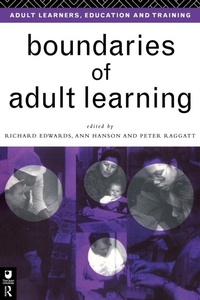
Boundaries of Adult Learning
Published on 30. November 1995
Book
Paperback/Softback
314 pages
978-0-415-13614-3 (ISBN)
Description
Until relatively recently, adult learning in the UK was largely recognised as being situated mainly within the LEA adult education centre, university extra-mural departments and the WEA. However, this picture has changed. The major change has been a shift from 'education' to 'learning' as the key organising concept. A greater range of settings are now recognised as sites producing learning, and alongside this has grown a debate about the purpose and form of study within adult learning. This has led people to question both the concept of adult learning and the boundaries of its provision.
This book reviews and assesses the changes which are taking place. It explores the disputes surrounding adult learning, discussing how boundaries have blurred thereby creating new opportunities such as APL and credit transfer, and including a significantly wider range of activities within the definition of learning. It also assesses the extent to which, despite the changes in boundaries, inequalities in learning opportunities still persist.
This book reviews and assesses the changes which are taking place. It explores the disputes surrounding adult learning, discussing how boundaries have blurred thereby creating new opportunities such as APL and credit transfer, and including a significantly wider range of activities within the definition of learning. It also assesses the extent to which, despite the changes in boundaries, inequalities in learning opportunities still persist.
Reviews / Votes
'Boundaries of Adult Learning is an excellent course book and ... offers a useful introduction to and overview of adult learning for students and others wishing to familiarise themselves with theories of adult learning, current issues and practice in the field.' - British Educational Research JournalMore details
Language
English
Place of publication
London
United Kingdom
Publishing group
Taylor & Francis Ltd
Target group
College/higher education
Professional and scholarly
Postgraduate and Professional
Dimensions
Height: 234 mm
Width: 156 mm
Thickness: 17 mm
Weight
483 gr
ISBN-13
978-0-415-13614-3 (9780415136143)
Copyright in bibliographic data and cover images is held by Nielsen Book Services Limited or by the publishers or by their respective licensors: all rights reserved.
Schweitzer Classification
Other editions
Additional editions
Richard Edwards | Ann Hanson | Peter Raggatt
Boundaries of Adult Learning
Book
11/2016
Routledge
€208.20
Shipment within 10-20 days
Richard Edwards | Ann Hanson | Peter Raggatt
Boundaries of Adult Learning
E-Book
09/2013
1st Edition
Routledge
€69.99
Available for download
Richard Edwards | Ann Hanson | Peter Raggatt
Boundaries of Adult Learning
E-Book
09/2013
1st Edition
Routledge
€69.99
Available for download
Persons
Richard Edwards, Ann Hanson, Peter Raggatt
Content
Introduction 1. From Technical Rationality to Reflection in Action D. Schon 2. Promoting Reflection in Learning: a model D. Boud, R. Keogh and D. Walker 3. On Contemporary Practice and Research: self-directed learning to critical theory M. Collins 4. Breaking the Code: engaging practitioners in critcal analysis of adult educational literature S. Brookfield 5. Andragogy: an emerging technology for adult learning M. Knowles 6. The Search for a Separate Theory of Adult Learning: does anyone really need andragogy? A. Hanson 7. Freire and a Feminist Pedagogy of Difference . Weiler 8. The British Adult Education Tradition B. Bell 9. Concepts, Organisation and Current Trends of Lifelong Education in Sweden K. Abrahamsson 10. Adult Education, the second chance: fact and fiction R. Rinne and O. Kivinen 11. Learning and Lieisure N. Sargant 12. Part-time: Whose Time? Women's Lives and Adult Learning M. Morrison 13. Outcomes, Autonomy and Adult Learners S. McNair 14. Competence and the Professions A. Gonzi and P. Hager 15. Core Skills and the Learning Society R. Harrison 16. Flexibility and Mobility in Furhter and Higher Education: policy continuity and progress and choosing to change D. Robertson