

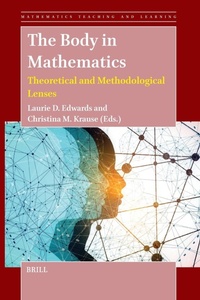
The Body in Mathematics
Theoretical and Methodological Lenses
Published on 9. January 2025
Book
Paperback/Softback
348 pages
978-90-04-71768-8 (ISBN)
Description
An embodied perspective on mathematical thinking, teaching and learning has grown from early theoretical and empirical work in the 90's to a diverse and productive collection of approaches today. The aim of this book is to survey the landscape of these approaches and to provide empirical examples of research and an in-depth analysis of the most influential perspectives on embodiment and mathematics. More particularly, the book clarifies differences and points of contact among several theoretical and methodological frameworks that all take embodiment as a core construct in understanding mathematical thinking, and illustrates in a concrete way the affordances of each of these frameworks.
Contributors are: Dor Abrahamson, Martha W. Alibali, Corey Brady, James A. Dixon, Laurie Edwards, Virginia J. Flood, Susan Gerofsky, Christina Krause, Ricardo Nemirovsky, Matthew Petersen, Luis Radford, Wolff-Michael Roth, Anna Shvarts, and Ashwin Vaidya.
Contributors are: Dor Abrahamson, Martha W. Alibali, Corey Brady, James A. Dixon, Laurie Edwards, Virginia J. Flood, Susan Gerofsky, Christina Krause, Ricardo Nemirovsky, Matthew Petersen, Luis Radford, Wolff-Michael Roth, Anna Shvarts, and Ashwin Vaidya.
More details
Series
Language
English
Place of publication
Leiden
Netherlands
Target group
Professional and scholarly
Product notice
Paperback (trade)
Unsewn / adhesive bound
Dimensions
Height: 233 mm
Width: 158 mm
Thickness: 19 mm
Weight
503 gr
ISBN-13
978-90-04-71768-8 (9789004717688)
Copyright in bibliographic data and cover images is held by Nielsen Book Services Limited or by the publishers or by their respective licensors: all rights reserved.
Schweitzer Classification
Other editions
Additional editions
Book
01/2025
Brill
€185.50
Shipment within 10-20 days
Persons
Laurie D. Edwards is Professor of Education, Emerita at Saint Mary's College of California. Her research addresses learning and cognition, embodiment, and the multiple modalities involved in doing, teaching, and learning mathematics. She is particularly interested in gesture and cognitive linguistics in mathematics.
Christina M. Krause is Assistant Professor of Mathematics Education at the University of Graz in Austria. Her research centers around the topics of language, embodiment, and multimodality in mathematics thinking and learning, integrating both individual and social perspectives, with a particular interest in understandings and practices of diversity and inclusion related to mathematics education.
Christina M. Krause is Assistant Professor of Mathematics Education at the University of Graz in Austria. Her research centers around the topics of language, embodiment, and multimodality in mathematics thinking and learning, integrating both individual and social perspectives, with a particular interest in understandings and practices of diversity and inclusion related to mathematics education.
Content
List of Figures and Tables
Notes on Contributors
1 Introduction: Locating the Body in Mathematics
?Laurie D. Edwards and Christina M. Krause
2 Bodies, Incorporeals, and the Birth of a Mathematical Diagram
?Ricardo Nemirovsky
3 Embodied Experimentation with Alberti's Window
?Corey Brady
4 Sensed Objects, Sensing Subjects: Embodiment from a Dialectical Materialist Perspective
?Luis Radford
5 Action, Attention, and Multimodal Scaffolding: A Cognitive-Developmental Perspective on Embodiment, Interaction, and Activity
?Martha W. Alibali
6 Intercorporeal Functional Dynamic System: A Dual Eye-Tracking Study of Student-Tutor Collaboration on a Mathematics Embodied Design
?Anna Shvarts and Dor Abrahamson
7 Ecological Foundations to the Creation of New Meaning
?James A. Dixon, Matthew Petersen and Ashwin Vaidya
8 Experiencing Mathematical Relationships at a Variety of Scales through Body Movement, Voice, and Touch
?Susan Gerofsky
9 Mathematical Enskilment: Embodied Apprenticeships in Mathematical Taskscapes
?Virginia J. Flood
10 Modalities, Image Schemas, and Mathematical Proof
?Laurie D. Edwards
11 Event as Minimal Unit of Analysis: A Transactional Perspective on the Role of the Body in Mathematical Cognition
?Wolff-Michael Roth
12 Discussion
?Laurie D. Edwards and Christina M. Krause
Index?329
Notes on Contributors
1 Introduction: Locating the Body in Mathematics
?Laurie D. Edwards and Christina M. Krause
2 Bodies, Incorporeals, and the Birth of a Mathematical Diagram
?Ricardo Nemirovsky
3 Embodied Experimentation with Alberti's Window
?Corey Brady
4 Sensed Objects, Sensing Subjects: Embodiment from a Dialectical Materialist Perspective
?Luis Radford
5 Action, Attention, and Multimodal Scaffolding: A Cognitive-Developmental Perspective on Embodiment, Interaction, and Activity
?Martha W. Alibali
6 Intercorporeal Functional Dynamic System: A Dual Eye-Tracking Study of Student-Tutor Collaboration on a Mathematics Embodied Design
?Anna Shvarts and Dor Abrahamson
7 Ecological Foundations to the Creation of New Meaning
?James A. Dixon, Matthew Petersen and Ashwin Vaidya
8 Experiencing Mathematical Relationships at a Variety of Scales through Body Movement, Voice, and Touch
?Susan Gerofsky
9 Mathematical Enskilment: Embodied Apprenticeships in Mathematical Taskscapes
?Virginia J. Flood
10 Modalities, Image Schemas, and Mathematical Proof
?Laurie D. Edwards
11 Event as Minimal Unit of Analysis: A Transactional Perspective on the Role of the Body in Mathematical Cognition
?Wolff-Michael Roth
12 Discussion
?Laurie D. Edwards and Christina M. Krause
Index?329