

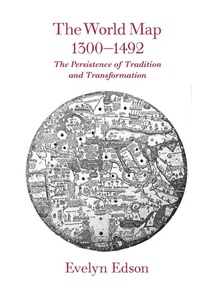
The World Map, 1300-1492
The Persistence of Tradition and Transformation
Published on 9. September 2007
Book
Paperback/Softback
312 pages
978-0-8018-8589-1 (ISBN)
Description
In the two centuries before Columbus, mapmaking was transformed. The World Map, 1300-1492 investigates this important, transitional period of mapmaking. Beginning with a 1436 atlas of ten maps produced by Venetian Andrea Bianco, Evelyn Edson uses maps of the fourteenth and fifteenth centuries to examine how the discoveries of missionaries and merchants affected the content and configuration of world maps. She finds that both the makers and users of maps struggled with changes brought about by technological innovation-the compass, quadrant, and astrolabe-rediscovery of classical mapmaking approaches, and increased travel. To reconcile the tensions between the conservative and progressive worldviews, mapmakers used a careful blend of the old and the new to depict a world that was changing-and growing-before their eyes. This engaging and informative study reveals how the ingenuity, creativity, and adaptability of these craftsmen helped pave the way for an age of discovery.
Reviews / Votes
A fine, unusual perspective of world history and cartographic influences. Midwest Book Review Attorneys who study maps either for work or pleasure - and many do - will enjoy Professor Evelyn Edson's The World Map, 1300-1492. -- Henry S. Cohn Federal Lawyer A work of thoughtful design and fascinating narrative. Choice Marvelous book. -- Tom Conley Portolan Edson has re-balanced our view of the later medieval period and in doing so has provided us with the latest scholarship in the field... The book is written in an easily accessible style and is very down to earth. -- Sarah Tyacke Journal of Economic and Social History of the Orient This study deserves a wide readership... Magisterial survey. -- Daniel Brownstein Renaissance Quarterly Throughout the work Evelyn Edson has cast her net widely, bringing under scrutiny many players, significant and lesser, who contributed to the making of maps in the two centures leading up to 1500. Her footnotes are extensive. -- Rodney Shirley Imcos Journal The book brings together current scholarship on all of the many maps it features, and the glue that holds it all together is Edson's intellectual breadth and curiosity. -- Naomi Reed Kline Speculum A comprehensive and complex picture of the changing face of medieval geography. With the mastery of a formidable palette of historiographic knowledge and well-reasoned discussions of the sources, The World Map, 1300-1492 will certainly remain an important work to consult for both medieval and early modern scholars for many years to come. -- Ian J. Aebel Terrae IncognitaeMore details
Language
English
Place of publication
Baltimore, MD
United States
Target group
Professional and scholarly
Illustrations
35 s/w Photographien bzw. Rasterbilder, 3 s/w Zeichnungen
3 Line drawings, black and white; 35 Halftones, black and white
Dimensions
Height: 234 mm
Width: 156 mm
Thickness: 19 mm
Weight
537 gr
ISBN-13
978-0-8018-8589-1 (9780801885891)
DOI
10.1353/book.3516
Copyright in bibliographic data and cover images is held by Nielsen Book Services Limited or by the publishers or by their respective licensors: all rights reserved.
Schweitzer Classification
Other editions
Additional editions
E-Book
09/2007
Johns Hopkins University Press
€41.49
Available for download
Person
Evelyn Edson recently retired as professor of history at Piedmont Virginia Community College. She is the author of Mapping Time and Space: How Medieval Mapmakers Viewed Their World.
Content
Preface
Introduction: Andrea Bianco's Three Maps
1. The World View of the Mappamundi in the Thirteenth Century
2. Marine Charts and Sailing Directions
3. Sea Chart and Mappamundi in the Fourteenth Century
4. Merchants, Missionaries, and Travel Writers
5. The Recovery of Ptolemy's Geography
6. Fra Mauro: The Debate on the Map
7. The Persistence of Tradition in Fifteenth-Century World Maps
8. The Transformation of the World Map
Conclusion: The World Map Transformed
Notes
Bibliography
Index
Introduction: Andrea Bianco's Three Maps
1. The World View of the Mappamundi in the Thirteenth Century
2. Marine Charts and Sailing Directions
3. Sea Chart and Mappamundi in the Fourteenth Century
4. Merchants, Missionaries, and Travel Writers
5. The Recovery of Ptolemy's Geography
6. Fra Mauro: The Debate on the Map
7. The Persistence of Tradition in Fifteenth-Century World Maps
8. The Transformation of the World Map
Conclusion: The World Map Transformed
Notes
Bibliography
Index