

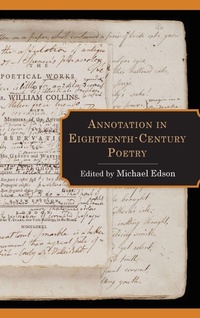
Annotation in Eighteenth-Century Poetry
Published on 18. October 2017
Book
Hardback
278 pages
978-1-61146-252-4 (ISBN)
Description
Recent years have witnessed a growing fascination with the printed annotations accompanying eighteenth-century texts. Previous studies of annotation have revealed the margins as dynamic textual spaces both shaping and shaped by diverse aesthetic, historical, and political sensibilities. Yet previous studies have also been restricted to notes by or for canonical figures; they have neglected annotation's relation to developments in reading audiences and the book trade; and they have overlooked the interaction, even tension, between prose notes and poetry, a tension reflecting eighteenth-century views of poetry as aesthetically superior to prose. Annotation in Eighteenth-Century Poetry addresses these oversights through a substantial introduction and eleven essays analyzing the printed endnotes and footnotes accompanying poems written or annotated between 1700 and 1830. Drawing on methods and critical developments in book history and print culture studies, this collection explores the functions that annotation performed on and through the printed page. By analyzing the annotation specific to poetry, these essays clarify the functions of notes among the other paratexts, including illustrations, by which scholars have mapped poetry's relation to the expanding book trade and the class-specific production of different formats. Because the reading and writing of poetry boasted social and pedagogical functions that predate the rise of the note as a print technology, studying the relation of notes to poetry also reveals how the evolving layout of the eighteenth-century book wrought significant changes not only on reading practices and reception, but on the techniques that booksellers used to make new poems, steady-sellers, and antiquarian discoveries legible to new readers. Above all, analyzing notes in poetry volumes contributes to larger inquiries into canon formation and the rise of literary studies as a discipline in the eighteenth century.
Reviews / Votes
The eleven essays in this collection and, especially, Michael Edson's introduction can sharpen the critical approaches of most readers of 18th century literature. This collection should be better known. * The Eighteenth-Century Intelligencer * [This] volume offers a persuasive brief for the scholarly need to look again at the history of verse annotation during the eighteenth century and the various roles it has played in publication history. [Michael Edson] treats the relations of footnote and endnote, of paratextual supplement and freestanding elaboration, with admirable clarity and subtlety. . . . In ranging across the history of British verse from Chaucer to Burns, the collection offers the broader literary community insight into both the history of verse annotation and also, surprisingly, the great deal that verse annotation can teach us about the history of poetic form. -- Tim Erwin, Professor of English, University of NevadaMore details
Series
Language
English
Place of publication
Cranbury
United States
Publishing group
Associated University Presses
Target group
Professional and scholarly
Illustrations
5 b/w illustrations; 4 tables
Dimensions
Height: 235 mm
Width: 157 mm
Thickness: 21 mm
Weight
609 gr
ISBN-13
978-1-61146-252-4 (9781611462524)
Copyright in bibliographic data and cover images is held by Nielsen Book Services Limited or by the publishers or by their respective licensors: all rights reserved.
Schweitzer Classification
Other editions
Additional editions
E-Book
10/2017
1st Edition
Lehigh University Press
€40.49
Available for download
Persons
Michael Edson is assistant Professor in the English department at the University of Wyoming.
Content
List of Illustrations
List of Tables
Acknowledgments
Introduction
Michael Edson
Part I: Georgic Annotation
1 Annotating Georgic Poetry
Karina Williamson and Michael Edson
2 William Falconer's The Shipwreck and the Birth of the Dictionary of the Marine
William Jones
Part II: Nationalism, Antiquarianism, and Annotation
3 The Afterlife of Annotation: How Robert of Gloucester Became the Founding Father of English Poetry
Jeff Strabone
4 Topographical Annotation in Thomas Percy's The Hermit of Warkworth and John Pinkerton's The Bruce
Thomas Van der Goten
5 Marginal Imprints: Robert Southey's Notes to Madoc
Alex Watson
Part III: Varieties of Annotation
6 A Translator's Annotation: Alexander Pope's Observations on His Iliad
David Hopkins
7 Allusion and Quotation in Chaucerian Annotation, 1687-1798
Tom Mason
8 Looking Homeward: Thomas Warton's Annotation of Milton and the Poetic Tradition
Adam Rounce
Part IV: Annotating the Canon
9 Zachary Grey's Annotations on Samuel Butler's Hudibras
Mark A. Pedreira
10 William Hymers and the Editing of William Collins's Poems, 1765-1797
Sandro Jung
11 Paratexting Beauty into Duty: Aesthetics and Morality in Late Eighteenth-Century Literary Collections
Barbara M. Benedict
Index
About the Contributors
List of Tables
Acknowledgments
Introduction
Michael Edson
Part I: Georgic Annotation
1 Annotating Georgic Poetry
Karina Williamson and Michael Edson
2 William Falconer's The Shipwreck and the Birth of the Dictionary of the Marine
William Jones
Part II: Nationalism, Antiquarianism, and Annotation
3 The Afterlife of Annotation: How Robert of Gloucester Became the Founding Father of English Poetry
Jeff Strabone
4 Topographical Annotation in Thomas Percy's The Hermit of Warkworth and John Pinkerton's The Bruce
Thomas Van der Goten
5 Marginal Imprints: Robert Southey's Notes to Madoc
Alex Watson
Part III: Varieties of Annotation
6 A Translator's Annotation: Alexander Pope's Observations on His Iliad
David Hopkins
7 Allusion and Quotation in Chaucerian Annotation, 1687-1798
Tom Mason
8 Looking Homeward: Thomas Warton's Annotation of Milton and the Poetic Tradition
Adam Rounce
Part IV: Annotating the Canon
9 Zachary Grey's Annotations on Samuel Butler's Hudibras
Mark A. Pedreira
10 William Hymers and the Editing of William Collins's Poems, 1765-1797
Sandro Jung
11 Paratexting Beauty into Duty: Aesthetics and Morality in Late Eighteenth-Century Literary Collections
Barbara M. Benedict
Index
About the Contributors