

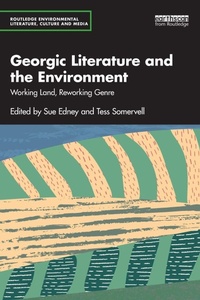
Georgic Literature and the Environment
Working Land, Reworking Genre
1st Edition
Published on 18. November 2022
Book
Paperback/Softback
252 pages
978-1-032-14825-0 (ISBN)
Description
This expansive edited collection explores in depth the georgic genre and its connections to the natural world. Together, its chapters demonstrate that georgic-a genre based primarily on two classical poems about farming, Virgil's Georgics and Hesiod's Works and Days-has been reworked by writers throughout modern and early modern English-language literary history as a way of thinking about humans' relationships with the environment.
The book is divided into three sections: Defining Georgic, Managing Nature and Eco-Georgic for the Anthropocene. It centres the georgic genre in the ecocritical conversation, giving it equal prominence with pastoral, elegy and lyric as an example of 'nature writing' that can speak to urgent environmental questions throughout literary history and up to the present day. It provides an overview of the myriad ways georgic has been reworked in order to address human relationships with the environment, through focused case studies on individual texts and authors, including James Grainger, William Wordsworth, Henry David Thoreau, George Eliot, Thomas Hardy, Seamus Heaney, Judith Wright and Rachel Blau DuPlessis.
This is a much-needed volume for literary critics, academics and students engaged in ecocritical studies, environmental humanities and literature, addressing a significantly overlooked environmental literary genre.
The book is divided into three sections: Defining Georgic, Managing Nature and Eco-Georgic for the Anthropocene. It centres the georgic genre in the ecocritical conversation, giving it equal prominence with pastoral, elegy and lyric as an example of 'nature writing' that can speak to urgent environmental questions throughout literary history and up to the present day. It provides an overview of the myriad ways georgic has been reworked in order to address human relationships with the environment, through focused case studies on individual texts and authors, including James Grainger, William Wordsworth, Henry David Thoreau, George Eliot, Thomas Hardy, Seamus Heaney, Judith Wright and Rachel Blau DuPlessis.
This is a much-needed volume for literary critics, academics and students engaged in ecocritical studies, environmental humanities and literature, addressing a significantly overlooked environmental literary genre.
Reviews / Votes
"The georgic is the genre of the Anthropocene. More than pastoral, georgic means a working countryside, humans embedded with nonhumans, sustaining without exploiting. These essays pose critical ecological questions arising from centuries of writing from Hesiod and Virgil to John Clare, Derek Jarman and Isabella Tree. Now more than ever we need the georgic to think with."Donna Landry, Emeritus Professor of English and American Literature, University of Kent, UK
More details
Series
Language
English
Place of publication
London
United Kingdom
Publishing group
Taylor & Francis Ltd
Target group
Professional and scholarly
College/higher education
Postgraduate and Undergraduate Advanced
Illustrations
5 s/w Abbildungen, 3 s/w Photographien bzw. Rasterbilder, 2 s/w Zeichnungen
2 Line drawings, black and white; 3 Halftones, black and white; 5 Illustrations, black and white
Dimensions
Height: 234 mm
Width: 156 mm
Thickness: 15 mm
Weight
415 gr
ISBN-13
978-1-032-14825-0 (9781032148250)
Copyright in bibliographic data and cover images is held by Nielsen Book Services Limited or by the publishers or by their respective licensors: all rights reserved.
Schweitzer Classification
Other editions
Additional editions
E-Book
11/2022
1st Edition
Routledge
€51.49
Available for download
Book
11/2022
1st Edition
Routledge
€185.60
Shipment within 10-20 days
E-Book
11/2022
1st Edition
Routledge
€51.49
Available for download
Persons
Sue Edney is a lecturer in English at Bristol University, UK, the Reviews Editor for Green Letters: Studies in Ecocriticism and the ecocriticism representative on the steering committee of the International Ecolinguistics Association.
Tess Somervell is Lecturer in English at Worcester College, University of Oxford, UK, and previously held a British Academy Postdoctoral Fellowship at the University of Leeds.
Tess Somervell is Lecturer in English at Worcester College, University of Oxford, UK, and previously held a British Academy Postdoctoral Fellowship at the University of Leeds.
Content
Foreword by David Fairer Introduction PART I Defining Georgic 1. What Is Georgic's Relation to Pastoral? 2. How Is Walden Georgic? 3. Middlemarch and the Georgic Novel PART II Managing Nature 4. Agrilogistics and Pest Control in Early Modern Georgic 5. James Grainger's The Sugar-Cane and Naturalists' Georgic 6. Rural Frances Burney 7. Wordsworth's Tidal Georgic 8. Wordsworth's 'Michael' and the Imperilled Georgic: Questions of Agricultural Permanence 9. Georgic Culture in Thomas Hardy's The Return of the Native: Participant Observation PART III Eco-Georgic for the Anthropocene 10. Georgic Hope in Robert Bloomfield and John Clare 11. Seamus Heaney's Elegiac and Domestic Georgics 12. The Semi-Georgic Australian Sugarcane Novel 13. Judith Wright and Virgil's Third Georgic 14. Derek Jarman's Gay Georgic 15. Georgic Reversals in Rachel Blau DuPlessis' Days and Works Afterword