

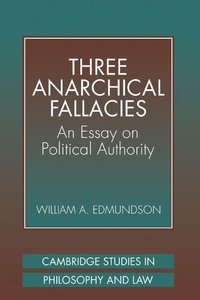
Three Anarchical Fallacies
An Essay on Political Authority
Published on 28. September 1998
Book
Hardback
206 pages
978-0-521-62454-1 (ISBN)
Description
How is a legitimate state possible? Obedience, coercion and intrusion are three ideas that seem inseparable from all government and seem to render state authority presumptively illegitimate. This book exposes three fallacies inspired by these ideas and in doing so challenges assumptions shared by liberals, libertarians, cultural conservatives, moderates and Marxists. In three clear and tightly argued essays William Edmundson dispels these fallacies and shows that living in a just state remains a worthy ideal. This is an important book for all philosophers, political scientists and legal theorists as well as other readers interested in the views of Rawls, Dworkin and Nozick, many of whose central ideas are subjected to rigorous critique.
Reviews / Votes
'The 'fallacies' in the title are three assumptions which stand as obstacles to finding a successful account of state legitimacy. Edmundson examines these assumptions in impressive detail, deploying interesting, if controversial, arguments for rejecting them.' Political StudiesMore details
Series
Language
English
Place of publication
Cambridge
United Kingdom
Target group
Professional and scholarly
Illustrations
2 Tables, unspecified
Dimensions
Height: 235 mm
Width: 157 mm
Thickness: 17 mm
Weight
493 gr
ISBN-13
978-0-521-62454-1 (9780521624541)
Copyright in bibliographic data and cover images is held by Nielsen Book Services Limited or by the publishers or by their respective licensors: all rights reserved.
Schweitzer Classification
Person
Content
Acknowledgements; Introduction; Part I. The Fallacious Argument from the Failure of Political Obligation: 1. Legitimacy and the duty to obey; 2. The correlativity thesis; 3. Legitimate political authority; Part II. The 'Law is Coercive' Fallacy: 4. The concept of coercion; 5. Political theory without coercion; 6. Coercion Redivivus; Part III. The Inner Sphere of Privacy Fallacy: 7. The private sphere; 8. The moral and the social; 9. The social and the political; Conclusion: the state for what?; Index.