

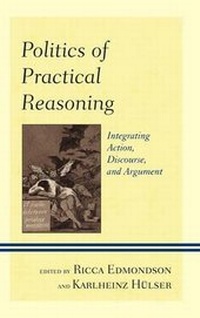
Politics of Practical Reasoning
Integrating Action, Discourse, and Argument
Published on 4. October 2012
Book
Hardback
320 pages
978-0-7391-7226-1 (ISBN)
Description
The capacity for reasonable argument about practical and political matters is important to our daily lives. Yet what does arguing really involve? Often, our very concept of what it is to argue seems systematically distorted. Practical, political arguing is too often stylized as hyper-cognitive, ending by treating people as objects rather than other selves - in ways that are fundamentally unreasonable.
This book examines what follows from seeing people as deliberating and acting in ways that intertwine a variety of emotional and evaluative processes and effects of virtue or character. From this point of view, practical arguing involves not just cognition, emotion, and virtue, but also practices, including imaginative practices. Politics of Practical Reasoning: Integrating Action, Discourse and Argument uses these ideas to interrogate ways in which reasoning is bound up with the interrelated lives that human beings lead in their everyday, public and political worlds.
We build here on efforts to re-concretize practical reasoning in modern traditions linked to phenomenology and Wittgensteinian thought, also referring back to Aristotle and the Stoics in classical times. Medieval theologians and philosophers such as Aquinas confront the same issue, as do Enlightenment thinkers such as Smith and Kant. Using the history of philosophical thought as one of our major sources, the contributors sympathize with the link underscored between interpretation, tradition and reasoning by Gadamer, the stress placed on communicative and emancipatory action by Habermas, and MacIntyre's notion of praxis as highlighting deliberation within communities. All these approaches respond to practical reasoning as practical.
Building on these points of view, the volume both explores what practical reasoning itself means, and applies it to particular questions: what it means to respond to arguments about meaningful work or disability, or how to debate institutional ethics or art. None of these debates is susceptible to exclusively cognitive or technical solutions; this does not mean abandoning them to unreason.
Practical and political reasoning is examined here from an appropriately broad spectrum of approaches, founded in a concern for what human reasoning can justifiably be expected to involve, and what justifying it can reasonably be expected to achieve.
This book examines what follows from seeing people as deliberating and acting in ways that intertwine a variety of emotional and evaluative processes and effects of virtue or character. From this point of view, practical arguing involves not just cognition, emotion, and virtue, but also practices, including imaginative practices. Politics of Practical Reasoning: Integrating Action, Discourse and Argument uses these ideas to interrogate ways in which reasoning is bound up with the interrelated lives that human beings lead in their everyday, public and political worlds.
We build here on efforts to re-concretize practical reasoning in modern traditions linked to phenomenology and Wittgensteinian thought, also referring back to Aristotle and the Stoics in classical times. Medieval theologians and philosophers such as Aquinas confront the same issue, as do Enlightenment thinkers such as Smith and Kant. Using the history of philosophical thought as one of our major sources, the contributors sympathize with the link underscored between interpretation, tradition and reasoning by Gadamer, the stress placed on communicative and emancipatory action by Habermas, and MacIntyre's notion of praxis as highlighting deliberation within communities. All these approaches respond to practical reasoning as practical.
Building on these points of view, the volume both explores what practical reasoning itself means, and applies it to particular questions: what it means to respond to arguments about meaningful work or disability, or how to debate institutional ethics or art. None of these debates is susceptible to exclusively cognitive or technical solutions; this does not mean abandoning them to unreason.
Practical and political reasoning is examined here from an appropriately broad spectrum of approaches, founded in a concern for what human reasoning can justifiably be expected to involve, and what justifying it can reasonably be expected to achieve.
Reviews / Votes
This impressive collection of essays exhibits the pragmatics of practical reasoning, as it is integrated into the rhetoric of political deliberation and argumentation. The work is historically informed: there are essays on Aristotle, the Stoics and Adam Smith, as well as on Descartes, Pascal and Rawls. The ramifications of this project - its attempts to contextualize the political implications of practical reasoning - range widely from biomedical ethics to Pollock's aesthetics. This book is a solid contribution to the growing literature on the moral and political dimensions of practical reason. -- Amelie Rorty, Boston University and Harvard Medical School This book defends a unified conception of practical reason, while illuminating in different essays a range of topics such as meaningful work, artistic creation, embodied subjectivity, disability, and deliberation in public policy and in biomedical practice. The multi-layered and versatile character of practical reasoning is elucidated by substantive historical scholarship (on Aristotle and the Stoics, Aquinas, Kant and Adam Smith) and by expert engagement with contemporary phenomenological and analytical perspectives across ethics, rhetoric, aesthetics, political philosophy and theory of argumentation. Politics of Practical Reasoning splendidly furthers the recent renaissance in the philosophy of practice and will be enthusiastically recommended reading for all serious students of the field. -- Joseph Dunne, Cregan Professor of Philosophy and Education, Dublin City University, author of Back to the Rough Ground: Practical Judgment and the Lure of TechniqueMore details
Language
English
Place of publication
United States
Publishing group
Bloomsbury Publishing Plc
Target group
College/higher education
Professional and scholarly
Illustrations
Illustrations; Tables; Black & White Illustrations
Dimensions
Height: 234 mm
Width: 158 mm
Thickness: 29 mm
Weight
612 gr
ISBN-13
978-0-7391-7226-1 (9780739172261)
Copyright in bibliographic data and cover images is held by Nielsen Book Services Limited or by the publishers or by their respective licensors: all rights reserved.
Schweitzer Classification
Other editions
Additional editions
Politics of Practical Reasoning
Integrating Action, Discourse, and Argument
E-Book
09/2012
1st Edition
Lexington Books
€49.49
Available for download
Persons
Ricca Edmondson is a lecturer in the School of Political Science and Sociology at the National University of Ireland, Galway.
Karlheinz Huelser is professor of ancient philosophy at the Universities of Jena and Konstanz.
Karlheinz Huelser is professor of ancient philosophy at the Universities of Jena and Konstanz.
Content
Introduction: Integrated Practical Reasoning
Ricca Edmondson and Karlheinz Huelser
Section 1. Fundamental Structures of Practical Reasoning
Chapter 1: Aristotle's Political Anthropology
Fran O'Rourke
Chapter 2: Pragmatics and the Idea of the Illocutionary in Stoic Language Theory
Karlheinz Huelser
Chapter 3: Utrum gratitudo sit virtus moralis vel passio animae or: Gratitude-an Aristotelian Virtue or an Emotion?
Thomas Nisters
Chapter 4: Seeing Ourselves as Others See Us: The Place of Reason in Adam Smith's Theory of Moral Sentiments
Gerard Casey
Chapter 5: Reasons to Act and Practical Reasoning
Thomas Gil
Section 2. Developing Convincing Arguments
Chapter 6: Practical Reasoning in Place: Tracing "Wise" Inferences in Everyday Life
Ricca Edmondson
Chapter 7: Toulmin's Rhetorical Logic
Frank Canovan
Chapter 8: Reason, Production, and Rival Visions of Working Life
Keith Breen
Chapter 9: Reasoning About Disability in the Light of Advances in Technology
Richard Hull
Chapter 10: Principles in Practice: Reasoning with Principles in Biomedical Ethics
Heike Felzmann
Section 3. Engagement for the Practical Unity of Life
Chapter 11: The Theory of Double Truth Revisited
Karsten Harries
Chapter 12: Philosophia sine qua non: John Rawls' transcendental-political reflections
Sebastian Lalla
Chapter 13: Sceptical Wisdom: Descartes, Pascal and the Challenge of Pyrrhonism
Felix O'Murchadha
Chapter 14: Art as "Organizer" of Life: the Case of Jackson Pollock
Elizabeth Langhorne
Afterword: Signs, Bodies, Artworks
Terry Eagleton
Ricca Edmondson and Karlheinz Huelser
Section 1. Fundamental Structures of Practical Reasoning
Chapter 1: Aristotle's Political Anthropology
Fran O'Rourke
Chapter 2: Pragmatics and the Idea of the Illocutionary in Stoic Language Theory
Karlheinz Huelser
Chapter 3: Utrum gratitudo sit virtus moralis vel passio animae or: Gratitude-an Aristotelian Virtue or an Emotion?
Thomas Nisters
Chapter 4: Seeing Ourselves as Others See Us: The Place of Reason in Adam Smith's Theory of Moral Sentiments
Gerard Casey
Chapter 5: Reasons to Act and Practical Reasoning
Thomas Gil
Section 2. Developing Convincing Arguments
Chapter 6: Practical Reasoning in Place: Tracing "Wise" Inferences in Everyday Life
Ricca Edmondson
Chapter 7: Toulmin's Rhetorical Logic
Frank Canovan
Chapter 8: Reason, Production, and Rival Visions of Working Life
Keith Breen
Chapter 9: Reasoning About Disability in the Light of Advances in Technology
Richard Hull
Chapter 10: Principles in Practice: Reasoning with Principles in Biomedical Ethics
Heike Felzmann
Section 3. Engagement for the Practical Unity of Life
Chapter 11: The Theory of Double Truth Revisited
Karsten Harries
Chapter 12: Philosophia sine qua non: John Rawls' transcendental-political reflections
Sebastian Lalla
Chapter 13: Sceptical Wisdom: Descartes, Pascal and the Challenge of Pyrrhonism
Felix O'Murchadha
Chapter 14: Art as "Organizer" of Life: the Case of Jackson Pollock
Elizabeth Langhorne
Afterword: Signs, Bodies, Artworks
Terry Eagleton