

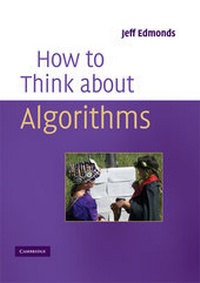
How to Think About Algorithms
Published on 19. May 2008
Book
Hardback
472 pages
978-0-521-84931-9 (ISBN)
Description
This textbook, for second- or third-year students of computer science, presents insights, notations, and analogies to help them describe and think about algorithms like an expert, without grinding through lots of formal proof. Solutions to many problems are provided to let students check their progress, while class-tested PowerPoint slides are on the web for anyone running the course. By looking at both the big picture and easy step-by-step methods for developing algorithms, the author guides students around the common pitfalls. He stresses paradigms such as loop invariants and recursion to unify a huge range of algorithms into a few meta-algorithms. The book fosters a deeper understanding of how and why each algorithm works. These insights are presented in a careful and clear way, helping students to think abstractly and preparing them for creating their own innovative ways to solve problems.
Reviews / Votes
'Reading this is like sitting at the feet of the master: it leads an apprentice from knowing how to program to understanding deep principles of algorithms.' Harold Thimbleby, The Times Higher Education Supplement '... a great book to learn how to design and create new algorithms ... a good book that the reader will appreciate in the first and subsequent reads, and it will make better developers and programmers.' Journal of Functional ProgrammingMore details
Language
English
Place of publication
Cambridge
United Kingdom
Target group
College/higher education
Illustrations
Worked examples or Exercises; 24 Tables, unspecified; 30 Halftones, unspecified; 126 Line drawings, unspecified
Dimensions
Height: 240 mm
Width: 182 mm
Thickness: 26 mm
Weight
890 gr
ISBN-13
978-0-521-84931-9 (9780521849319)
Copyright in bibliographic data and cover images is held by Nielsen Book Services Limited or by the publishers or by their respective licensors: all rights reserved.
Schweitzer Classification
Other editions
New editions
Jeff Edmonds
How to Think about Algorithms
Book
03/2024
2nd Edition
Cambridge University Press
€153.10
Shipment within 15-20 days
Additional editions
Jeff Edmonds
How to Think About Algorithms
E-Book
08/2008
1st Edition
Cambridge University Press
€42.99
Available for download
Person
Jeff Edmonds received his Ph.D. in 1992 at University of Toronto in theoretical computer science. His thesis proved that certain computation problems require a given amount of time and space. He did his postdoctorate work at the ICSI in Berkeley on secure multi-media data transmission and in 1995 became an Associate Professor in the Department of Computer Science at York University, Canada. He has taught their algorithms course thirteen times to date. He has worked extensively at IIT Mumbai, India, and University of California San Diego. He is well published in the top theoretical computer science journals in topics including complexity theory, scheduling, proof systems, probability theory, combinatorics, and, of course, algorithms.
Content
Part I. Iterative Algorithms and Loop Invariants: 1. Measures of progress and loop invariants; 2. Examples using more of the input loop invariant; 3. Abstract data types; 4. Narrowing the search space: binary search; 5. Iterative sorting algorithms; 6. Euclid's GCD algorithm; 7. The loop invariant for lower bounds; Part II. Recursion: 8. Abstractions, techniques, and theory; 9. Some simple examples of recursive algorithms; 10. Recursion on trees; 11. Recursive images; 12. Parsing with context-free grammars; Part III. Optimization Problems: 13. Definition of optimization problems; 14. Graph search algorithms; 15. Network flows and linear programming; 16. Greedy algorithms; 17. Recursive backtracking; 18. Dynamic programming algorithms; 19. Examples of dynamic programming; 20. Reductions and NP-completeness; 21. Randomized algorithms; Part IV. Appendix: 22. Existential and universal quantifiers; 23. Time complexity; 24. Logarithms and exponentials; 25. Asymptotic growth; 26. Adding made easy approximations; 27. Recurrence relations; 28. A formal proof of correctness; Part V. Exercise Solutions.