

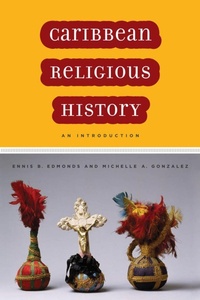
Caribbean Religious History
An Introduction
Published on 2. June 2010
Book
Hardback
270 pages
978-0-8147-2234-3 (ISBN)
Description
The colonial history of the Caribbean created a context in which many religions, from indigenous to African-based to Christian, intermingled with one another, creating a rich diversity of religious life. Caribbean Religious History offers the first comprehensive religious history of the region.
Ennis B. Edmonds and Michelle A. Gonzalez begin their exploration with the religious traditions of the Amerindians who flourished prior to contact with European colonizers, then detail the transplantation of Catholic and Protestant Christianity and their centuries of struggles to become integral to the Caribbean's religious ethos, and trace the twentieth century penetration of American Evangelical Christianity, particularly in its Pentecostal and Holiness iterations. Caribbean Religious History also illuminates the influence of Africans and their descendants on the shaping of such religious traditions as Vodou, Santeria, Revival Zion, Spiritual Baptists, and Rastafari, and the success of Indian indentured laborers and their descendants in reconstituting Hindu and Islamic practices in their new environment.
Paying careful attention to the region's social and political history, Edmonds and Gonzalez present a one-volume panoramic introduction to this religiously vibrant part of the world.
Ennis B. Edmonds and Michelle A. Gonzalez begin their exploration with the religious traditions of the Amerindians who flourished prior to contact with European colonizers, then detail the transplantation of Catholic and Protestant Christianity and their centuries of struggles to become integral to the Caribbean's religious ethos, and trace the twentieth century penetration of American Evangelical Christianity, particularly in its Pentecostal and Holiness iterations. Caribbean Religious History also illuminates the influence of Africans and their descendants on the shaping of such religious traditions as Vodou, Santeria, Revival Zion, Spiritual Baptists, and Rastafari, and the success of Indian indentured laborers and their descendants in reconstituting Hindu and Islamic practices in their new environment.
Paying careful attention to the region's social and political history, Edmonds and Gonzalez present a one-volume panoramic introduction to this religiously vibrant part of the world.
Reviews / Votes
"...Many inside the academic community and out will find much to benefit from in this well crafted volume." - Natalia M. Imperatori-Lee (Journal of the American Academy of Religion) "[Caribbean Religious History] is indispensible in the study of Caribbean religions.N. Samuel Murrell" - N. Samuel Murrell (New West Indian Guide) "In Caribbean Religious History, Edmonds and Gonzalez offer nine chapters plus a conclusion that include a refreshing consideration of Amerindian, Afro-Christian, Islamic, and Asian influences on the creation of religious cultures in the region." - Solimar Otero (Caribbean Studies) "Many inside the academic community and out will find much to benefit from in this well-crafted volume." - Natalia M. Imperatori-Lee (Journal of American Academy of Religion) "As reflecting the ongoing power of the past in the present, and as an introduction, Caribbean Religious History is very much alive and complete." - Yvonne Chireau (Church History: Studies in Christianity and Culture) "Ennis Edmonds and Michelle Gonzalez have produced an interesting and necessary addition to anyone's church history library...which is well worth reading, and which ought to inspire others to dig deeper into the areas so fascinatingly highlighted." - Rachele E. Vernon (Equinox Online) "Carefully researched and highly accessible, Caribbean Religious History: An Introduction investigates the development, emancipation, and transformation of diverse religious traditions in the region. Clearly, the most important text on Caribbean religions to appear in the last 20 years. A must read for students of religion." - Noel Leo Erskine,,author of From Garvey to Marley: Rastafari Theology "Crafted by prominent scholars and instructively organized, this splendid book provides a sophisticated account of the liveliness and resolve of indigenous as well as transcultural faiths found in the Caribbean. It will be indispensable to professors and students intrigued by the regions past, present, and future." - Darren J. N. Middleton,Texas Christian UniversityMore details
Language
English
Place of publication
New York
United States
Target group
Professional and scholarly
Product notice
Cloth over boards
Dimensions
Height: 229 mm
Width: 152 mm
Thickness: 19 mm
Weight
552 gr
ISBN-13
978-0-8147-2234-3 (9780814722343)
Copyright in bibliographic data and cover images is held by Nielsen Book Services Limited or by the publishers or by their respective licensors: all rights reserved.
Schweitzer Classification
Other editions
Additional editions
E-Book
06/2010
New York University Press
€142.99
Available for download
Persons
Ennis B. Edmonds is Associate Professor of Religious Studies at Kenyon College and author of Rastafari: From Outcasts to Culture Bearers.
Michelle A. Gonzalez is Associate Professor of Religious Studies at the University of Miami and author of Afro-Cuban Theology: Religion, Race, Culture, and Identity.
Michelle A. Gonzalez is Associate Professor of Religious Studies at the University of Miami and author of Afro-Cuban Theology: Religion, Race, Culture, and Identity.
Content
Acknowledgments 1 Introduction : Caribbean Crossroads: Historical and Theoretical Considerations 2 Amerindians and Spanish Catholics in Contact 3 Early Colonial Catholicism 4 For God and Nation: Protestantism in the Colonial Caribbean 5 Creole African Traditions: Santeria, Palo Monte, Abakua, Vodou, and Espiritismo 6 Afro-Christian Faiths: Revival Zion and Spiritual Baptists 7 Mainline and Sideline: Post-Independence Mainline Protestantism and Pentecostalism 8 Migration and Revitalization: Hinduism, Islam, and Rastafarianism 9 Legitimation, Indigenization, and Contextualization Conclusion Notes Bibliography Index About the Authors