

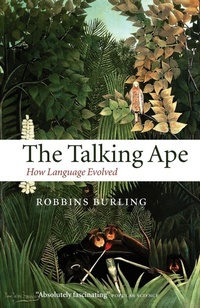
The Talking Ape
How Language Evolved
Published on 8. March 2007
Book
Paperback/Softback
304 pages
978-0-19-921403-7 (ISBN)
Description
In this fascinating, mind-opening book, Robbins Burling presents the most convincing account of the origins of language ever published. He sheds new light on how language affects the way we think, behave, and relate to each other; and he gives us a deeper understanding of the nature of language itself.
The author traces language back to its earliest origins among our distant ape-like forbears several million years ago and charts its growth to the time of our recent human ancestors. He offers a new account of the route by which we acquired our defining characteristic and explores the nature of language as it developed throughout the course of our evolution. He explains what the earliest forms of communication are likely to have been, how they worked, and why they were deployed. He examines the qualities of mind and brain needed to support the operations of language and the selective advantages they offered those able to use them. Robbins Burling investigates the first links between signs, sounds, and meanings and explores the beginnings and prehistories of vocabulary and grammar. He connects work in fields extending from linguistics, sign languages, and psychology to human paleontology, evolutionary biology, and archeology. And he does all this in a crystal-clear style, constantly enlivened by flashes of wit and humor.
The author traces language back to its earliest origins among our distant ape-like forbears several million years ago and charts its growth to the time of our recent human ancestors. He offers a new account of the route by which we acquired our defining characteristic and explores the nature of language as it developed throughout the course of our evolution. He explains what the earliest forms of communication are likely to have been, how they worked, and why they were deployed. He examines the qualities of mind and brain needed to support the operations of language and the selective advantages they offered those able to use them. Robbins Burling investigates the first links between signs, sounds, and meanings and explores the beginnings and prehistories of vocabulary and grammar. He connects work in fields extending from linguistics, sign languages, and psychology to human paleontology, evolutionary biology, and archeology. And he does all this in a crystal-clear style, constantly enlivened by flashes of wit and humor.
Reviews / Votes
Burling's book also gives full attention to an idea that has emerged in recent years * The Times Higher *More details
Series
Language
English
Place of publication
Oxford
United Kingdom
Illustrations
yes
Dimensions
Height: 198 mm
Width: 129 mm
Thickness: 16 mm
Weight
319 gr
ISBN-13
978-0-19-921403-7 (9780199214037)
Copyright in bibliographic data and cover images is held by Nielsen Book Services Limited or by the publishers or by their respective licensors: all rights reserved.
Schweitzer Classification
Other editions
Additional editions
E-Book
03/2007
OUP eBook
€9.99
Available for download
Person
Robbins Burling is Professor Emeritus of Anthropology and Linguistics at the University of Michigan. He has long been interested in language, human evolution, and comprehension in communication. He has done extensive anthropological and linguistic field research in Bangladesh and northeastern India, and written widely in both subjects. His books include Hill Farms and Padi Fields: Life in Mainland Southeast Asia, The Passage of Power: Studies in Political Succession, Man's Many Voices: Language in its Cultural Context, Sounding Right: Comprehension Based Language Instruction, Patterms of Language: Structure, Variation, Change and The Strong Women of Modhupur.
Content
1. In The Beginning ; 2. Smiles, Winks, and Words ; 3. Truths and Lies ; 4. The Mind and Language ; 5. Signs and Symbols ; 6. Icons Gained and Icons Lost ; 7. From A Few Sounds To Many Words ; 8. Syntax: Wired and Learned ; 9. Step By Step To Grammar ; 10. Power, Gossip, and Seduction ; 11. What Has Language Done To Us? ; Notes ; Glossary ; Bibliography ; Index