

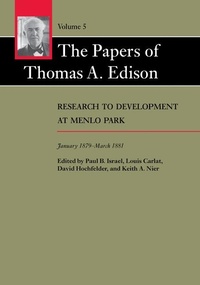
The Papers of Thomas A. Edison
Research to Development at Menlo Park, January 1879-March 1881
Published on 7. January 2005
Book
Hardback
1152 pages
978-0-8018-3104-1 (ISBN)
Description
The fifth volume of The Papers of Thomas A. Edison covers Edison's invention and development of the first commercial incandescent electric light and power system. In the process he turned his famed Menlo Park laboratory into the first true research and development facility. This also enabled him to develop a new telephone for the British market in the midst of his herculean efforts on electric lighting. In the face of daunting technical challenges and skepticism from leading scientists and engineers, Edison and his team of experimenters and machinists found the solution to the decades-old problem of creating a practical incandescent lamp. By focusing on the characteristics of the entire system Edison reconceptualized the requirements of a successful lamp design. While rivals worked primarily on lamps, Edison developed other parts of a complete system as well. This approach was most notable in his revolutionary work on generator technology, one of the highlights of this volume. Successful exhibitions of the system in December 1879 drew crowds to Menlo Park to witness the softly glowing lamps.
These spectacles gratified his financial backers but Edison realized the importance of following experimental demonstrations with the hard work of commercial development. He needed to make each component work effectively in daily use and to improve the designs so that they were easy to use and inexpensive to manufacture. To create a daytime market for electricity he also developed electric motors for a variety of uses, including electric railways, for which he built a small demonstration line at Menlo Park. To accomplish all this Edison greatly enlarged his staff to as many as sixty experimenters, machinists, carpenters, and office workers. He began manufacturing lamps at a factory in Menlo Park. At the end of 1880, Edison was ready to move his system into commercial production and made plans to produce other components in New York. He also invited New York officials to a demonstration in order to win their approval for running underground lines in lower Manhattan where he planned to put his first commercial central station.
In March 1881, he moved to the Edison Electric Light Company's headquarters on Fifth Avenue and began the hard work of introducing the new electric light and power technology.
These spectacles gratified his financial backers but Edison realized the importance of following experimental demonstrations with the hard work of commercial development. He needed to make each component work effectively in daily use and to improve the designs so that they were easy to use and inexpensive to manufacture. To create a daytime market for electricity he also developed electric motors for a variety of uses, including electric railways, for which he built a small demonstration line at Menlo Park. To accomplish all this Edison greatly enlarged his staff to as many as sixty experimenters, machinists, carpenters, and office workers. He began manufacturing lamps at a factory in Menlo Park. At the end of 1880, Edison was ready to move his system into commercial production and made plans to produce other components in New York. He also invited New York officials to a demonstration in order to win their approval for running underground lines in lower Manhattan where he planned to put his first commercial central station.
In March 1881, he moved to the Edison Electric Light Company's headquarters on Fifth Avenue and began the hard work of introducing the new electric light and power technology.
Reviews / Votes
What is most extraordinary about the collection isn't necessarily what it reveals about Edison's inventions... It's the insight into the process. -- Chris Newmarker Associated Press Those interested in America's technological culture can eagerly look forward to the appearance of each volume of the Edison Papers. Technology and Culture 2005More details
Series
Language
English
Place of publication
Baltimore, MD
United States
Target group
Professional and scholarly
College/higher education
Product notice
sewn/stitched
Cloth over boards
Illustrations
15 s/w Abbildungen, 383 s/w Zeichnungen
383 Line drawings, black and white; 15 Illustrations, black and white
Dimensions
Height: 260 mm
Width: 190 mm
Thickness: 57 mm
Weight
2318 gr
ISBN-13
978-0-8018-3104-1 (9780801831041)
DOI
10.1353/book.23823
Copyright in bibliographic data and cover images is held by Nielsen Book Services Limited or by the publishers or by their respective licensors: all rights reserved.
Schweitzer Classification
Persons
Paul B. Israel is director and editor of the Thomas A. Edison Papers Project at Rutgers University. Louis Carlat and David Hochfelder are, respectively, managing editor and assistant editor. Keith A. Nier is a former editor of the project.
Content
Calendar of Documents
List of Editorial Headnotes
Preface
Chronology of Thomas A. Edison, January 1879-March 1881
Editorial Policy and User's Guide
Editorial Symbols
List of Abbreviations
1. January-March 1879 (Docs. 1652-1717)
2. April-June 1879 (Docs. 1718-1767)
3. July-September 1879 (Docs. 1768-1813)
4. October-December 1879 (Docs. 1814-1874)
5. January-March 1880 (Docs. 1875-1923)
6. April-June 1880 (Docs. 1924-1949)
7. July-September 1880 (Docs. 1950-1993)
8. October-December 1880 (Docs. 1994-2041)
9. January-March 1881 (Docs. 2042-2073)
Appendix 1: Edison's Autobiographical Notes
Appendix 2: Menlo Park Employees, 1879-1880
Appendix 3: Edison Lamps (1879-1881) at the Henry Ford Museum & Greenfield Village
Appendix 4: Edison's U.S. Patents, January 1879-March 1881
Bibliography
Credits
Index
List of Editorial Headnotes
Preface
Chronology of Thomas A. Edison, January 1879-March 1881
Editorial Policy and User's Guide
Editorial Symbols
List of Abbreviations
1. January-March 1879 (Docs. 1652-1717)
2. April-June 1879 (Docs. 1718-1767)
3. July-September 1879 (Docs. 1768-1813)
4. October-December 1879 (Docs. 1814-1874)
5. January-March 1880 (Docs. 1875-1923)
6. April-June 1880 (Docs. 1924-1949)
7. July-September 1880 (Docs. 1950-1993)
8. October-December 1880 (Docs. 1994-2041)
9. January-March 1881 (Docs. 2042-2073)
Appendix 1: Edison's Autobiographical Notes
Appendix 2: Menlo Park Employees, 1879-1880
Appendix 3: Edison Lamps (1879-1881) at the Henry Ford Museum & Greenfield Village
Appendix 4: Edison's U.S. Patents, January 1879-March 1881
Bibliography
Credits
Index