

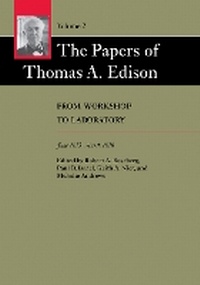
The Papers of Thomas A. Edison
From Workshop to Laboratory, June 1873-March 1876
Published on 26. February 1992
Book
Hardback
896 pages
978-0-8018-3101-0 (ISBN)
Description
The third volume of this widely acclaimed series reveals the breath-taking intensity, intellectual acumen, and vast self-confidence of twenty-nine-year-old Thomas Edison. In the depths of the 1870s depression, he moved his independent research and development laboratory from industrial Newark to pastoral Menlo Park, some fifteen miles to the south on the main line of the railroad from New York to Philadelphia. There, equipped with resources for experimental development that were extraordinary for their time, Edison and a few close associates began twenty months of research that expanded their well-established accomplishments in telegraphy into pioneering work on the telephone. Edison's ideas and techniques from telegraph message recording and the telephone next led to his invention of the phonograph, the first patent for which was filed in December 1877. This invention ultimately gave Edison a world-wide reputation--and the nickname "the wizard of Menlo Park." Praise for previous volumes of 'The Papers of Thomas A. Edison:' "The essence of the volume is Edison's technical notebooks, a window onto the inventor's workshop. His lucidity comes through everywhere...His writing and drawing come together as a single, vigorous thought process.
"--Russell McCormmach, 'New York Times.' "A mine of material...Scrupulously edited...No one could ask for more...A choplicking feast for Edison biographers--well into the next century, and perhaps beyond."--Fred Howard, 'Washington Post.' "A triumph of the bookmaker's art, with splendidly arranged illustrations, essential background information, and cautionary reminders of the common sources on which Edison's imagination drew."--David Joravsky, 'New York Review of Books.' "In the pages of this volume Edison the man, his work, and his times come alive...A delight to browse through or to read carefully."--Thomas J. Misa, 'Science.'
"--Russell McCormmach, 'New York Times.' "A mine of material...Scrupulously edited...No one could ask for more...A choplicking feast for Edison biographers--well into the next century, and perhaps beyond."--Fred Howard, 'Washington Post.' "A triumph of the bookmaker's art, with splendidly arranged illustrations, essential background information, and cautionary reminders of the common sources on which Edison's imagination drew."--David Joravsky, 'New York Review of Books.' "In the pages of this volume Edison the man, his work, and his times come alive...A delight to browse through or to read carefully."--Thomas J. Misa, 'Science.'
Reviews / Votes
"Beyond its status as 'the' resource for Edison studies, providing a near inexhaustible supply of scholarly fodder, this series, along with its microfilm counterpart, will surely become a model for such projects in the future...The sheer diversity of material offered here refreshingly transcends any exclusive restriction to Edisonia."--'British Journal for the History of Science' "As a volume that intends to interweave the scientific, technical, and business accomplishments with the more intimate life, 'The Papers of Thomas A Edison' may be recommended as a very fair and nicely written account of Edison and his time."--'Isis'More details
Series
Language
English
Place of publication
Baltimore, MD
United States
Target group
College/higher education
Professional and scholarly
Dimensions
Height: 260 mm
Width: 184 mm
Weight
2041 gr
ISBN-13
978-0-8018-3101-0 (9780801831010)
DOI
10.1353/book.26667
Copyright in bibliographic data and cover images is held by Nielsen Book Services Limited or by the publishers or by their respective licensors: all rights reserved.
Schweitzer Classification