

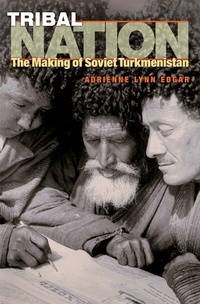
Tribal Nation
The Making of Soviet Turkmenistan
Published on 10. October 2004
Book
Hardback
320 pages
978-0-691-11775-1 (ISBN)
Description
On October 27, 1991, the Turkmen Soviet Socialist Republic declared its independence from the Soviet Union. Hammer and sickle gave way to a flag, a national anthem, and new holidays. Seven decades earlier, Turkmenistan had been a stateless conglomeration of tribes. What brought about this remarkable transformation? "Tribal Nation" addresses this question by examining the Soviet effort in the 1920s and 1930s to create a modern, socialist nation in the Central Asian Republic of Turkmenistan. Adrienne Edgar argues that the recent focus on the Soviet state as a 'maker of nations' overlooks another vital factor in Turkmen nationhood: the complex interaction between Soviet policies and indigenous notions of identity.In particular, the genealogical ideas that defined premodern Turkmen identity were reshaped by Soviet territorial and linguistic ideas of nationhood. The Soviet desire to construct socialist modernity in Turkmenistan conflicted with Moscow's policy of promoting nationhood, since many Turkmen viewed their 'backward customs' as central to Turkmen identity.
"Tribal Nation" is the first book in any Western language on Soviet Turkmenistan, the first to use both archival and indigenous-language sources to analyze Soviet nation-making in Central Asia, and among the few works to examine the Soviet multinational state from a non-Russian perspective. By investigating Soviet nation-making in one of the most poorly understood regions of the Soviet Union, it also sheds light on broader questions about nationalism and colonialism in the twentieth century.
"Tribal Nation" is the first book in any Western language on Soviet Turkmenistan, the first to use both archival and indigenous-language sources to analyze Soviet nation-making in Central Asia, and among the few works to examine the Soviet multinational state from a non-Russian perspective. By investigating Soviet nation-making in one of the most poorly understood regions of the Soviet Union, it also sheds light on broader questions about nationalism and colonialism in the twentieth century.
Reviews / Votes
This expertly written volume ... describes its shift from an obedient Soviet republic to an independent Turkmenistan with its own flag, national anthem, and problems. Choice Adrienne Lynn Edgar has filled a significant gap in the scholarship with this engaging new book on the history of Soviet Turkmenistan. There is really nothing out there quite like it. -- Michael G. Smith Slavic Review The book is one of the most important of the regional studies that are currently enhancing our knowledge of nation-building in the interwar Soviet Union. Its fluent and easy style, and Edgar's disposition not to take for granted an acquaintance with Soviet history, make it a very good introduction to Soviet nationalities policy through case study, and a book also suitable for undergraduate courses. -- Niccolo Pianciola International Review of Social History As the first English-language monograph to analyze the complexity of Turkmen life and identity within the context of Soviet policies, the book superbly reviews the compromises between the central Soviet authorities in Moscow and the European and Turkmeni communists in Central Asia. -- George O. Liber Europe: Early Modern and Modern Professor Edgar covers the period of Soviet Turkmenistan since its creation in its more constructive formative period until the time of the Great Terror. She has researched her subject admirably well and presents her discoveries in thorough yet readable detail. -- Albrecht Rothacher Asian Europe Journal One of the most exciting new works of central Asian history in recent years... This book richly illustrates the Turkmen 1920s and 1930s, but it loses none of its salience in a diagnosis of central Asian life today. An ideal length for teaching and a pleasure to take up: Edgar's book is a must-read for anyone engaged in central Asian history, ethnography, and comparative politics. -- Bruce Grant Journal of Modern HistoryMore details
Language
English
Place of publication
New Jersey
United States
Target group
Professional and scholarly
College/higher education
Product notice
Trade binding
Illustrations
3 Maps
Dimensions
Height: 229 mm
Width: 152 mm
Weight
595 gr
ISBN-13
978-0-691-11775-1 (9780691117751)
Copyright in bibliographic data and cover images is held by Nielsen Book Services Limited or by the publishers or by their respective licensors: all rights reserved.
Schweitzer Classification
Other editions
Additional editions
Book
09/2006
Princeton University Press
€35.90
Shipment within 10-20 days
E-Book
09/2006
1st Edition
Princeton University Press
€44.49
Available for download
Person
Adrienne Lynn Edgar is Associate Professor of History at the University of California, Santa Barbara. She was formerly an editor of "World Policy Journal".
Content
LIST OF MAPS AND ILLUSTRATIONS ix ACKNOWLEDGMENTS xi NOTE ON TRANSLITERATION xv INTRODUCTION Tribe, Class, and Nation in Turkmenistan 1 PART I: MAKING A NATION CHAPTER ONE Sources of Identity among the Turkmen 17 CHAPTER TWO Assembling the Nation: The Creation of a Turkmen National Republic 41 CHAPTER THREE Ethnic Preferences and Ethnic Conflict: The Rise of a Turkmen National Elite 70 CHAPTER FOUR Helpers, Not Nannies: Moscow and the Turkmen Communist Party 100 CHAPTER FIVE Dueling Dialects: The Creation of a Turkmen Language 129 PART II: CONSTRUCTING SOCIALISM CHAPTER SIX A Nation Divided: Class Struggle and the Assault on "Tribalism" 167 CHAPTER SEVEN Cotton and Collectivization: Rural Resistance in Soviet Turkmenistan 197 CHAPTER EIGHT Emancipation of the Unveiled: Turkmen Women under Soviet Rule 221 CONCLUSION From Soviet Republic to Independent Nation-State 261 GLOSSARY OF TERMS AND ABBREVIATIONS 267 BIBLIOGRAPHY 269 INDEX 287