

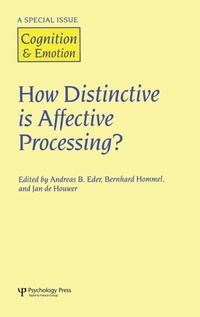
How Distinctive is Affective Processing?
A Special Issue of Cognition and Emotion
1st Edition
Published on 27. September 2007
Book
Hardback
236 pages
978-1-84169-814-4 (ISBN)
Description
Influential theories on affect and emotion propose a fundamental differentiation between emotion and cognition, and research paradigms designed to test them focus on differences rather than similarities between affective and cognitive processes. This research orientation is increasingly challenged by the widespread and successful use of cognitive research paradigms in the study of affect and emotion - a challenge with far-reaching implications. Where and on what basis do theorists draw the line between cognition and emotion, and when is it useful to do so? Should researchers build more global, integrative models of cognition and emotion, or should they rely on local, content-specific models that draw attention to a differentiation between affective and cognitive processes? This special issue compiles different viewpoints on fundamental issues in the relationship between affect and cognition.
More details
Series
Language
English
Place of publication
Hove
United Kingdom
Publishing group
Taylor & Francis Ltd
Target group
College/higher education
Dimensions
Height: 240 mm
Width: 161 mm
Thickness: 17 mm
Weight
523 gr
ISBN-13
978-1-84169-814-4 (9781841698144)
Copyright in bibliographic data and cover images is held by Nielsen Book Services Limited or by the publishers or by their respective licensors: all rights reserved.
Schweitzer Classification
Other editions
Additional editions
Andreas. B. Eder | Bernhard Hommel | Jan de Houwer
How Distinctive is Affective Processing?
A Special Issue of Cognition and Emotion
Book
06/2015
1st Edition
Psychology Press Ltd
€73.40
Shipment within 10-20 days
Persons
Andreas. B Eder, Bernhard Hommel, Jan De Houwer
Content
A.B. Eder, B. Hommel, J. De Houwer, How Distinctive is Affective Processing? On the Implications of Using Cognitive Paradigms to Study Affect and Emotion. P.J. Barnard, D.J. Duke, R.W. Byrne, I. Davidson, Differentiation in Cognitive and Emotional Meanings: An Evolutionary Analysis. S. Duncan, L. Feldman Barrett, Affect is a Form of Cognition: A Neurobiological Analysis. J. Storbeck, G.L. Clore, On the Interdependence of Cognition and Emotion. A. Moors, Can Cognitive Methods be Used to Study the Unique Aspect of Emotion: An Appraisal Theorist's Answer. T. Lavender, B. Hommel, Affect and Action: Towards an Event-coding Account. A.B. Eder, K.C. Klauer, Common Valence Coding in Action and Evaluation: Affective Blindness towards Response-Compatible Stimuli. M. Rotteveel, R.H. Phaf, Mere Exposure in Reverse: Mood and Motion Modulate Memory Bias. J.T. Cacioppo, Affective Distinctiveness: Illusory or Real?