

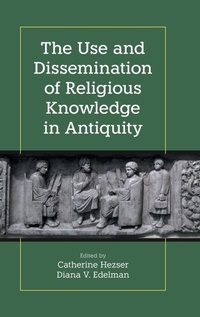
The Use and Dissemination of Religious Knowledge in Antiquity
1st Edition
Published on 31. August 2021
Book
Hardback
296 pages
978-1-78179-876-8 (ISBN)
Description
Ancient Mesopotamian, biblical, rabbinic, and Christian literature was created and transmitted by the intellectual elite and therefore presents their world views and perspectives. This volume investigates for the first time whether and to what extent religious knowledge - e.g., "sacred" narratives, customary practices, legal rules, family traditions, festival observances - was accessible to and known by ordinary people beyond religious functionaries.
Which contexts (e.g., family, synagogue and church, private and public study, communal rituals) enabled the dissemination and acquisition of religious knowledge beyond scholarly circles? In which forms other than written texts was such knowledge available and who (e.g., parents, teachers, scribes, rabbis, priests, monks) mediated it to a public that was largely illiterate? Can we assume that the majority of those who identified themselves as Jewish or Christian would have possessed a "working knowledge" of the respective religious traditions and customary practices? Would that knowledge have differed from one person to another, depending on gender, socio-economic status, religious commitment, and the general circumstances in which one lived?
This book is the first collaborative interdisciplinary study of this important subject area with chapters written by international experts on ancient Mesopotamia, the Hebrew Bible, Qumran literature, rabbinic literature, and early Christianity including apocrypha and monastic traditions.
Which contexts (e.g., family, synagogue and church, private and public study, communal rituals) enabled the dissemination and acquisition of religious knowledge beyond scholarly circles? In which forms other than written texts was such knowledge available and who (e.g., parents, teachers, scribes, rabbis, priests, monks) mediated it to a public that was largely illiterate? Can we assume that the majority of those who identified themselves as Jewish or Christian would have possessed a "working knowledge" of the respective religious traditions and customary practices? Would that knowledge have differed from one person to another, depending on gender, socio-economic status, religious commitment, and the general circumstances in which one lived?
This book is the first collaborative interdisciplinary study of this important subject area with chapters written by international experts on ancient Mesopotamia, the Hebrew Bible, Qumran literature, rabbinic literature, and early Christianity including apocrypha and monastic traditions.
More details
Language
English
Place of publication
London
United Kingdom
Target group
College/higher education
Product notice
sewn/stitched
Cloth over boards
Illustrations
2 figures
Dimensions
Height: 240 mm
Width: 161 mm
Thickness: 21 mm
Weight
614 gr
ISBN-13
978-1-78179-876-8 (9781781798768)
Copyright in bibliographic data and cover images is held by Nielsen Book Services Limited or by the publishers or by their respective licensors: all rights reserved.
Schweitzer Classification
Persons
Catherine Hezser is Professor of Jewish Studies at SOAS, University of London. Diana V. Edelman is Emeritus Professor of Hebrew Bible/Old Testament in the Faculty of Theology at the University of Oslo.
Content
Introduction: The Use and Dissemination of Religious Knowledge in Antiquity
Catherine Hezser
Part 1: Ancient Mesopotamia
1. Access to Religious Knowledge in Ancient Babylonia
Andrew George, SOAS, University of London
2. Public Lamentation in Ancient Mesopotamia
Sam Mirelman, SOAS, University of London
Part 2: Ancient and Medieval Judaism
3. Textual Strategies for Disseminating Torah Knowledge among Ordinary Jews ca. 350-200 BCE
Diana Edelman
4. The Production and Dissemination of Knowledge within the Qumran Community
David Hamidovic, University of Lausanne
5. 'If They Are Not Prophets, They Are Sons of Prophets': Folk Religion (Minhag) as a Source of Rabbinic Law
Philip Alexander, University of Manchester
6. Interaction between Rabbis and Non-Rabbinic Jews in Palestinian Rabbinic Literature of Late Antiquity
Catherine Hezser
7. Medieval Jewish Liturgy as Religious Education
Stefan C. Reif, University of Cambridge
Part 3: Early and Byzantine Christianity
8. Reading Thecla: Holy Women as Transmitters of Knowledge
Christine Amadou, University of Oslo
9. The Dissemination of Religious Knowledge through Apocrypha in Egyptian Monasteries
Hugo Lundhaug, University of Oslo
10. Religious Knowledge and Models of Authority in Sixth-Century Gaza
Jan R. Stenger, University of Glasgow
Catherine Hezser
Part 1: Ancient Mesopotamia
1. Access to Religious Knowledge in Ancient Babylonia
Andrew George, SOAS, University of London
2. Public Lamentation in Ancient Mesopotamia
Sam Mirelman, SOAS, University of London
Part 2: Ancient and Medieval Judaism
3. Textual Strategies for Disseminating Torah Knowledge among Ordinary Jews ca. 350-200 BCE
Diana Edelman
4. The Production and Dissemination of Knowledge within the Qumran Community
David Hamidovic, University of Lausanne
5. 'If They Are Not Prophets, They Are Sons of Prophets': Folk Religion (Minhag) as a Source of Rabbinic Law
Philip Alexander, University of Manchester
6. Interaction between Rabbis and Non-Rabbinic Jews in Palestinian Rabbinic Literature of Late Antiquity
Catherine Hezser
7. Medieval Jewish Liturgy as Religious Education
Stefan C. Reif, University of Cambridge
Part 3: Early and Byzantine Christianity
8. Reading Thecla: Holy Women as Transmitters of Knowledge
Christine Amadou, University of Oslo
9. The Dissemination of Religious Knowledge through Apocrypha in Egyptian Monasteries
Hugo Lundhaug, University of Oslo
10. Religious Knowledge and Models of Authority in Sixth-Century Gaza
Jan R. Stenger, University of Glasgow