

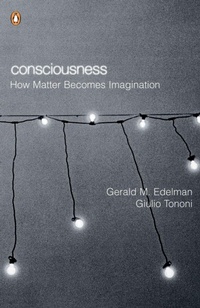
Consciousness
How Matter Becomes Imagination
Published on 26. April 2001
Book
Paperback/Softback
288 pages
978-0-14-028147-7 (ISBN)
Description
What goes on in our heads when we have a thought? With this book, Edelman and Tononi present an empirically-supported full-scale theory of consciousness. They apply all of the resources and insights of modern neuroscience, from the largest computermodels ever constructed to new experiments that detect the changes in brain activity. This pioneering work represents a landmark in our growing understanding of consciousness. Praise for Gerald Edelman: "The new Darwin...His theory is an enrichment of life itself" - Oliver Sacks, The Times
Reviews / Votes
"Praise for Gerald Edelman: "The new Darwin...His theory is an enrichment of life itself" - Oliver Sacks, The Times"More details
Language
English
Place of publication
London
United Kingdom
Product notice
Paperback (UK-B)
Dimensions
Height: 198 mm
Width: 129 mm
Thickness: 18 mm
Weight
348 gr
ISBN-13
978-0-14-028147-7 (9780140281477)
Copyright in bibliographic data and cover images is held by Nielsen Book Services Limited or by the publishers or by their respective licensors: all rights reserved.
Schweitzer Classification
Other editions
Additional editions
E-Book
11/2013
1st Edition
Penguin Books Ltd
€10.99
Available for download
Persons
Nobel Laureate Gerald M Edelman is Director of the Neurosciences Institute and President of the Neurosciences Research Foundation. He lives in California. Giulio Tononi is a Senior Fellow in Theoretical and Experimental Neurobiology at the Neurosciences Institute.
Content
Part 1 The world knot: consciousness - philosophical paradox or scientific object?; the special problem of consciousness; everyman's private theatre - ongoing unity, endless variety. Part 2 Consciousness and the brain: building a picture of the brain; consciousness and distributed neural activity; neural activity integrated and differentiated. Part 3 Mechanisms of consciousness - the Darwinian perspective: selectionism; nonrepresentational memory; perception into memory - the remembered present. Part 4 Dealing with plethora - the dynamic core hypothesis: integration and reentry; consciousness and complexity; determining where the knot is tied - the dynamic core hypothesis. Part 5 Untangling the knot: qualia and discrimination; the conscious and the unconscious. Part 6 Observer time: language and the self; thinking; prisoners of description.