

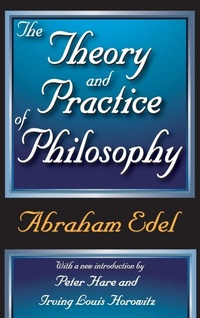
The Theory and Practice of Philosophy
1st Edition
Published on 20. September 2017
Book
Hardback
498 pages
978-1-138-53904-4 (ISBN)
Description
There is an historical element throughout philosophy. As Edel notes, this is always in the context of problems, so emphasis will fall on the major objective of reflective analysis of ideas. The major objective of Edel's analysis in The Theory and Practice of Philosophy is the fundamental interrelatedness of problems of method, metaphysics, and value. Each part is an integral whole, complete in itself.
That philosophy has this central role in human practice indicates that it should be neither discarded nor deified. This is the explicit premise of the book. Students are likely to be faced increasingly with a demand for clarification on the fundamental issues of life and value. The expectation that philosophy will provide ready-made answers to these kinds of questions is as naive as the demand for any panacea, but this task cannot be turned over to any other department of human knowledge or any other branch of social activity.
By placing emphasis on the importance of theory in matters of practice, the need for clear and systematic understanding of the world and man within it, and on the constant role of reflection in the management of human affairs, Edel seeks to shed light on the larger questions of philosophy by examining them in a systematic way. The result is a great text and tool for students and teachers that deals directly with the fundamental issues of our civilization.
That philosophy has this central role in human practice indicates that it should be neither discarded nor deified. This is the explicit premise of the book. Students are likely to be faced increasingly with a demand for clarification on the fundamental issues of life and value. The expectation that philosophy will provide ready-made answers to these kinds of questions is as naive as the demand for any panacea, but this task cannot be turned over to any other department of human knowledge or any other branch of social activity.
By placing emphasis on the importance of theory in matters of practice, the need for clear and systematic understanding of the world and man within it, and on the constant role of reflection in the management of human affairs, Edel seeks to shed light on the larger questions of philosophy by examining them in a systematic way. The result is a great text and tool for students and teachers that deals directly with the fundamental issues of our civilization.
More details
Language
English
Place of publication
London
United Kingdom
Publishing group
Taylor & Francis Ltd
Target group
College/higher education
Dimensions
Height: 235 mm
Width: 157 mm
Thickness: 31 mm
Weight
865 gr
ISBN-13
978-1-138-53904-4 (9781138539044)
Copyright in bibliographic data and cover images is held by Nielsen Book Services Limited or by the publishers or by their respective licensors: all rights reserved.
Schweitzer Classification
Other editions
Additional editions
Abraham Edel
The Theory and Practice of Philosophy
E-Book
07/2017
Routledge
€69.99
Available for download
Abraham Edel
The Theory and Practice of Philosophy
E-Book
07/2017
Routledge
€69.99
Available for download
Abraham Edel
The Theory and Practice of Philosophy
Book
01/2009
1st Edition
Routledge
€78.20
Shipment within 10-15 days
Person
Abraham Edel
Content
1: The Nature and Role of Philosophy; I: The Nature of Explanation; 2: Essence and Purpose: the Teleological Approach; 3: Causality and the Mechanistic Approach; 4: The Meaning of Law and the Nature of System; II: Empirical or Scientific Method; 5: Science and Its Method; 6: The Demand for Absolute Knowledge; 7: Testing by Experience; 8: Sense-Perception; 9: Critiques of Science; 10: Science, Truth, and Reality; III: What is a Man?; 11: Man as a Twofold Being; 12: Man as Ultimately Mental; 13: Man a Machine; 14: A Naturalistic Account of Man; 15: Problems of the Self; IV: Of Human Bondage and Human Freedom; 16: Values, Ends, and Means; 17: Freedom; 18: Liberty; 19: Techniques of Freedom and Liberty; 20: Democracy; V: The Direction of Human Affairs; 21: Materialism and Idealism; 22: Interpretation of Religion; 23: Interpretation of Art; 24: The Idealist Outlook on Human Affairs; 25: The Materialist Outlook on Human Affairs