

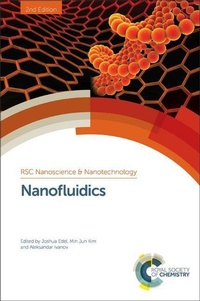
Nanofluidics
2nd Edition
Published on 18. November 2016
Book
Hardback
320 pages
978-1-84973-404-2 (ISBN)
Description
There has been significant growth in the field of nanofluidics, where nanoscale analytical instruments employ micromachined features and are able to manipulate fluid samples with high precision and efficiency and have many advantages over their conventional (larger) analogues.
The new edition of Nanofluidics has been fully revised and updated with the latest advancements and applications. With a focus on bioanalysis, specific applications are given with case studies. The end of each chapter now also features a methodology section to explain experimental protocols and "tips and tricks".
The editors draw on an international authorship and provide a handbook for the community. Written at an accessible level the book is suitable for both experts and non-experts alike.
The new edition of Nanofluidics has been fully revised and updated with the latest advancements and applications. With a focus on bioanalysis, specific applications are given with case studies. The end of each chapter now also features a methodology section to explain experimental protocols and "tips and tricks".
The editors draw on an international authorship and provide a handbook for the community. Written at an accessible level the book is suitable for both experts and non-experts alike.
Reviews / Votes
Recommended for the reader wanting to get a rapid look into a number of active research areas in nanofluidics. * Analytical and Bioanalytical Chemistry *More details
Series
Edition
2nd edition
Language
English
Place of publication
Cambridge
United Kingdom
Target group
Professional and scholarly
College/higher education
Edition type
New edition
Product notice
Unsewn / adhesive bound
Dimensions
Height: 236 mm
Width: 160 mm
Thickness: 25 mm
Weight
635 gr
ISBN-13
978-1-84973-404-2 (9781849734042)
Copyright in bibliographic data and cover images is held by Nielsen Book Services Limited or by the publishers or by their respective licensors: all rights reserved.
Schweitzer Classification
Other editions
Additional editions
Joshua Edel | Aleksandar Ivanov | Minjun Kim
Nanofluidics
E-Book
11/2016
2nd Edition
Royal Society of Chemistry
€219.99
Available for download
Joshua Edel | Aleksandar Ivanov | Minjun Kim
Nanofluidics
E-Book
11/2016
2nd Edition
Royal Society of Chemistry
€219.99
Available for download
Persons
Derek Stein was a post-doctoral research in the Molecular Biophysics group of Cees Dekker at the Delft University of Technology, where I studied the properties of DNA polymers and ionic fluids confined to nanofluidic channels (2003-2006). My Ph.D. thesis research was performed in the group of Jene Golovchenko at Harvard University, where I was involved in making the first solid state nanopores, and then using them to study individual DNA molecules. This was a joint project with the Molecular Biology group of Daniel Branton (1997-2002). After my Ph.D. I spent three months in the Life Science Technologies Laboratory at Agilent Technologies transferring nanopore technology to them by developing an industrial ion-beam-sculpting apparatus (2002).
Content
Transport of Ions, DNA Polymers, and Microtubules in the Nanofluidic Regime;
Electrokinetic Transportand Fluidic Manipulation in Three Dimensional Integrated Nanofluidic Networks;
Nanopillars, Nanowires and Nanoballs for DNA and Protein Analysis;
Nanofluidic Devices for Electroanalytical Applications;
Nanofluidic Strategies for Cancer Research;
Nanofluidics for Biomolecular Detection;
Silicon Nitride Thin Films for Nanofluidic Device Fabrication;
Single Molecule Protein Unfolding Using a Nanopore;
Low Noise Nanopore Platforms Optimised for the Synchronised Optical and Electrical Detection of Biomolecules
Electrokinetic Transportand Fluidic Manipulation in Three Dimensional Integrated Nanofluidic Networks;
Nanopillars, Nanowires and Nanoballs for DNA and Protein Analysis;
Nanofluidic Devices for Electroanalytical Applications;
Nanofluidic Strategies for Cancer Research;
Nanofluidics for Biomolecular Detection;
Silicon Nitride Thin Films for Nanofluidic Device Fabrication;
Single Molecule Protein Unfolding Using a Nanopore;
Low Noise Nanopore Platforms Optimised for the Synchronised Optical and Electrical Detection of Biomolecules