

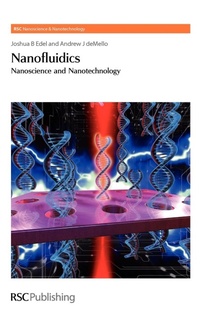
Nanofluidics
Nanoscience and Nanotechnology
Published on 3. December 2008
Book
Hardback
210 pages
978-0-85404-147-3 (ISBN)
Description
"In his now celebrated lecture at the 1959 meeting of the American Physical Society, Richard Feynman pondered the potential of miniaturization in the physical sciences. His vision, based on known technology, examined the limits set by physical principles and proposed a variety of new nano-tools including the concept of ""atom-by-atom"" fabrication. In the intervening decades, many of these predictions have become reality. In particular, the development and application of nanofluidics is becoming a competitive and exciting field of research. These nanoscale analytical instruments employ micromachined features and are able to manipulate fluid samples with high precision and efficiency. In a fundamental sense, chip-based analytical systems have been shown to have many advantages over their conventional (larger) analogues. Despite the growth of this field, there are surprisingly few books dedicated to nanofluidics. This book will fill the gap in the literature for a text focusing on bioanalytical applications. Written at a level accessible to experts and non-experts alike, it has the potential to become a mainstream text book for advanced nanobiotechnology courses within academic institutions."
More details
Series
Language
English
Place of publication
Cambridge
United Kingdom
Target group
College/higher education
Professional and scholarly
Product notice
Unsewn / adhesive bound
Dimensions
Height: 240 mm
Width: 163 mm
Thickness: 18 mm
Weight
492 gr
ISBN-13
978-0-85404-147-3 (9780854041473)
Copyright in bibliographic data and cover images is held by Nielsen Book Services Limited or by the publishers or by their respective licensors: all rights reserved.
Schweitzer Classification
Other editions
Additional editions
E-Book
12/2008
1st Edition
Royal Society of Chemistry
€168.99
Available for download
Complete work / Part of the work
Book
03/2010
Royal Society of Chemistry
€1,335.54
Article is exhausted; no reprint
Persons
"Joshua B. Edel received his PhD in physical chemistry at Imperial College London in 2004. His thesis focused on the development of single molecule detection within microfluidic systems. He then moved to Cornell University for postdoctoral training in nanobiotechnology. In 2005, Dr Edel was awarded a research fellowship at the Rowland Institute, Harvard University to study the structure and interactions of biomolecules in their native cellular environment. In July 2006, he accepted a joint lectureship at the Institute of Biomedical Engineering and the Department of Chemistry, Imperial College London. His current research focuses on the development of nanofluidic devices to further understand biophysical systems at the single molecule level. He has published 22 research articles, 13 conference proceedings, 1 book chapter and has 5 patents and patent applications to his name. Andrew J. deMello received his PhD in molecular photophysics at Imperial College London in 1995. His post-doctoral studies at the University of California, Berkeley focused on the application of microfluidic systems for DNA analysis and resulted in the first demonstration of PCR amplification, separation and detection of DNA on an integrated microchip. He has been on the faculty of the Chemistry Department at Imperial College since 1997 and now holds the Chair of Chemical Nanosciences. His research centres on miniaturized chemical analysis systems and ultra-high sensitivity detection. More generally, studies focus on performing chemistry and biology in pico- to nanoliter volumes, high-efficiency manipulation of small liquid samples and investigating novel phenomena on the micro- and nanoscale. In 2002, he was awarded the SAC Silver Medal by the Royal Society of Chemistry for his contributions to the Analytical Sciences and in 2004 became a Fellow of the Royal Society of Chemistry."
Content
"Chapter 1: Transport of Ions, DNA Polymers, and Microtubules in the Nanofluidic Regime;
Chapter 2: Biomolecule Separation, Concentration, and Detection using Nanofluidic Channels;
Chapter 3: Particle Transport in Micro and Nanostructured Arrays: Asymmetric Low Reynolds Number Flow;
Chapter 5: Fabrication of Silica Nanofluidic Tubing for Single Molecule Detection;
Chapter 6: Single Molecule Analysis Using Single Nanopores;
Chapter 7: Nanopore-Based Optofluidic Devices for Single Molecule Sensing;
Chapter 8: Ion-Current Rectification in Nanofluidic Devices;
Chapter 9: Nanopillars and Nanoballs for DNA Analysis;"
Chapter 2: Biomolecule Separation, Concentration, and Detection using Nanofluidic Channels;
Chapter 3: Particle Transport in Micro and Nanostructured Arrays: Asymmetric Low Reynolds Number Flow;
Chapter 5: Fabrication of Silica Nanofluidic Tubing for Single Molecule Detection;
Chapter 6: Single Molecule Analysis Using Single Nanopores;
Chapter 7: Nanopore-Based Optofluidic Devices for Single Molecule Sensing;
Chapter 8: Ion-Current Rectification in Nanofluidic Devices;
Chapter 9: Nanopillars and Nanoballs for DNA Analysis;"