

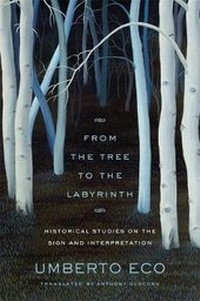
From the Tree to the Labyrinth
Historical Studies on the Sign and Interpretation
Published on 24. February 2014
Book
Hardback
640 pages
978-0-674-04918-5 (ISBN)
Description
The way we create and organize knowledge is the theme of From the Tree to the Labyrinth, a major achievement by one of the world's foremost thinkers on language and interpretation. Umberto Eco begins by arguing that our familiar system of classification by genus and species derives from the Neo-Platonist idea of a "tree of knowledge." He then moves to the idea of the dictionary, which-like a tree whose trunk anchors a great hierarchy of branching categories-orders knowledge into a matrix of definitions. In Eco's view, though, the dictionary is too rigid: it turns knowledge into a closed system. A more flexible organizational scheme is the encyclopedia, which-instead of resembling a tree with finite branches-offers a labyrinth of never-ending pathways. Presenting knowledge as a network of interlinked relationships, the encyclopedia sacrifices humankind's dream of possessing absolute knowledge, but in compensation we gain the freedom to pursue an infinity of new connections and meanings.
Moving effortlessly from analyses of Aristotle and James Joyce to the philosophical difficulties of telling dogs from cats, Eco demonstrates time and again his inimitable ability to bridge ancient, medieval, and modern modes of thought. From the Tree to the Labyrinth is a brilliant illustration of Eco's longstanding argument that problems of interpretation can be solved only in historical context.
Moving effortlessly from analyses of Aristotle and James Joyce to the philosophical difficulties of telling dogs from cats, Eco demonstrates time and again his inimitable ability to bridge ancient, medieval, and modern modes of thought. From the Tree to the Labyrinth is a brilliant illustration of Eco's longstanding argument that problems of interpretation can be solved only in historical context.
Reviews / Votes
Lush, comprehensive scholarship. * Kirkus Reviews * From the Tree to the Labyrinth is a sort of summa of one of our most important thinkers on matters of language, signification, and interpretation. It illuminates all of Umberto Eco's earlier work by providing a great deal of the historical contextualization for his arguments. It provides important and fruitful ways of thinking about the organization of knowledge and of our attitudes towards it. It intervenes in a number of debates in the philosophy of language and in linguistics. It contains a myriad of insights on medieval thinkers, Kant, and Peirce, to mention but a few. This is a book that will enjoy a wide readership. -- Wlad Godzich, University of California, Santa CruzMore details
Language
English
Place of publication
Cambridge, Mass
United States
Target group
College/higher education
Professional and scholarly
Illustrations
3 halftones, 44 line illustrations, 4 tables
Dimensions
Height: 235 mm
Width: 156 mm
Thickness: 45 mm
Weight
1129 gr
ISBN-13
978-0-674-04918-5 (9780674049185)
Copyright in bibliographic data and cover images is held by Nielsen Book Services Limited or by the publishers or by their respective licensors: all rights reserved.
Schweitzer Classification
Other editions
Additional editions
Umberto Eco
From the Tree to the Labyrinth
E-Book
02/2014
1st Edition
Harvard University Press
€44.59
Available for download
E-Book
02/2014
Harvard University Press
€66.59
Available for download
Persons
Umberto Eco (1932-2016) was an acclaimed writer, philosopher, medievalist, and semiotician. In addition to dozens of nonfiction books, he authored seven novels, including The Name of the Rose, which has been translated into more than forty languages and has sold more than fifty million copies worldwide.