

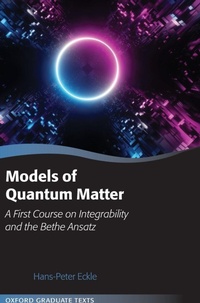
Models of Quantum Matter
A First Course on Integrability and the Bethe Ansatz
Published on 29. July 2019
Book
Hardback
732 pages
978-0-19-967883-9 (ISBN)
Description
An important task of theoretical quantum physics is the building of idealized mathematical models to describe the properties of quantum matter. This book provides an introduction to the arguably most important method for obtaining exact results for strongly interacting models of quantum matter - the Bethe ansatz. It introduces and discusses the physical concepts and mathematical tools used to construct realistic models for a variety of different fields, including condensed matter physics and quantum optics. The various forms of the Bethe ansatz - algebraic, coordinate, multicomponent, and thermodynamic Bethe ansatz, and Bethe ansatz for finite systems - are then explained in depth and employed to find exact solutions for the physical properties of the integrable forms of strongly interacting quantum systems.
The Bethe ansatz is one of the very few methodologies which can calculate physical properties non-perturbatively. Arguably, it is the only such method we have which is exact. This means, once the model has been set up, no further approximations or assumptions are necessary, and the relevant physical properties of the model can be computed exactly. Furthermore, an infinite set of conserved quantities can be obtained. The quantum mechanical model under consideration is fully integrable. This makes the search for quantum models which are amenable to an exact solution by the Bethe ansatz, and which are quantum integrable, so important and rewarding. The exact solution will provide benchmarks for other models, which do not admit an exact solution. Bethe ansatz techniques provide valuable insight into the physics of strongly correlated quantum matter.
The Bethe ansatz is one of the very few methodologies which can calculate physical properties non-perturbatively. Arguably, it is the only such method we have which is exact. This means, once the model has been set up, no further approximations or assumptions are necessary, and the relevant physical properties of the model can be computed exactly. Furthermore, an infinite set of conserved quantities can be obtained. The quantum mechanical model under consideration is fully integrable. This makes the search for quantum models which are amenable to an exact solution by the Bethe ansatz, and which are quantum integrable, so important and rewarding. The exact solution will provide benchmarks for other models, which do not admit an exact solution. Bethe ansatz techniques provide valuable insight into the physics of strongly correlated quantum matter.
More details
Series
Language
English
Place of publication
Oxford
United Kingdom
Target group
College/higher education
Illustrations
45 illustrations
Dimensions
Height: 250 mm
Width: 175 mm
Thickness: 43 mm
Weight
1420 gr
ISBN-13
978-0-19-967883-9 (9780199678839)
Copyright in bibliographic data and cover images is held by Nielsen Book Services Limited or by the publishers or by their respective licensors: all rights reserved.
Schweitzer Classification
Other editions
Additional editions

Book
approx. 07/2026
Oxford University Press
€62.00
Not yet published
E-Book
07/2019
1st Edition
OUP eBook
€116.99
Available for download
Person
Hans-Peter Eckles is Adjunct Professor at Ulm University. His research is focused on exactly solvable and integrable models of strongly interacting quantum systems, especially quantum optical models in collaboration with University of Gothenburg, Sweden. He organises and teaches at summer schools in Ireland and Turkey, and is involved with the development and teaching of courses in philosophy of science and research ethics at Ulm University and invited courses on research ethics (e.g. in Aachen, Berlin, Dresden, Freiburg, Goettingen, and Konstanz).
Previously, he has taught and conducted research in theoretical physics at Princeton University, University of Arizona, USA, Australian National University and University of New South Wales, Sydney, University, Universities of Tours and Nancy, France, University of Gothenburg, Sweden, University of Jyvaeskylae, Finland, and University of Hannover and Free University Berlin, Germany.
Previously, he has taught and conducted research in theoretical physics at Princeton University, University of Arizona, USA, Australian National University and University of New South Wales, Sydney, University, Universities of Tours and Nancy, France, University of Gothenburg, Sweden, University of Jyvaeskylae, Finland, and University of Hannover and Free University Berlin, Germany.
Content
1: Introduction
Part 1 Methods and Models in the Theory of Quantum Matter
2: Quantum Many-Particle Systems and Second Quantization
3: Angular Momentum
4: Equilibrium Statistical Mechanics
5: Phase Transitions, Critical Phenomena, and Finite-Size Scaling
6: Statistical Mechanics and Quantum Field Theory
7: Conformal Symmetry in Statistical Mechanics
8: Models of Strongly Interacting Quantum Matter
Part 2 Algebraic Bethe Ansatz
9: Ice Model
10: General Square Lattice Vertex Models
11: Six-Vertex Model
12: Quantum Tavis-Cummings Model
Part 3 Coordinate Bethe Ansatz
13: The Anisotropic Heisenberg Quantum Spin Chain
14: Bethe Ansatz for the Anisotropic Heisenberg Quantum Spin Chain
15: Bose Gas in One Dimension: Lieb-Liniger Model
Part 4 Electronic Systems: Nested Bethe Ansatz
16: Electronic Systems
Part 5 Thermodynamic Bethe Ansatz
17: Thermodynamics of the Repulsive Lieb-Liniger Model
18: Thermodynamics of the Isotropic Heisenberg Quantum Spin Chain
Part 6 Bethe Ansatz for Finite Systems
19: Mathematical Tools
20: Finite Heisenberg Quantum Spin Chain
References
Index
Part 1 Methods and Models in the Theory of Quantum Matter
2: Quantum Many-Particle Systems and Second Quantization
3: Angular Momentum
4: Equilibrium Statistical Mechanics
5: Phase Transitions, Critical Phenomena, and Finite-Size Scaling
6: Statistical Mechanics and Quantum Field Theory
7: Conformal Symmetry in Statistical Mechanics
8: Models of Strongly Interacting Quantum Matter
Part 2 Algebraic Bethe Ansatz
9: Ice Model
10: General Square Lattice Vertex Models
11: Six-Vertex Model
12: Quantum Tavis-Cummings Model
Part 3 Coordinate Bethe Ansatz
13: The Anisotropic Heisenberg Quantum Spin Chain
14: Bethe Ansatz for the Anisotropic Heisenberg Quantum Spin Chain
15: Bose Gas in One Dimension: Lieb-Liniger Model
Part 4 Electronic Systems: Nested Bethe Ansatz
16: Electronic Systems
Part 5 Thermodynamic Bethe Ansatz
17: Thermodynamics of the Repulsive Lieb-Liniger Model
18: Thermodynamics of the Isotropic Heisenberg Quantum Spin Chain
Part 6 Bethe Ansatz for Finite Systems
19: Mathematical Tools
20: Finite Heisenberg Quantum Spin Chain
References
Index