

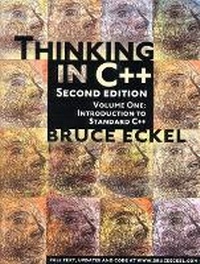
Thinking in C++
Introduction to Standard C++, Volume One
2nd Edition
Published on 19. April 2000
Book
Mixed media product
840 pages
978-0-13-979809-2 (ISBN)
Description
In the first edition of Thinking in C++, Bruce Eckel synthesized years of C++ teaching and programming experience into a beautifully structured course in making the most of the language. It became an instant classic, winning the 1995 Software Development Jolt Cola Award for best book of the year. Now, Eckel has thoroughly rewritten Thinking in C++ to reflect the final ANSI/ISO C++ standard. Every page has been revisited and rethought, with many new examples and exercises -- all designed to help you understand C++ "down to the bare metal," so you can solve virtually any problem. Eckel starts with a detailed look at objects, showing how C++ programs can be constructed from off-the-shelf object libraries. This edition includes a new, chapter-length overview of the C features that are used in C++ -- plus a new CD-ROM containing an outstanding C seminar that covers all the foundations developers need before they can truly take advantage of C++. Eckel then walks through initialization and cleanup; function overloading and default arguments; constants; inline functions; name control; references and the copy constructor; operator overloading; and more. There are chapters on dynamic object creation; inheritance and composition; polymorphism and virtual functions, and templates. (Bonus coverage of string, templates, and the Standard Template Library, can be found at Eckel's web site.) Every chapter contains many modular, to-the-point examples, plus exercises based on Eckel's extensive experience teaching C++ seminars. Put simply, Eckel has made an outstanding book on C++ even better.
Reviews / Votes
"This book is a tremendous achievement. You owe it to yourself to have a copy on your shelf. The chapter on iostreams is the most comprehensive and understandable treatment of that subject I've seen to date." - Al Stevens Contributing Editor, Doctor Dobbs Journal"Eckel's book is the only one to so clearly explain how to rethink program construction for object orientation. That the book is also an excellent tutorial on the ins and outs of C++ is an added bonus." - Andrew Binstock, Editor, Unix Review
"Bruce continues to amaze me with his insight into C++, and Thinking in C++ is his best collection of ideas yet. If you want clear answers to difficult questions about C++, buy this outstanding book." - Gary Entsminger Author, The Tao of Objects
"Thinking in C++ patiently and methodically explores the issues of when and how to use inlines, references, operator overloading, inheritance and dynamic objects, as well as advanced topics such as the proper use of templates, exceptions and multiple inheritance. The entire effort is woven in a fabric that includes Eckel's own philosophy of object and program design. A must for every C++ developer's bookshelf, Thinking in C++ is the one C++ book you must have if you're doing serious development with C++." - Richard Male Shaw Contributing Editor, PC Magazine
More details
Other editions
New editions
Book
01/2004
Pearson
€88.50
Shipment within 15-20 days
Previous edition

Person
Bruce Eckel is the author of Thinking in Java and Thinking in C++ (both from Prentice Hall). He provides C++ and Java seminars and design consulting worldwide, has published over 150 articles, was a founding member of the ANSI/ISO C++ committee, and is C++ & Java track chair for the Software Development conference.
Content
1. Introduction to Objects.
2. Making & Using Objects.
3. The C in C++.
4. Data Abstraction.
5. Hiding the Implementation.
6. Initialization & Cleanup.
7. Function Overloading & Default Arguments.
8. Constants.
9. Inline Functions.
10. Name Control.
11. References & the Copy-Constructor.
12. Operator Overloading.
13. Dynamic Object Creation.
14. Inheritance & Composition.
15. Polymorphism & Virtual Functions.
16. Introduction to Templates.
2. Making & Using Objects.
3. The C in C++.
4. Data Abstraction.
5. Hiding the Implementation.
6. Initialization & Cleanup.
7. Function Overloading & Default Arguments.
8. Constants.
9. Inline Functions.
10. Name Control.
11. References & the Copy-Constructor.
12. Operator Overloading.
13. Dynamic Object Creation.
14. Inheritance & Composition.
15. Polymorphism & Virtual Functions.
16. Introduction to Templates.