

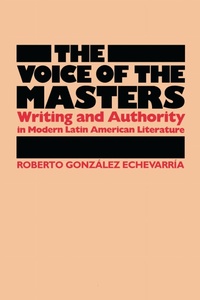
The Voice of the Masters
Writing and Authority in Modern Latin American Literature
Published on 1. September 1985
Book
Paperback/Softback
207 pages
978-0-292-78709-4 (ISBN)
Description
By one of the most original and learned critical voices in Hispanic studies- a timely and ambitious study of authority as theme and authority as authorial strategy in modern Latin American literature.
An ideology is implicit in modern Latin American literature, argues Roberto GonzAlez EchevarrIa, through which both the literature itself and criticism of it define what Latin American literature is and how it ought to be read. In the works themselves this ideology is constantly subjected to a radical critique, and that critique renders the ideology productive and in a sense is what constitutes the work. In literary criticism, however, too frequently the ideology merely serves as support for an authoritative discourse that seriously misrepresents Latin American literature.
In The Voice of the Masters, GonzAlez EchevarrIa attempts to uncover the workings of modern Latin American literature by creating a dialogue of texts, a dynamic whole whose parts are seven illuminating essays on seminal texts in the tradition. As he says, "To have written a sustained, expository book ... would have led me to make the same kind of critical error that I attribute to most criticism of Latin American literature.... I would have naively assumed an authoritative voice while attempting a critique of precisely that critical gesture."
Instead, major works by Barnet, Cabrera Infante, Carpentier, CortAzar, Fuentes, Gallegos, GarcIa MArquez, Roa Bastos, and RodO are the object of a set of independent deconstructive (and reconstructive) readings. Writing in the tradition of Derrida and de Man, GonzAlez EchevarrIa brings to these readings both the penetrative brilliance of the French master and a profound understanding of historical and cultural context. His insightful annotation of Cabrera Infante's "Meta-End," the full text of which is presented at the close of the study, clearly demonstrates these qualities and exemplifies his particular approach to the text.
An ideology is implicit in modern Latin American literature, argues Roberto GonzAlez EchevarrIa, through which both the literature itself and criticism of it define what Latin American literature is and how it ought to be read. In the works themselves this ideology is constantly subjected to a radical critique, and that critique renders the ideology productive and in a sense is what constitutes the work. In literary criticism, however, too frequently the ideology merely serves as support for an authoritative discourse that seriously misrepresents Latin American literature.
In The Voice of the Masters, GonzAlez EchevarrIa attempts to uncover the workings of modern Latin American literature by creating a dialogue of texts, a dynamic whole whose parts are seven illuminating essays on seminal texts in the tradition. As he says, "To have written a sustained, expository book ... would have led me to make the same kind of critical error that I attribute to most criticism of Latin American literature.... I would have naively assumed an authoritative voice while attempting a critique of precisely that critical gesture."
Instead, major works by Barnet, Cabrera Infante, Carpentier, CortAzar, Fuentes, Gallegos, GarcIa MArquez, Roa Bastos, and RodO are the object of a set of independent deconstructive (and reconstructive) readings. Writing in the tradition of Derrida and de Man, GonzAlez EchevarrIa brings to these readings both the penetrative brilliance of the French master and a profound understanding of historical and cultural context. His insightful annotation of Cabrera Infante's "Meta-End," the full text of which is presented at the close of the study, clearly demonstrates these qualities and exemplifies his particular approach to the text.
Reviews / Votes
. . . a challenging book for the reader, bold, innovative, and profound, as one would expect from Roberto GonzAlez EchevarrIa. (Hispanic Review) ...breaks new ground in the interpretation of Latin American literature. (World Literature Today) Language and authority may well be inseparable. Unfortunately, as these essays point out, the reality of Latin America reflects excessive abuses on both counts. The Voice of the Masters clearly reflects the need for a more pluralistic Latin American society in which divergent ideologies are allowed to be expressed without fear of native or foreign interference. (Times of the Americas)More details
Series
Language
English
Place of publication
Austin, TX
United States
Product notice
Paperback (trade)
Dimensions
Height: 229 mm
Width: 152 mm
Thickness: 12 mm
Weight
313 gr
ISBN-13
978-0-292-78709-4 (9780292787094)
Copyright in bibliographic data and cover images is held by Nielsen Book Services Limited or by the publishers or by their respective licensors: all rights reserved.
Schweitzer Classification
Person
Roberto GonzAlez EchevarrIa is the R. Seldon Rose Professor of Spanish at Yale University.
Content
Acknowledgments
Preamble
1. The Case of the Speaking Statue: Ariel and the Magisterial Rhetoric of the Latin American Essay
2. Dona Barbara Writes the Plain
3. The Dictatorship of Rhetoric/The Rhetoric of Dictatorship
4. Terra Nostra: Theory and Practice
5. Los reyes: Cortazar's Mythology of Writing
6. Biografia de un cimarron and the Novel of the Cuban Revolution
7. Literature and Exile: Carpentier's "Right of Sanctuary"
"Meta-End," by Guillermo Cabrera Infante, Translated, with an Introduction, Commentary, and Notes
Notes
Index
Preamble
1. The Case of the Speaking Statue: Ariel and the Magisterial Rhetoric of the Latin American Essay
2. Dona Barbara Writes the Plain
3. The Dictatorship of Rhetoric/The Rhetoric of Dictatorship
4. Terra Nostra: Theory and Practice
5. Los reyes: Cortazar's Mythology of Writing
6. Biografia de un cimarron and the Novel of the Cuban Revolution
7. Literature and Exile: Carpentier's "Right of Sanctuary"
"Meta-End," by Guillermo Cabrera Infante, Translated, with an Introduction, Commentary, and Notes
Notes
Index