

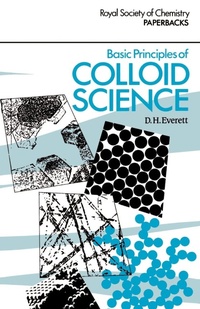
Basic Principles of Colloid Science
1st Edition
Published on 16. September 1988
Book
Paperback/Softback
270 pages
978-0-85186-443-3 (ISBN)
Description
This book provides an introduction to colloid science, based on the application of the principles of physical chemistry. Early chapters assume only an elementary knowledge of physical chemistry and provide the basis for more thorough discussion in later chapters covering specific aspects of colloid science. The widespread occurrence of colloids is stressed and the more important industrial applications of colloid technology are outlined. The final chapter deals with the future of colloid science and indicates the directions in which further developments are likely to take place. The book is ideal for undergraduate courses and, supplemented by further reading, for postgraduates too. It will also be useful to industrial research workers who wish to become familiar with the basic ideas and their many important applications to industry.
More details
Language
English
Place of publication
Cambridge
United Kingdom
Target group
College/higher education
Adult education
Product notice
Unsewn / adhesive bound
Dimensions
Height: 216 mm
Width: 142 mm
Thickness: 17 mm
Weight
325 gr
ISBN-13
978-0-85186-443-3 (9780851864433)
DOI
10.1039/9781847550200
Schweitzer Classification
Other editions
Additional editions
Douglas H. Everett
Basic Principles of Colloid Science
E-Book
10/2007
1st Edition
Royal Society of Chemistry
€20.49
Available for download
Content
Chapter 1: What are Colloids?;
Chapter 2: Why are Colloidal Dispersions Stable? Basic Principles;
Chapter 3: Why are Colloidal Dispersions Stable? Interparticle Forces;
Chapter 4: How are Colloidal Dispersions Prepared?;
Chapter 5: What is the Role of Surface Chemistry? Surface Tension and Adsorption;
Chapter 6: Some Important Properties of Colloids I Kinetic Properties;
Chapter 7: Some Important Properties of Colloids II Scattering Radiation;
Chapter 8: Some Important Properties of Colloids III Rheology;
Chapter 9: How are Colloidal Dispersions Destroyed? I Aggregation Processes;
Chapter 10: How are Colloidal Dispersions Destroyed? II Coalescence and Particle Growth;
Chapter 11: Association Colloids and Self-Assembly Systems;
Chapter 12: Thin Films, Foams and Emulsions;
Chapter 13: Gels;
Chapter 14: The Industrial Importance of Colloids;
Chapter 15: The Future of Colloid Science
Chapter 2: Why are Colloidal Dispersions Stable? Basic Principles;
Chapter 3: Why are Colloidal Dispersions Stable? Interparticle Forces;
Chapter 4: How are Colloidal Dispersions Prepared?;
Chapter 5: What is the Role of Surface Chemistry? Surface Tension and Adsorption;
Chapter 6: Some Important Properties of Colloids I Kinetic Properties;
Chapter 7: Some Important Properties of Colloids II Scattering Radiation;
Chapter 8: Some Important Properties of Colloids III Rheology;
Chapter 9: How are Colloidal Dispersions Destroyed? I Aggregation Processes;
Chapter 10: How are Colloidal Dispersions Destroyed? II Coalescence and Particle Growth;
Chapter 11: Association Colloids and Self-Assembly Systems;
Chapter 12: Thin Films, Foams and Emulsions;
Chapter 13: Gels;
Chapter 14: The Industrial Importance of Colloids;
Chapter 15: The Future of Colloid Science