

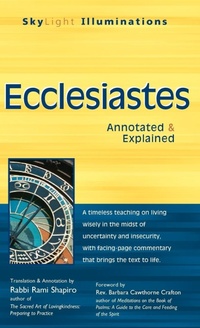
Ecclesiastes
Annotated & Explained
SkyLight Paths Publishing,US
Published on 14. October 2010
Book
Hardback
160 pages
978-1-68336-041-4 (ISBN)
Description
Koheleth's powerful guidebook for living without certainty and security in a world of constant change can become a companion for your own spiritual journey.
Twenty-three hundred years ago, an unnamed Hebrew sage known only as Koheleth, the Assembler of Wisdom, rocked the ancient Jewish world with a critique of society that shattered conventional notions of God, piety, politics and power. Koheleth lived in a world of change and challenge not unlike our own. His teachings, known as the Book of Ecclesiastes, sought to empower people not unlike ourselves, which is why this book of the Hebrew Bible still speaks to us-people of all faiths-today.
In this contemporary and accurate translation, Rami Shapiro presents the Book of Ecclesiastes as neither revelation nor prophecy but as a rational and inspirational guide to living well in the midst of uncertainty. Beginning with its opening broadside, "Havel havalim!"-not "futility" or "vanity" as most translations would have it, but "breath," "vapor" and "impermanence"-Shapiro opens up Koheleth's approach to living in a world where nothing lasts and justice is illusory; a world devoted to accumulating power, wealth, pleasure and even knowledge that leaves you drowning in anxiety and needless suffering. He shows how Koheleth's God demands neither sacrifice nor adherence to commandments, offering instead a practical lifestyle rooted in moderation, meaningful work and friendship.
Now you can experience the Book of Ecclesiastes and understand Koheleth's teachings with no previous knowledge of the Hebrew Bible. This SkyLight Illuminations edition presents insightful commentary that restores this ancient text to its timeless place as a guide to living sanely in an often insane world.
Twenty-three hundred years ago, an unnamed Hebrew sage known only as Koheleth, the Assembler of Wisdom, rocked the ancient Jewish world with a critique of society that shattered conventional notions of God, piety, politics and power. Koheleth lived in a world of change and challenge not unlike our own. His teachings, known as the Book of Ecclesiastes, sought to empower people not unlike ourselves, which is why this book of the Hebrew Bible still speaks to us-people of all faiths-today.
In this contemporary and accurate translation, Rami Shapiro presents the Book of Ecclesiastes as neither revelation nor prophecy but as a rational and inspirational guide to living well in the midst of uncertainty. Beginning with its opening broadside, "Havel havalim!"-not "futility" or "vanity" as most translations would have it, but "breath," "vapor" and "impermanence"-Shapiro opens up Koheleth's approach to living in a world where nothing lasts and justice is illusory; a world devoted to accumulating power, wealth, pleasure and even knowledge that leaves you drowning in anxiety and needless suffering. He shows how Koheleth's God demands neither sacrifice nor adherence to commandments, offering instead a practical lifestyle rooted in moderation, meaningful work and friendship.
Now you can experience the Book of Ecclesiastes and understand Koheleth's teachings with no previous knowledge of the Hebrew Bible. This SkyLight Illuminations edition presents insightful commentary that restores this ancient text to its timeless place as a guide to living sanely in an often insane world.
Reviews / Votes
Rabbi Rami Shapiro is a gifted translator and teacher and provides a text that is clear and easy to understand. In his extensive preface he clearly outlines his own presuppositions and his approach to the text of Ecclesiastes. Heavily influenced by Buddhism, he understands the references to "God" in the text as referring to nature or the way things are "under the sun." He tempers his views by noting his understanding that the author is writing for people of all faiths and backgrounds. The book also includes a foreword by Rev. Barbara Cawthorne Crafton.Shapiro's notes compare the text of Ecclesiastes with Pirke Avot, as well as with the classic wisdom literature of other religions, and of classical philosophy. According to Rabbi Shapiro, Ecclesiastes is the one book of the Hebrew Bible that speaks to those who may be alienated from traditional religion. The text never uses the Tetragrammaton, and does not discuss devotional practices or life after death. It hews to a simple but thought provoking message that says that the key to a happy and well lived life is to eat and drink simply and moderately, to find good and satisfying work and to cultivate a few close relationships. Rabbi Shapiro emphasizes this point over and over again in his comments.
Not all will agree with all of his interpretations and conclusions. Nonetheless Rabbi Shapiro's book is a serious, well thought out, and well written contribution to a perplexing part of the Hebrew Bible. His work deserves to be included in all collections devoted to Biblical Studies and Jewish thought, and is appropriate for all adult students of the Bible whether in academia or in the general community. * Association of Jewish Libraries *
More details
Series
Language
English
Place of publication
Woodstock
United States
Publishing group
Jewish Lights Publishing
Product notice
Laminated cover
Dimensions
Height: 222 mm
Width: 145 mm
Thickness: 12 mm
Weight
339 gr
ISBN-13
978-1-68336-041-4 (9781683360414)
Copyright in bibliographic data and cover images is held by Nielsen Book Services Limited or by the publishers or by their respective licensors: all rights reserved.
Schweitzer Classification
Other editions
Additional editions
Ecclesiastes
Annotated & Explained
E-Book
11/2010
1st Edition
SkyLight Paths
€16.49
Available for download
Persons
Rami Shapiro, a renowned teacher of spirituality across faith traditions, is an award-winning storyteller, poet and essayist. He is author of The Sacred Art of Lovingkindness: Preparing to Practice, Recovery-The Sacred Art: The Twelve Steps as Spiritual Practice and The Divine Feminine in Biblical Wisdom Literature: Selections Annotated & Explained (all SkyLight Paths), among other books.
Rami Shapiro is available to speak on the following topics:
Writing-The Sacred Art: Beyond the Page to Spiritual Practice
Stop Playing God: 12 Steps as Spiritual Practice
Biblical Wisdom for Post-biblical Times: An Exploration of Proverbs, Ecclesiastes and Job
The Sacred Art of Lovingkindness: Cultivating Compassion in Daily Life
Hasidic Wisdom: An Exploration of Hasidic Storytelling, Theology and Contemplative Practice
Saints and Sages: Biblical Prophets, Ancient Rabbis and the Building of a Just World
Rev. Barbara Cawthorne Craftonis an Episcopal priest and the author of many books. She heads The Geranium Farm, an online institute for the encouragement of spiritual growth.
Rami Shapiro is available to speak on the following topics:
Writing-The Sacred Art: Beyond the Page to Spiritual Practice
Stop Playing God: 12 Steps as Spiritual Practice
Biblical Wisdom for Post-biblical Times: An Exploration of Proverbs, Ecclesiastes and Job
The Sacred Art of Lovingkindness: Cultivating Compassion in Daily Life
Hasidic Wisdom: An Exploration of Hasidic Storytelling, Theology and Contemplative Practice
Saints and Sages: Biblical Prophets, Ancient Rabbis and the Building of a Just World
Rev. Barbara Cawthorne Craftonis an Episcopal priest and the author of many books. She heads The Geranium Farm, an online institute for the encouragement of spiritual growth.
Content
Foreword vii
Preface ix
Introduction xv
About the Translation xxvii
Chapter One 3
Chapter Two 13
Chapter Three 27
Chapter Four 39
Chapter Five 47
Chapter Six 55
Chapter Seven 61
Chapter Eight 73
Chapter Nine 81
Chapter Ten 91
Chapter Eleven 99
Chapter Twelve 105
Epilogue (Chapter Twelve, Continued) 109
Bibliography 113
Preface ix
Introduction xv
About the Translation xxvii
Chapter One 3
Chapter Two 13
Chapter Three 27
Chapter Four 39
Chapter Five 47
Chapter Six 55
Chapter Seven 61
Chapter Eight 73
Chapter Nine 81
Chapter Ten 91
Chapter Eleven 99
Chapter Twelve 105
Epilogue (Chapter Twelve, Continued) 109
Bibliography 113