

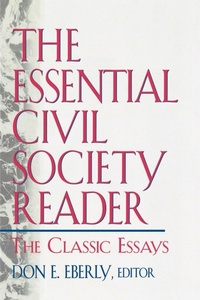
The Essential Civil Society Reader
The Classic Essays
Published on 5. July 2000
Book
Paperback/Softback
424 pages
978-0-8476-9719-9 (ISBN)
Description
There is a growing anxiety about the basic health of society. Everywhere we see the fraying of the social fabric, the decline of families, the absence of consensus on unifying moral principles, and the disappearance of community and voluntary associations. Around the world, politicians and intellectuals of all political persuasions seek to restore civil society by cultivating stronger public ethics and social institutions. In The Essential Civil Society Reader Don Eberly, one of the nation's leading civil society theorists and activists, presents the classic writings of the leading scholars and organizers who have brought the civil society debate to the forefront of American politics. The future of democracy depends on a strong civil society, and this book tells readers how we can achieve it.
Reviews / Votes
The revival of scholarly and public policy interest in the 'institutions of civil society' is one of the more encouraging intellectual and social movements of the past decade. Still, much work needs to be done to clarify the normative tasks and limits of these institutions and to try to explain how they should properly relate to government, individual citizens, the market, and to each other. This collection of essays helps set the stage for the next round in the "civil society debate. -- Keith J. Pavlischek, Fellow, Center for Public Justice Few know more or care more about civil society than Don Eberly, so it's not surprising that he has gathered in this book one of the finest collections of essays available on the subject. You'll agree with some, disagree with others, and learn from them all. -- E. J. Dionne Jr., syndicated columnist and editor of Community Works: The Revival of Civil Society in America Emily Dickinson called poetry the best words in the best order. These essays are the poetry of our national conversation on civil society. If you want an accessible, everything-under-one-roof introduction to our current social condition, you will not find a better book. -- David Blankenhorn, president of the Institute for American Values and co-chair of the Council on Civil SocietyMore details
Language
English
Place of publication
United States
Publishing group
Bloomsbury Publishing Plc
Target group
College/higher education
Product notice
Paperback (trade)
Dimensions
Height: 229 mm
Width: 152 mm
Thickness: 25 mm
Weight
682 gr
ISBN-13
978-0-8476-9719-9 (9780847697199)
Copyright in bibliographic data and cover images is held by Nielsen Book Services Limited or by the publishers or by their respective licensors: all rights reserved.
Schweitzer Classification
Other editions
Additional editions
The Essential Civil Society Reader
The Classic Essays
E-Book
07/2000
1st Edition
Rowman & Littlefield Publishers
€36.99
Available for download
Persons
Don E. Eberly is the director of the Civil Society Project, a national initiative advancing ideas to strengthen America's social institutions and community life. He is the editor of many books, including The Content of America's Character: The Recovery of Civic Virtue. Eberly is an affiliate scholar at the Institute for American Values, and founder of the National Fatherhood Initiative. He lives in Lancaster, PA.
Content
Part 1 Introduction and Overview
Chapter 2 The Meaning, Origins, and Applications of Civil Society
Part 3 Civil Society Theory
Chapter 4 The Quest for Community: A Study in the Ethics of Order and Freedom
Chapter 5 Whose Keeper? Social Science and Moral Obligation
Chapter 6 The Good Society: We Live Through Our Institutions
Chapter 7 The Demoralization of Society: What's wrong with Civil Society
Chapter 8 Democracy on Trial: The Role of Civil Society in Sustaining Democratic Values
Chapter 9 Communitarianism and the Moral Dimension
Part 10 Community as a Generator of Social Capital
Chapter 11 To Empower People: from State to Civil Society
Chapter 12 Professionalized Services: Disabling Help for Communities and Citizens
Chapter 13 Culture,Incentives, and the Underclass
Chapter 14 The Urban Church: Faith, Outreach and the Inner City Poor
Part 15 Civil Society: Civic Trust, Social Authority
Chapter 16 The Lost City: The Case for Social Authority
Chapter 17 Trust: The Social Virtues and the Creation of Prosperity
Part 18 Civil Society and the Democratic State
Chapter 19 Democracy's Discontent: The Procedural Republic
Chapter 20 Rights Talk: The Impoverishment of Political Discourse
Chapter 21 The Progressive Assault of Civic Community
Chapter 22 Individualism, Liberalism and Democratic Civic Society
Chapter 23 American Exceptionalism Revisted: The role of Civil Society
Chapter 24 Politics, Morality, and Civility
Chapter 2 The Meaning, Origins, and Applications of Civil Society
Part 3 Civil Society Theory
Chapter 4 The Quest for Community: A Study in the Ethics of Order and Freedom
Chapter 5 Whose Keeper? Social Science and Moral Obligation
Chapter 6 The Good Society: We Live Through Our Institutions
Chapter 7 The Demoralization of Society: What's wrong with Civil Society
Chapter 8 Democracy on Trial: The Role of Civil Society in Sustaining Democratic Values
Chapter 9 Communitarianism and the Moral Dimension
Part 10 Community as a Generator of Social Capital
Chapter 11 To Empower People: from State to Civil Society
Chapter 12 Professionalized Services: Disabling Help for Communities and Citizens
Chapter 13 Culture,Incentives, and the Underclass
Chapter 14 The Urban Church: Faith, Outreach and the Inner City Poor
Part 15 Civil Society: Civic Trust, Social Authority
Chapter 16 The Lost City: The Case for Social Authority
Chapter 17 Trust: The Social Virtues and the Creation of Prosperity
Part 18 Civil Society and the Democratic State
Chapter 19 Democracy's Discontent: The Procedural Republic
Chapter 20 Rights Talk: The Impoverishment of Political Discourse
Chapter 21 The Progressive Assault of Civic Community
Chapter 22 Individualism, Liberalism and Democratic Civic Society
Chapter 23 American Exceptionalism Revisted: The role of Civil Society
Chapter 24 Politics, Morality, and Civility