

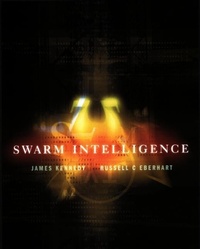
Swarm Intelligence
Published on 11. April 2001
Book
Hardback
544 pages
978-1-55860-595-4 (ISBN)
Description
Traditional methods for creating intelligent computational systems have
privileged private "internal" cognitive and computational processes. In
contrast, Swarm Intelligence argues that human
intelligence derives from the interactions of individuals in a social world
and further, that this model of intelligence can be effectively applied to
artificially intelligent systems. The authors first present the foundations of
this new approach through an extensive review of the critical literature in
social psychology, cognitive science, and evolutionary computation. They
then show in detail how these theories and models apply to a new
computational intelligence methodology-particle swarms-which focuses
on adaptation as the key behavior of intelligent systems. Drilling down
still further, the authors describe the practical benefits of applying particle
swarm optimization to a range of engineering problems. Developed by
the authors, this algorithm is an extension of cellular automata and
provides a powerful optimization, learning, and problem solving method.
This important book presents valuable new insights by exploring the
boundaries shared by cognitive science, social psychology, artificial life,
artificial intelligence, and evolutionary computation and by applying these
insights to the solving of difficult engineering problems. Researchers and
graduate students in any of these disciplines will find the material
intriguing, provocative, and revealing as will the curious and savvy
computing professional.
privileged private "internal" cognitive and computational processes. In
contrast, Swarm Intelligence argues that human
intelligence derives from the interactions of individuals in a social world
and further, that this model of intelligence can be effectively applied to
artificially intelligent systems. The authors first present the foundations of
this new approach through an extensive review of the critical literature in
social psychology, cognitive science, and evolutionary computation. They
then show in detail how these theories and models apply to a new
computational intelligence methodology-particle swarms-which focuses
on adaptation as the key behavior of intelligent systems. Drilling down
still further, the authors describe the practical benefits of applying particle
swarm optimization to a range of engineering problems. Developed by
the authors, this algorithm is an extension of cellular automata and
provides a powerful optimization, learning, and problem solving method.
This important book presents valuable new insights by exploring the
boundaries shared by cognitive science, social psychology, artificial life,
artificial intelligence, and evolutionary computation and by applying these
insights to the solving of difficult engineering problems. Researchers and
graduate students in any of these disciplines will find the material
intriguing, provocative, and revealing as will the curious and savvy
computing professional.
Reviews / Votes
"Well received the September UK Game industry show." --Recent publicity includes a mention in Visual Basic Design Magazine, June issue.More details
Series
Language
English
Place of publication
San Francisco
United States
Publishing group
Elsevier Science & Technology
Target group
Professional and scholarly
Computer scientist; electrical engineers; artificial intelligence researchers; cognitive scientist and social psychologists; computing professionals.
Product notice
sewn/stitched
Cloth over boards
Dimensions
Height: 242 mm
Width: 195 mm
Thickness: 30 mm
Weight
1050 gr
ISBN-13
978-1-55860-595-4 (9781558605954)
Copyright in bibliographic data and cover images is held by Nielsen Book Services Limited or by the publishers or by their respective licensors: all rights reserved.
Schweitzer Classification
Other editions
Additional editions
Russell C. Eberhart | Yuhui Shi | James Kennedy
Swarm Intelligence
E-Book
04/2001
Morgan Kaufmann
€89.95
Available for download

Russell C. Eberhart | Yuhui Shi | James Kennedy
Swarm Intelligence
Book
04/2001
Morgan Kaufmann
€135.78
Article exhausted; check different version
Persons
Russ Eberhart is Associate Dean of Research at Purdue School of Engineering and Technology in Indianapolis, IN. He is the author of Neural Network PC Tools (Academic Press), a leading book in the field of Neural Networks. Among his credits, he is the former President of the IEEE Neural Networks Council. Yuhui Shi received the Ph.D. degree in electrical engineering from Southeast University, China, in 1992. Since then, he has worked at several universities including the Department of Radio Engineering, Southeast University, Nanjing, China, the Department of Electrical & Computer Engineering, Concordia University, Montreal, Canada, the Department of Computer Science, Australian Defense Force Academic, Canberra, Australia, the Department of Computer Science, Korean Advanced Institute of Science and Technology, Taejon, Korea, and the Department of Electrical Engineering, Purdue School of Engineering and Technology, Indianapolis, Indiana, USA. He is currently with Electronic Data Systems, Inc., Kokomo, Indiana, USA, as an Applied Specialist. His main interests include artificial neural networks, evolutionary computation, fuzzy logic systems and their industrial applications. Dr. Shi was a co-presenter of the tutorial, Introduction to Computation Intelligence, at the 1998 WCCI Conference, Anchorage, Alaska, and presented the tutorial, Evolutionary Computation and Fuzzy Systems, at the 1998 ANNIE Conference, St. Louis. He is the technical co-chair of 2001 Particle Swarm Optimization Workshop, Indianapolis, Indiana. James Kennedy is a social psychologist who works in survey methods at the US Department of Labor. He has conducted basic and applied research into social effects on cognition and attitude. Dr. Kennedy has worked with the particle swarm computer model of social influence in artificial communities since 1994, presenting research in both the computer-science and social-science publications.
Content
Introduction
Part 1: Foundations
Life and Intelligence
Optimization by Trial and Error
On our Nonexistence as Entities
Evolutionary Computation Theory and Paradigms
Humans - Actual, Imagined and Implied
Thinking is Social
Part 2: Particle Optimization and Collective Intelligence
The Binary Particle Swarm
Variations and Comparisons;
Applications
Implications and Speculations
Conclusions
Part 1: Foundations
Life and Intelligence
Optimization by Trial and Error
On our Nonexistence as Entities
Evolutionary Computation Theory and Paradigms
Humans - Actual, Imagined and Implied
Thinking is Social
Part 2: Particle Optimization and Collective Intelligence
The Binary Particle Swarm
Variations and Comparisons;
Applications
Implications and Speculations
Conclusions