

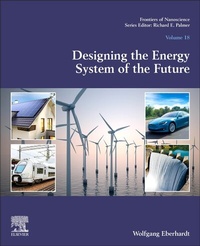
Designing the Energy System of the Future: Volume 18
Efficiency Challenges and Future Opportunities
Will be published approx. on 2. August 2021
Book
Paperback/Softback
264 pages
978-0-08-102513-0 (ISBN)
Description
Designing the Energy System of the Future describes a pathway towards a sustainable energy supply for the world, largely based upon existing technologies, which eliminates the dangers of climate change. This system enables economic growth and an improved standard of living, even in the face of a growing population on earth. While the driver for these changes are global, the solutions for each country will have to be individualized depending on geography and available energy resources. In general, the move is towards electrification and a de-carbonization of the energy system, i.e. abandoning or replacing most fossil sources of energy. As the necessity for a secure, sustainable and affordable supply of energy for a growing population looms front and center, this book is an ideal reference. It is intended to provide a fact-based description of the presently available technology options and the most urgent additional developments.
More details
Series
Language
English
Place of publication
London
United Kingdom
Publishing group
Elsevier Health Sciences
Target group
Professional and scholarly
Researchers in both academia, government and industry who want to learn more about how nanotechnology is used in the energy sector
Dimensions
Height: 235 mm
Width: 191 mm
ISBN-13
978-0-08-102513-0 (9780081025130)
Copyright in bibliographic data and cover images is held by Nielsen Book Services Limited or by the publishers or by their respective licensors: all rights reserved.
Schweitzer Classification
Person
Wolfgang Eberhardt studied Physics in Giessen and Hamburg. After graduating in 1978 he was a postdoc and Assistant professor at University of Pennsylvania. In 1983 he joined the corporate research lab of EXXON (USA). In 1991 he was appointed director of the Institute 'Electronic Properties' at IFF Juelich and professor at Univ. of Cologne (Germany), in 2001 he was appointed as scientific director of BESSY in Berlin and professor at the TU Berlin. In 2003 he received an honorary PhD from Uppsala University. From 2009 to 2011 he was Director at HZB for 'Energy Research' and since 2011 he is at DESY-CFEL. In 2016 he retired from TU Berlin.
He is most notably known for his achievements in using synchrotron radiation and electron spectroscopy for the characterization of the electronic properties of materials. At EXXON he developed and characterized materials for photovoltaics and catalysis, and since joining CFEL at DESY he is studying the materials properties and electron dynamics of organic materials for PV applications. He was member of the directorate (2009-2012) and spokesperson (2011) of the renewable energy research association (FVEE) in Germany. He coauthored two reports of the DOE (USA) and one for the BMU (Germany) on building the future energy system based upon renewable energies.
He is most notably known for his achievements in using synchrotron radiation and electron spectroscopy for the characterization of the electronic properties of materials. At EXXON he developed and characterized materials for photovoltaics and catalysis, and since joining CFEL at DESY he is studying the materials properties and electron dynamics of organic materials for PV applications. He was member of the directorate (2009-2012) and spokesperson (2011) of the renewable energy research association (FVEE) in Germany. He coauthored two reports of the DOE (USA) and one for the BMU (Germany) on building the future energy system based upon renewable energies.
Content
Population, standard of living, pollution, and climate change-the drivers of the energy system
Designing the energy system of the future
The future of electric power generation
Transportation
Energy for industry, commercial centers, and housing
Putting it all together: roadmap and economics for the transition
Designing the energy system of the future
The future of electric power generation
Transportation
Energy for industry, commercial centers, and housing
Putting it all together: roadmap and economics for the transition