

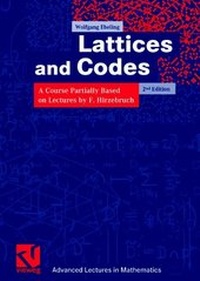
Lattices and Codes
A Course Partially Based on Lectures by F. Hirzebruch
2nd Edition
Published on 14. August 2002
Book
Paperback/Softback
XVIII, 188 pages
978-3-528-16497-3 (ISBN)
Description
The purpose of coding theory is the design of efficient systems for the transmission of information. The mathematical treatment leads to certain finite structures: the error-correcting codes. Surprisingly problems which are interesting for the design of codes turn out to be closely related to problems studied partly earlier and independently in pure mathematics. This book is about an example of such a connection: the relation between codes and lattices. Lattices are studied in number theory and in the geometry of numbers. Many problems about codes have their counterpart in problems about lattices and sphere packings. We give a detailed introduction to these relations including recent results of G. van der Geer and F. Hirzebruch. Let us explain the history of this book. In [LPS82] J. S. Leon, V. Pless, and N. J. A. Sloane considered the Lee weight enumerators of self-dual codes over the prime field of characteristic 5. They wrote in the introduction to their paper: "The weight enumerator of anyone of the codes . . . is strongly constrained: it must be invariant under a three-dimensional representation of the icosahedral group. These invariants were already known to Felix Klein, and the consequences for coding theory were discovered by Gleason and Pierce (and independently by the third author) . . . (It is worth mentioning that precisely the same invariants have recently been studied by Hirzebruch in connection with cusps of the Hilbert modular surface associated with Q( J5).
More details
Series
Edition
Softcover reprint of the original 2nd ed. 2002
Language
English
Place of publication
Wiesbaden
Germany
Publishing group
Vieweg & Teubner
Target group
College/higher education
Professional and scholarly
Edition type
Revised edition
Product notice
Paperback (trade)
Illustrations
black & white illustrations
Dimensions
Height: 24.4 cm
Width: 17 cm
Thickness: 11 mm
Weight
366 gr
ISBN-13
978-3-528-16497-3 (9783528164973)
DOI
10.1007/978-3-322-90014-2
Schweitzer Classification
Other editions
New editions
Book
09/2012
3rd Edition
Springer Spektrum
€69.54
Shipment within 10-15 days
Additional editions
E-Book
12/2012
2nd Edition
Vieweg+Teubner Verlag
€82.38
Available for download
Previous edition
Book
01/1994
Vieweg+Teubner Verlag
€85.59
Article exhausted; check for reprint
Person
Prof. Dr. Wolfgang Ebeling, Department of Mathematics, Universität Hannover, Germany.
Content
1 Lattices and Codes.- 1.1 Lattices.- 1.2 Codes.- 1.3 From Codes to Lattices.- 1.4 Root Lattices.- 1.5 Highest Root and Weyl Vector.- 2 Theta Functions and Weight Enumerators.- 2.1 The Theta Function of a Lattice.- 2.2 Modular Forms.- 2.3 The Poisson Summation Formula.- 2.4 Theta Functions as Modular Forms.- 2.5 The Eisenstein Series.- 2.6 The Algebra of Modular Forms.- 2.7 The Weight Enumerator of a Code.- 2.8 The Golay Code and the Leech Lattice.- 2.9 The MacWilliams Identity and Gleason's Theorem.- 2.10 Quadratic Residue Codes.- 3 Even Unimodular Lattices.- 3.1 Theta Functions with Spherical Coefficients.- 3.2 Root Systems in Even Unimodular Lattices.- 3.3 Overlattices and Codes.- 3.4 The Classification of Even Unimodular Lattices of Dimension 24.- 4 The Leech Lattice.- 4.1 The Uniqueness of the Leech Lattice.- 4.2 The Sphere Covering Determined by the Leech Lattice.- 4.3 Twenty-Three Constructions of the Leech Lattice.- 4.4 Embedding the Leech Lattice in a Hyperbolic Lattice.- 4.5 Automorphism Groups.- 5 Lattices over Integers of Number Fields and Self-Dual Codes.- 5.1 Lattices over Integers of Cyclotomic Fields.- 5.2 Construction of Lattices from Codes over ??p.- 5.3 Theta Functions over Number Fields.- 5.4 The Case p = 3: Ternary Codes.- 5.5 The Equation of the Tetrahedron and the Cube.- 5.6 The Case p = 5: the Icosahedral Group.- 5.7 Theta Functions as Hilbert Modular Forms (by N.-P. Skoruppa).