

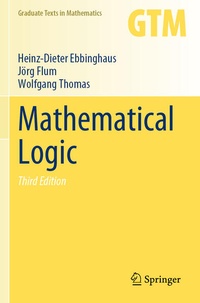
Mathematical Logic
3rd Edition
Published on 30. May 2022
Book
Paperback/Softback
IX, 304 pages
978-3-030-73841-9 (ISBN)
Description
What is a mathematical proof? How can proofs be justified? Are there limitations to provability? To what extent can machines carry out mathe matical proofs? Only in this century has there been success in obtaining substantial and satisfactory answers. The present book contains a systematic discussion of these results. The investigations are centered around first-order logic. Our first goal is Godel's completeness theorem, which shows that the con sequence relation coincides with formal provability: By means of a calcu lus consisting of simple formal inference rules, one can obtain all conse quences of a given axiom system (and in particular, imitate all mathemat ical proofs). A short digression into model theory will help us to analyze the expres sive power of the first-order language, and it will turn out that there are certain deficiencies. For example, the first-order language does not allow the formulation of an adequate axiom system for arithmetic or analysis. On the other hand, this difficulty can be overcome--even in the framework of first-order logic-by developing mathematics in set-theoretic terms. We explain the prerequisites from set theory necessary for this purpose and then treat the subtle relation between logic and set theory in a thorough manner.
Reviews / Votes
"This newest edition has been reclassified, fittingly, as a graduate text, and it is admirably suited to that role. ... Those who are already well-versed in logic will find this text to be a valuable reference and a strong resource for teaching at the graduate level, while those who are new to the field will come to know not only how mathematical logic is studied but also, perhaps more importantly, why." (Stephen Walk, MAA Reviews, January 6, 2023)"This newest edition has been reclassified, fittingly, as a graduate text, and it is admirably suited to that role. ... Those who are already well-versed in logic will find this text to be a valuable reference and a strong resource for teaching at the graduate level, while those who are new to the field will come to know not only how mathematical logic is studied but also, perhaps more importantly, why." (Stephen Walk, MAA Reviews, January 6, 2023)
More details
Product info
Paperback
Series
Edition
3rd ed. 2021
Language
English
Place of publication
Cham
Switzerland
Publishing group
Springer International Publishing
Target group
College/higher education
Edition type
Revised edition
Illustrations
17
17 s/w Abbildungen
IX, 304 p. 17 illus.
Dimensions
Height: 235 mm
Width: 155 mm
Thickness: 18 mm
Weight
482 gr
ISBN-13
978-3-030-73841-9 (9783030738419)
DOI
10.1007/978-3-030-73839-6
Schweitzer Classification
Other editions
Additional editions
Heinz-Dieter Ebbinghaus | Jörg Flum | Wolfgang Thomas
Mathematical Logic
Book
05/2021
3rd Edition
Springer
€74.89
Shipment within 7-9 days
Persons
Heinz-Dieter Ebbinghaus is Professor Emeritus at the Mathematical Institute of the University of Freiburg. His work spans fields in logic, such as model theory and set theory, and includes historical aspects.Joerg Flum is Professor Emeritus at the Mathematical Institute of the University of Freiburg. His research interests include mathematical logic, finite model theory, and parameterized complexity theory.
Wolfgang Thomas is Professor Emeritus at the Computer Science Department of RWTH Aachen University. His research interests focus on logic in computer science, in particular logical aspects of automata theory.
<b>Heinz-Dieter Ebbinghaus</b> is Professor Emeritus at the Mathematical Institute of the University of Freiburg. His work spans fields in logic, such as model theory and set theory, and includes historical aspects.
<b>Wolfgang Thomas</b> is Professor Emeritus at the Computer Science Department of RWTH Aachen University. His research interests focus on logic in computer science, in particular logical aspects of automata theory.
Wolfgang Thomas is Professor Emeritus at the Computer Science Department of RWTH Aachen University. His research interests focus on logic in computer science, in particular logical aspects of automata theory.
<b>Heinz-Dieter Ebbinghaus</b> is Professor Emeritus at the Mathematical Institute of the University of Freiburg. His work spans fields in logic, such as model theory and set theory, and includes historical aspects.
<b>Joerg Flum</b> is Professor Emeritus at the Mathematical Institute of the University of Freiburg. His research interests include mathematical logic, finite model theory, and parameterized complexity theory.
<b>Wolfgang Thomas</b> is Professor Emeritus at the Computer Science Department of RWTH Aachen University. His research interests focus on logic in computer science, in particular logical aspects of automata theory.
Content
A.- I Introduction.- II Syntax of First-Order Languages.- III Semantics of First-Order Languages.- IV A Sequent Calculus.- V The Completeness Theorem.- VI The Loewenheim-Skolem and the Compactness Theorem.- VII The Scope of First-Order Logic.- VIII Syntactic Interpretations and Normal Forms.- B.- IX Extensions of First-Order Logic.- X Computability and Its Limitations.- XI Free Models and Logic Programming.- XII An Algebraic Characterization of Elementary Equivalence.- XIII Lindstroem's Theorems.- References.- List of Symbols.- Subject Index.