

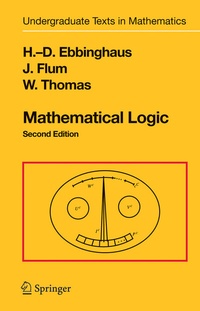
Mathematical Logic
2nd Edition
Published on 12. December 2012
Book
Paperback/Softback
X, 291 pages
978-1-4757-2357-1 (ISBN)
Description
This introduction to first-order logic clearly works out the role of first-order logic in the foundations of mathematics, particularly the two basic questions of the range of the axiomatic method and of theorem-proving by machines. It covers several advanced topics not commonly treated in introductory texts, such as Fraïssé's characterization of elementary equivalence, Lindström's theorem on the maximality of first-order logic, and the fundamentals of logic programming.
Reviews / Votes
"...the book remains my text of choice for this type of material, and I highly recommend it to anyone teaching a first logic course at this level." - Journal of Symbolic LogicMore details
Product info
Book
Series
Edition
2nd ed. 1994. Softcover reprint of the original 2nd ed. 1994
Language
English
Place of publication
NY
United States
Target group
Professional and scholarly
Lower undergraduate
Edition type
Revised edition
Illustrations
X, 291 p.
Dimensions
Height: 23.5 cm
Width: 15.5 cm
Weight
468 gr
ISBN-13
978-1-4757-2357-1 (9781475723571)
DOI
10.1007/978-1-4757-2355-7
Schweitzer Classification
Other editions
New editions
Heinz-Dieter Ebbinghaus | Jörg Flum | Wolfgang Thomas
Mathematical Logic
Book
05/2021
3rd Edition
Springer
€74.89
Shipment within 7-9 days
Additional editions
H.-D. Ebbinghaus | J. Flum | Wolfgang Thomas
Mathematical Logic
E-Book
03/2013
2nd Edition
Springer
€62.99
Available for download
H.-D. Ebbinghaus | J. Flum | Wolfgang Thomas
Mathematical Logic
Book
06/1994
2nd Edition
Springer
€64.15
Shipment within 5-7 days
Content
Preface; Part A: 1. Introduction; 2. Syntax of First-Order Languages; 3. Semantics of first-Order Languages; 4. A Sequent Calculus; 5. The Completeness Theorem; 6. The Lowenheim-Skolem and the Compactness Theorem; 7. The Scope of First-Order Logic; 8. Syntactic Interpretations and Normal Forms; Part B: 9. Extensions of First-Order Logic; 10. Limitations of the Formal Method; 11. Free Models and Logic Programming; 12. An Algebraic Characterization of Elementary Equivalence; 13. Lindstroem's Theorems; References; Symbol Index; Subject Index