

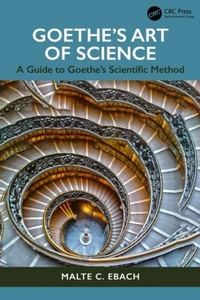
Goethe's Art of Science
A Guide to Goethe's Scientific Method
1st Edition
Will be published approx. on 12. October 2026
Book
Hardback
184 pages
978-1-032-23038-2 (ISBN)
Description
This book places Goethe's scientific method into context for 21st century scientists and science. Moreover, Goethe's Art of Science is an excellent compendium for scientists interested in 18th century and early 19th century geology, colour theory and comparative biology.
Few scientists realise that Goethe contributed a significant body of work on geology, the theory of colour, and comparative biology. Goethe's main concern was developing his scientific method called Morphology, which involved observing and describing form, whether it be minerals, rocks, the interaction of colour, or organisms, the latter which many taxonomists would be familiar with today. Goethe's scientific legacy was hampered by his Neptunist ideas in geology, and his criticism of Newton on colour theory. Nevertheless, his view that our interaction as observers with natural phenomena was a fundamental principle that can be applied across many different scientific fields.
In order to raise the awareness of Goethe's scientific method this book will:
* Provide a detailed description of his method, Morphology.
* Investigate his geological writings and how they were hampered by his Neptunist thinking.
* Demonstrate his Theory of Colours and how Anschauung and the Urphenomenon were crucial to his method.
* Follow the development of Goethe's plant and animal morphology.
* Explore what Goethe thought about his own scientific legacy and provide a list of his scientific achievements and honours.
* Provide new English translations of Goethe's writings.
Few scientists realise that Goethe contributed a significant body of work on geology, the theory of colour, and comparative biology. Goethe's main concern was developing his scientific method called Morphology, which involved observing and describing form, whether it be minerals, rocks, the interaction of colour, or organisms, the latter which many taxonomists would be familiar with today. Goethe's scientific legacy was hampered by his Neptunist ideas in geology, and his criticism of Newton on colour theory. Nevertheless, his view that our interaction as observers with natural phenomena was a fundamental principle that can be applied across many different scientific fields.
In order to raise the awareness of Goethe's scientific method this book will:
* Provide a detailed description of his method, Morphology.
* Investigate his geological writings and how they were hampered by his Neptunist thinking.
* Demonstrate his Theory of Colours and how Anschauung and the Urphenomenon were crucial to his method.
* Follow the development of Goethe's plant and animal morphology.
* Explore what Goethe thought about his own scientific legacy and provide a list of his scientific achievements and honours.
* Provide new English translations of Goethe's writings.
More details
Language
English
Place of publication
London
United Kingdom
Publishing group
Taylor & Francis Ltd
Target group
College/higher education
Professional and scholarly
Postgraduate and Professional
Illustrations
5 s/w Abbildungen, 17 farbige Abbildungen, 4 s/w Photographien bzw. Rasterbilder, 15 Farbfotos bzw. farbige Rasterbilder, 1 s/w Zeichnung, 2 farbige Zeichnungen, 23 s/w Tabellen
23 Tables, black and white; 2 Line drawings, color; 1 Line drawings, black and white; 15 Halftones, color; 4 Halftones, black and white; 17 Illustrations, color; 5 Illustrations, black and white
Dimensions
Height: 234 mm
Width: 156 mm
ISBN-13
978-1-032-23038-2 (9781032230382)
Copyright in bibliographic data and cover images is held by Nielsen Book Services Limited or by the publishers or by their respective licensors: all rights reserved.
Schweitzer Classification
Other editions
Additional editions
E-Book
approx. 10/2026
CRC Press
€185.99
Not yet available
E-Book
approx. 10/2026
CRC Press
€185.99
Not yet available
Person
Professor Malte C. Ebach's research is primarily focused on Australasian biogeography, Gondwanan palaeobiogeography, natural classification (cladistics, biological taxonomy) and Goethe's scientific studies. He has written over 120 scientific articles, including 11 books, a series of popular science articles and opinion pieces. In 2010, Malte and his co-author Lynne R. Parenti were recipients of the Smithsonian's Secretary Research Prize for the textbook Comparative Biogeography.
Content
Chapter 1. Goethe on Science. Chapter 2. Goethe on Geology. Chapter 3. Goethe on Colour. Chapter 4. Goethe on Botany. Chapter 5. Goethe on Zoology. Chapter 6. Reimagine Goethe's Art of Science Chapter 7. Goethean Encyclopaedia