

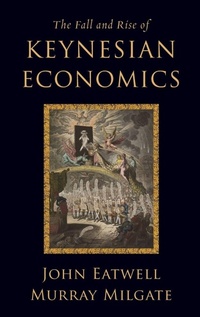
The Fall and Rise of Keynesian Economics
Published on 16. June 2011
Book
Hardback
448 pages
978-0-19-977769-3 (ISBN)
Description
During the 1970s, when doctrines like monetarism and new classical macroeconomics ushered in an era of neoliberal economic policymaking, Keynesian economics was pushed aside. It was almost forgotten that when Keynesian thinking had dominated economic policymaking in the middle decades of the twentieth century, it had underwritten postwar economic reconstruction in both Europe and Japan, and was largely responsible for the unprecedented prosperity and stable growth of the 1950s and 1960s. The global financial crisis and recession changed all that. Influential voices in progressive economics circles began to remind us how useful Keynesian ways of thinking could be again, especially in assisting us to come to terms with our economic predicaments. When politicians across the globe were confronted with economic crisis, almost by accident they introduced pragmatic and workable measures that bore all the hallmarks of Keynesianism. This book is about this fall and rise of Keynesian economics.
Eatwell and Milgate range widely across the landscape that defines their subject matter. They consider how powerful Keynesian ideas can be when applied to our past and present economic problems. They show how helpful these ideas are in explaining why we came to find ourselves in the mess we are in. They examine where and how the analytical and methodological foundations of conventional macroeconomic wisdom went wrong. They set out a blueprint for an alternative that provides a clearer, more consistent, and more applicable approach to understanding how markets work. They also highlight the interpretive shortcomings that have come to characterize Keynes scholarship itself. They do all of this within the context of a provocative reconsideration of some of the most pressing economic problems that confront financial markets and the global economy today.
Eatwell and Milgate range widely across the landscape that defines their subject matter. They consider how powerful Keynesian ideas can be when applied to our past and present economic problems. They show how helpful these ideas are in explaining why we came to find ourselves in the mess we are in. They examine where and how the analytical and methodological foundations of conventional macroeconomic wisdom went wrong. They set out a blueprint for an alternative that provides a clearer, more consistent, and more applicable approach to understanding how markets work. They also highlight the interpretive shortcomings that have come to characterize Keynes scholarship itself. They do all of this within the context of a provocative reconsideration of some of the most pressing economic problems that confront financial markets and the global economy today.
Reviews / Votes
[A]cademics, analysts and policy makers will be well served to consider Eatwell and Milgate's view of Keynesian response to the current economic situation in order to understand better the interventionist fiscal and monetary responses being debated so heatedly today. * Jonathan Newell, Political Studies Review *More details
Series
Language
English
Place of publication
New York
United States
Target group
College/higher education
Illustrations
14 illustrations
Dimensions
Height: 240 mm
Width: 161 mm
Thickness: 29 mm
Weight
837 gr
ISBN-13
978-0-19-977769-3 (9780199777693)
Copyright in bibliographic data and cover images is held by Nielsen Book Services Limited or by the publishers or by their respective licensors: all rights reserved.
Schweitzer Classification
Other editions
Additional editions
John Eatwell | Murray Milgate
The Fall and Rise of Keynesian Economics
E-Book
04/2011
1st Edition
OUP eBook
€72.49
Available for download
John Eatwell | Murray Milgate
The Fall and Rise of Keynesian Economics
E-Book
04/2011
1st Edition
OUP eBook
€72.49
Available for download
Persons
John Eatwell is the current President of Queens' College, Cambridge.
Murray Milgate is Fellow and Director of Studies in Economics at Queens' College, Cambridge.
Murray Milgate is Fellow and Director of Studies in Economics at Queens' College, Cambridge.
Content
Preface ; Preamble ; Part One: Practical ; Part Two: Analytical ; Part Three: Critical ; Part four: Historical ; Bibliography ; Index