

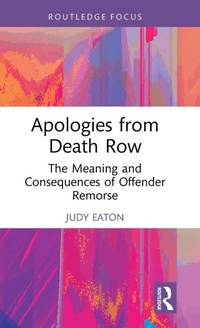
Apologies from Death Row
The Meaning and Consequences of Offender Remorse
1st Edition
Published on 31. October 2023
Book
Hardback
126 pages
978-1-032-47179-2 (ISBN)
Description
Apologies from Death Row explores the notion of remorse, apologies, and forgiveness within the context of capital punishment in the United States, through the final words of offenders on death row, and the covictims' responses to them in their statements to the press after witnessing the execution.
The book demonstrates that there is evidence that some offenders on death row are truly remorseful and that some of the family members of their victims could benefit from this remorse, but that this is unlikely in the current system of capital punishment. Drawing from the fields of criminology, psychology, and sociology, the book begins with a theoretically informed introduction to the concepts of remorse and forgiveness, followed by an exploration of apology and forgiveness specifically in the context of capital punishment. It discusses how some initiatives within the criminal justice system, such as apology laws and restorative justice programmes, are being used to make it easier for offenders to apologize to their victims. Offenders on death row are considered, addressing why they might or might not apologize, and whether they are even capable of showing true remorse. The book then considers the family members of their victims ("covictims"), addressing whether they benefit from hearing the offender express remorse and witnessing the execution, and whether forgiveness is possible in this context. Evidence to support the arguments presented in the book come from the offenders' final words and the covictims' responses to them in their statements to the press. The book dispels two common myths about the death penalty. First, it shows that offenders on death row are not simply "monsters" who are incapable of understanding the severity of their crimes. Second, it provides evidence that, despite the popular belief that the death penalty is necessary in order to provide closure for the victims' family members, it may actually have the opposite effect. The family members' statements to the press after witnessing the execution contain more negative themes like anger and disappointment than positive themes like closure and peace. The book concludes with a discussion of the implications this has for systems of justice in general, and how a better understanding of the emotional state of offenders can help both victims and offenders.
Apologies from Death Row will be of great interest to students and scholars of Criminology, Psychology, and Sociology.
The book demonstrates that there is evidence that some offenders on death row are truly remorseful and that some of the family members of their victims could benefit from this remorse, but that this is unlikely in the current system of capital punishment. Drawing from the fields of criminology, psychology, and sociology, the book begins with a theoretically informed introduction to the concepts of remorse and forgiveness, followed by an exploration of apology and forgiveness specifically in the context of capital punishment. It discusses how some initiatives within the criminal justice system, such as apology laws and restorative justice programmes, are being used to make it easier for offenders to apologize to their victims. Offenders on death row are considered, addressing why they might or might not apologize, and whether they are even capable of showing true remorse. The book then considers the family members of their victims ("covictims"), addressing whether they benefit from hearing the offender express remorse and witnessing the execution, and whether forgiveness is possible in this context. Evidence to support the arguments presented in the book come from the offenders' final words and the covictims' responses to them in their statements to the press. The book dispels two common myths about the death penalty. First, it shows that offenders on death row are not simply "monsters" who are incapable of understanding the severity of their crimes. Second, it provides evidence that, despite the popular belief that the death penalty is necessary in order to provide closure for the victims' family members, it may actually have the opposite effect. The family members' statements to the press after witnessing the execution contain more negative themes like anger and disappointment than positive themes like closure and peace. The book concludes with a discussion of the implications this has for systems of justice in general, and how a better understanding of the emotional state of offenders can help both victims and offenders.
Apologies from Death Row will be of great interest to students and scholars of Criminology, Psychology, and Sociology.
More details
Series
Language
English
Place of publication
London
United Kingdom
Publishing group
Taylor & Francis Ltd
Target group
College/higher education
Professional and scholarly
Academic, Postgraduate, and Undergraduate Advanced
Illustrations
9 s/w Tabellen
9 Tables, black and white
Dimensions
Height: 222 mm
Width: 145 mm
Thickness: 11 mm
Weight
317 gr
ISBN-13
978-1-032-47179-2 (9781032471792)
Copyright in bibliographic data and cover images is held by Nielsen Book Services Limited or by the publishers or by their respective licensors: all rights reserved.
Schweitzer Classification
Other editions
Additional editions
Book
01/2025
1st Edition
Routledge
€32.90
Shipment within 10-20 days
E-Book
10/2023
1st Edition
Taylor & Francis
€27.49
Available for download
E-Book
10/2023
1st Edition
Taylor & Francis
€27.49
Available for download
Person
Judy Eaton is a Professor of Psychology at Wilfrid Laurier University, Canada. She did her graduate work in social psychology at York University, receiving her MA in 2000 and PhD in 2005. Prior to that, she earned BAs in English and Psychology at McMaster University. The main focus of Professor Eaton's research is the causes, consequences, and resolution of interpersonal conflict. Using a social cognitive framework, her research examines the role of apology and other gestures of remorse in facilitating forgiveness. In the context of the criminal justice system, she has studied remorse in offenders on death row, the concept of closure as it relates to victims of crime, and how victims of crime are viewed (and influenced) by third parties (i.e., people not involved in the crime).
Content
1. Remorse and Forgiveness in the Criminal Justice System 2. Remorse in the Unique Context of Death Row 3. The Remorseful Offender? Evidence From Their Last Statements 4. The Forgiving Victim? Evidence From Their Statements to the Media 5. Implications for the Death Penalty and Justice Systems in General